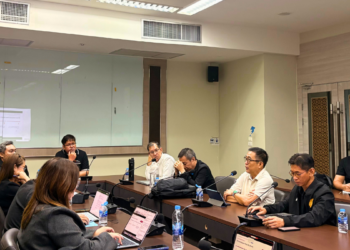
Thammasat Advances “Carbon Neutral Campus” Initiative, Holding Kick-off Meeting to Establish Climate Change Strategic Framework

HIGHLIGHTS

  • Thammasat University launches its Carbon Neutral Campus initiative through the first kick-off meeting of the Carbon Neutral Campus Working Group, establishing a strategic framework to accelerate climate action and carbon neutrality policies across the university.
  • Sets ambitious climate targets aligned with Thailand’s national commitments, including a 47% greenhouse gas emission reduction by 2035 (from the 2019 baseline), achieving Net Zero emissions by 2050, and positioning Thammasat as a national leader in climate change action.
  • Implements a four-pillar strategy for measurable impact—Transformative Policy, Systematic Data Collection, Participatory Actions, and Empowering TU Community—covering all campuses to build a data-driven pathway toward sustainable transformation and climate resilience.

On 15 June 2026, Thammasat University—led by the Quality and Sustainability Development Division in collaboration with SDG Move (Centre for Research and Support of Sustainable Development Goals), Faculty of Economics—held the first kick-off meeting of the Carbon Neutral Campus Working Group (1/2026). The objective is to accelerate carbon neutrality policies, which currently stand as a core mission and key environmental agenda for the university.

The working group comprises executives and experts from various sectors. Their primary role is to provide policy recommendations and design actionable initiatives to present to the Rector and the Sustainable Development Goals Steering Committee. Furthermore, the group is tasked with driving policies and activities alongside internal and external organisations to ensure alignment with Thammasat University’s sustainable development strategy across all dimensions.

Core Objectives Aligned with National Targets

During the meeting, the working group established university targets that align with Thailand’s Nationally Determined Contributions (NDC). The three primary objectives are:

  • Reduce greenhouse gas (GHG) emissions by 47% by 2035 (compared to the 2019 baseline).
  • Achieve Net Zero GHG emissions by 2050.
  • Become a national leader in supporting and driving climate change initiatives.

These objectives primarily respond to Sustainable Development Goal (SDG) 13: Climate Action, with a specific emphasis on greenhouse gas mitigation.

Four Strategic Directions

To ensure these goals translate into tangible results, the meeting proposed four key strategic directions:

  • Transformative Policy: Driving policies from the University Council to direct, support, and facilitate the establishment of systems, data collection, and GHG reduction measures.
  • Systematic Data Collection: Implementing a system to collect GHG emissions data across Scopes 1, 2, and 3, alongside the systematic tracking of carbon credits and offsetting.
  • Participatory Actions: Planning and executing initiatives collaboratively with all faculties, departments, and the student union, complemented by continuous data-driven reviews.
  • Empowering TU Community: Enhancing climate change knowledge and green skills amongst students, staff, faculty members, and the wider society.

First-Year Operational Plan

For the inaugural year, the working group has outlined clear quarterly targets:

  • Quarter 1: Establish data collection systems for Scopes 1, 2, and 3 to inform policy planning, and prepare a trial for data collection and calculation for Scopes 1 and 2.
  • Quarter 2: Focus on capacity building for relevant personnel across all units to support accurate GHG data collection.
  • Quarter 3: Calculate the university’s historical GHG emissions from the baseline year to the present.
  • Quarter 4: Design measures to reduce and offset GHG emissions in line with national targets through the participation of all sectors.

This carbon neutrality initiative will encompass data and operations across all Thammasat University campuses. It serves to prepare the institution for the draft Climate Change Act, which will require higher education institutions to formulate plans and report their GHG emissions. Additionally, it acts as a crucial mechanism to help Thammasat University achieve its goal of becoming the top-ranked university in Thailand in the THE Impact Rankings, whilst fostering sustainable change both within and beyond the university.

Thammasat University Order on the Appointment of the Net Zero Greenhouse Gas Emissions Working Group
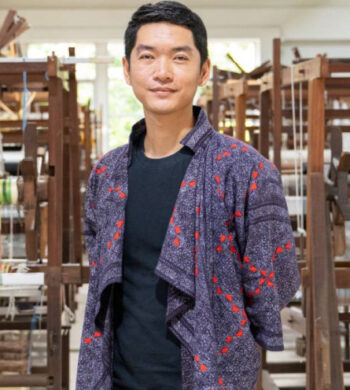
Wuthigrai Siriphon, Ph.D.

Full NameWuthigrai Siriphon, Ph.D.
Academic PositionAssistant Professor
DepartmentFaculty of Fine and Applied Arts
Emailw.siriphon@gmail.com
Primary SDGsSDG 12: Responsible Consumption and Production
Related SDGsSDG 8: Decent Work and Economic Growth
SDG 11: Sustainable Cities and Communities
Area of ExpertiseTextile Design & Hand-weaving
Community Craft
Sustainable Materials, Natural Dyes, & Circular Design
Selected Publications / ProjectsPromoting Next-Generation Weavers Through Sustainable Design Concept (โครงการวิจัยการส่งเสริมช่างทอรุ่นใหม่ด้วยแนวคิดการออกแบบเพื่อความยั่งยืน)
Development of Holistic Design Concepts for Community Craft Product Development: – A Case Study of Textiles in Ko Sub-district, Li District, Lamphun Province (โครงการวิจัยการพัฒนาแนวคิดการออกแบบแบบองค์รวม เพื่อการพัฒนาสินค้าหัตถกรรมชุมชน กรณีศึกษาสิ่งทอของตำบลก้อ อำเภอลี้ จังหวัดลำพูน สนับสนุนทุนวิจัยโดย มูลนิธิอานันทมหิดล)
– A Study on the Creation Process of Wooden Reed Making in Lao-Khrang Culture in Thailand (การศึกษากระบวนการสร้างฟืมทอผ้าที่ทำด้วยไม้ในวัฒนธรรมลาวครั่งในประเทศไทย)

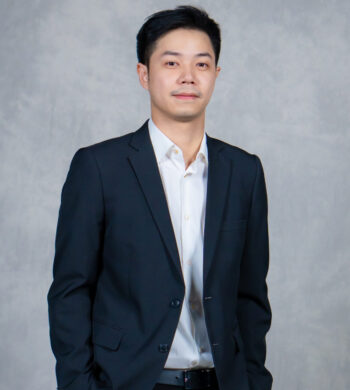
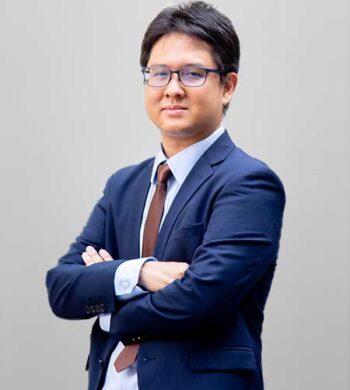
Pakpoom Lohavaritanond, Ph.D.

Full NamePakpoom Lohavaritanond, Ph.D.
Academic PositionLecturer
DepartmentNatural Resources and Environmental Law Centre, Faculty of Law
Emailpakpoom55@tu.ac.th
Primary SDGsSDG 7: Affordable and Clean Energy
Related SDGsSDG 13: Climate Action
SDG 16: Peace, Justice and Strong Institutions
Area of ExpertiseEnergy & Environmental Law
Environmental Justice
Selected Publications / ProjectsResearch report on the Evaluation of Oil Fuel Fund Act B.E. 2562 (2025) – Presented to the Oil Fuel Fund Office, Ministry of Energy.
Research Project on promoting cooperatives for investing in solar power generation (2024) – Presented to RE Generation.

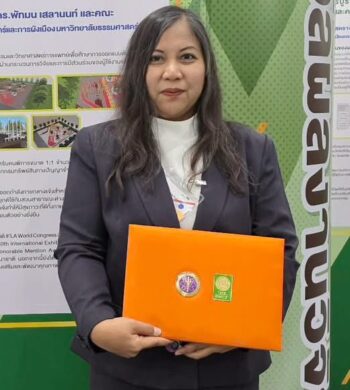
Pattamon Selanon, Ph.D.

Full NamePattamon Selanon, Ph.D.
Academic PositionAssociate Professor
DepartmentFaculty of Architecture and Planning
Emailpselanon@hotmail.com
Primary SDGsSDG 11: Sustainable Cities and Communities
Related SDGsSDG 13: Climate Action
SDG 10: Reduced Inequalities
Area of ExpertiseLandscape Architecture and Planning,
Inclusive Environments
Universal Design in Green Spaces
Selected Publications / ProjectsAn Inclusive Park Design Based on a Research Process: A Case Study of Thammasat Water Sport Center, Pathum Thani, Thailand
Beyond Accessibility: Rethinking Universal and Inclusive Design in Bangkok’s Public Parks
Improving Accessibility to Urban Greenspaces for People with Disabilities: A Modified Universal Design Approach

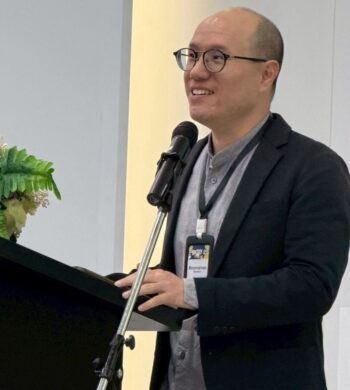
Boonanan Natakun, Ph.D.

Full NameBoonanan Natakun, Ph.D.
Academic PositionAssistant Professor
DepartmentUrban Futures and Policy Research Unit, Faculty of Architecture and Planning
Emailnboonanan@gmail.com
Primary SDGsSDG 11: Sustainable Cities and Communities
Related SDGsSDG 13: Climate Action
SDG 10: Reduced Inequalities
Area of ExpertiseLow-Income Housing Development
Community Planning & Design
Urban and Community Resilience
Selected Publications / ProjectsExamining the use of serious games for enhancing community resilience to climate risks in Thailand
Nature for the people, by the people: Negotiating values, attitudes and behaviours for implementing urban nature-based solutions in social housing
Rethinking Affordable Row House Design for Multi-generational Lower Middle-income Families in Developing Countries: A Case Study of Bangkok, Thailand

Natakorn Phuksuksakul, Ph.D.

Full NameNatakorn Phuksuksakul, Ph.D.
Academic positionLecturer
DepartmentDepartment of Civil Engineering, Faculty of Engineering
Emailpnatakor@engr.tu.ac.th
Primary SDGsSDG 11: Sustainable Cities and Communities
Related SDGsSDG 3: Good Health and Well-being
SDG 9: Industry, Innovation, and Infrastructure
Area of ExpertiseRoad Safety
Crash Severity Analysis
Intelligence Mobility
Selected Publications / ProjectsFactors affecting behavior of mobile phone use while driving and effect of mobile phone use on driving performance
Future Street: Improving Road Safety with Virtual Reality (VR) Technology

SDG Guidebook for Youth in Action

SDG Guidebook for Youth in Action is a resource developed by the United Nations Development Programme (UNDP) to empower young people to engage with and contribute to the Sustainable Development Goals (SDGs). Designed as a self-learning journey, the guidebook encourages readers to explore their communities through an SDG lens while fostering innovative thinking and collaboration to address real-world challenges.

The guide provides reflective questions, practical exercises, and actionable guidance to help youth design and implement small-scale sustainability projects in their communities. By highlighting the importance of youth perspectives, it positions young people as key drivers of change in achieving the 2030 Agenda.

Ideal for students, educators, and youth leaders, this resource supports the development of critical thinking and problem-solving skills, inspiring individuals to take meaningful action toward a more sustainable and inclusive future.

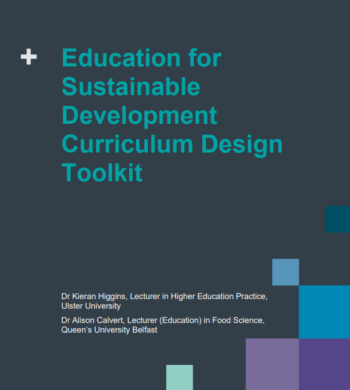
Education for Sustainable Development Curriculum Design Toolkit

Education for Sustainable Development Curriculum Design Toolkit is a practical resource developed by Advance HE to support higher education institutions in embedding sustainability into their curricula. Grounded in the CRAFTS methodology, the toolkit provides a structured yet flexible approach to integrating Education for Sustainable Development (ESD) across modules and programmes, aligning learning with the UN Sustainable Development Goals.

Designed for educators, programme leaders, and teaching teams, the toolkit guides users through a five-phase process—from analysing stakeholder needs and mapping existing curriculum content, to redesigning courses with an ESD focus and creating action plans for continuous improvement.

With practical templates, reflective exercises, and active learning strategies, this resource supports the development of sustainability competencies across cognitive, socio-emotional, and behavioural domains. It enables institutions to move beyond surface-level integration, fostering meaningful learning experiences that equip students with the knowledge, skills, and values needed to address complex global challenges.

General Guidelines for the Implementation of Sustainability in Higher Education Institutions

The General Guidelines for the Implementation of Sustainability in Higher Education Institutions, developed by UNESCO, provide a high-level framework to support higher education institutions in systematically integrating sustainability and the Sustainable Development Goals (SDGs) across all dimensions of the university. The guidelines emphasize embedding sustainability into institutional governance and strategic planning, teaching and learning, research, campus operations, and engagement with external stakeholders and society at large. They highlight the unique role of higher education institutions as knowledge producers, capacity builders, and catalysts for social transformation, while promoting flexible and context-sensitive approaches that can be adapted to different institutional realities, resources, and levels of readiness, with a strong focus on continuous improvement, monitoring, and evaluation rather than prescriptive or rigid requirements.

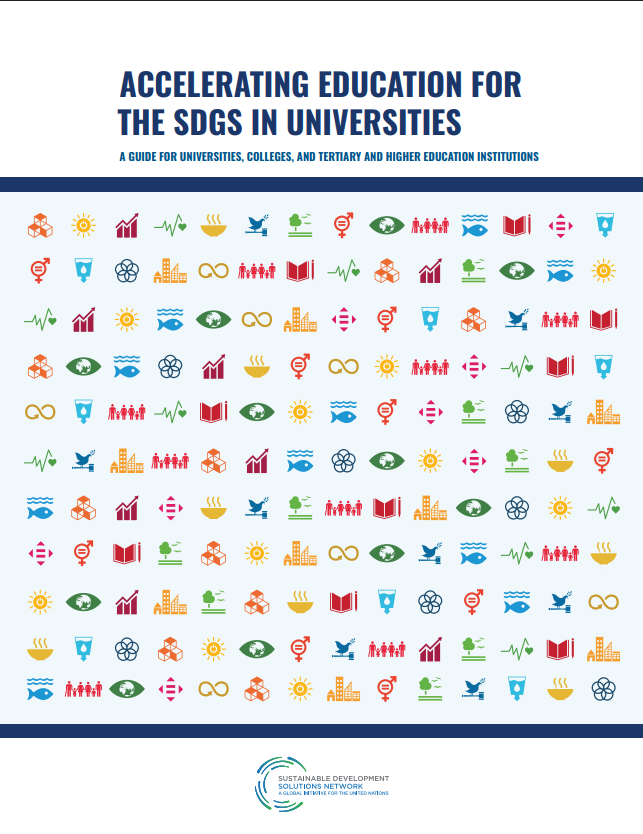
Accelerating Education for the SDGs in Universities: A Guide for Universities, Colleges, and Tertiary and Higher Education Institutions

Accelerating Education for the SDGs in Universities is a practical resource designed to help universities, colleges, and higher education institutions embed and advance Education for the Sustainable Development Goals (SDGs) across their teaching, learning, and institutional practices. Developed by the Sustainable Development Solutions Network (SDSN) in collaboration with the SDSN Regional Network for Australia, New Zealand & Pacific, the Technical University of Madrid, and Monash University, the guide draws on insights and contributions from institutions around the world. It expands on the education component of the widely recognized 2017 publication Getting Started with the SDGs in Universities, offering updated guidance, examples, and strategies to support institutions in driving meaningful impact.

Choomket Sawangjaroen, Ph.D.

Full NameChoomket Sawangjaroen, Ph.D.
Academic positionAssociate Professor
DepartmentUniversal Design Center, Faculty of Architecture and Planning
Emailchoomket@gmail.com
Primary SDGsSDG 11: Sustainable Cities and Communities
Related SDGsSDG 10: Reduced Inequalities
Area of ExpertiseUniversal Design
Design for Social Change
Sustainable Land-use and Natural Resources Management
Selected Publications / ProjectsRANGSIT MODEL:The success of Universal Design through the Participatory process
บ้านแสนอยู่ดี – 100,000 UD HOUSE