Data and Performance
Proportion of Graduates in Law and Civil Enforcement
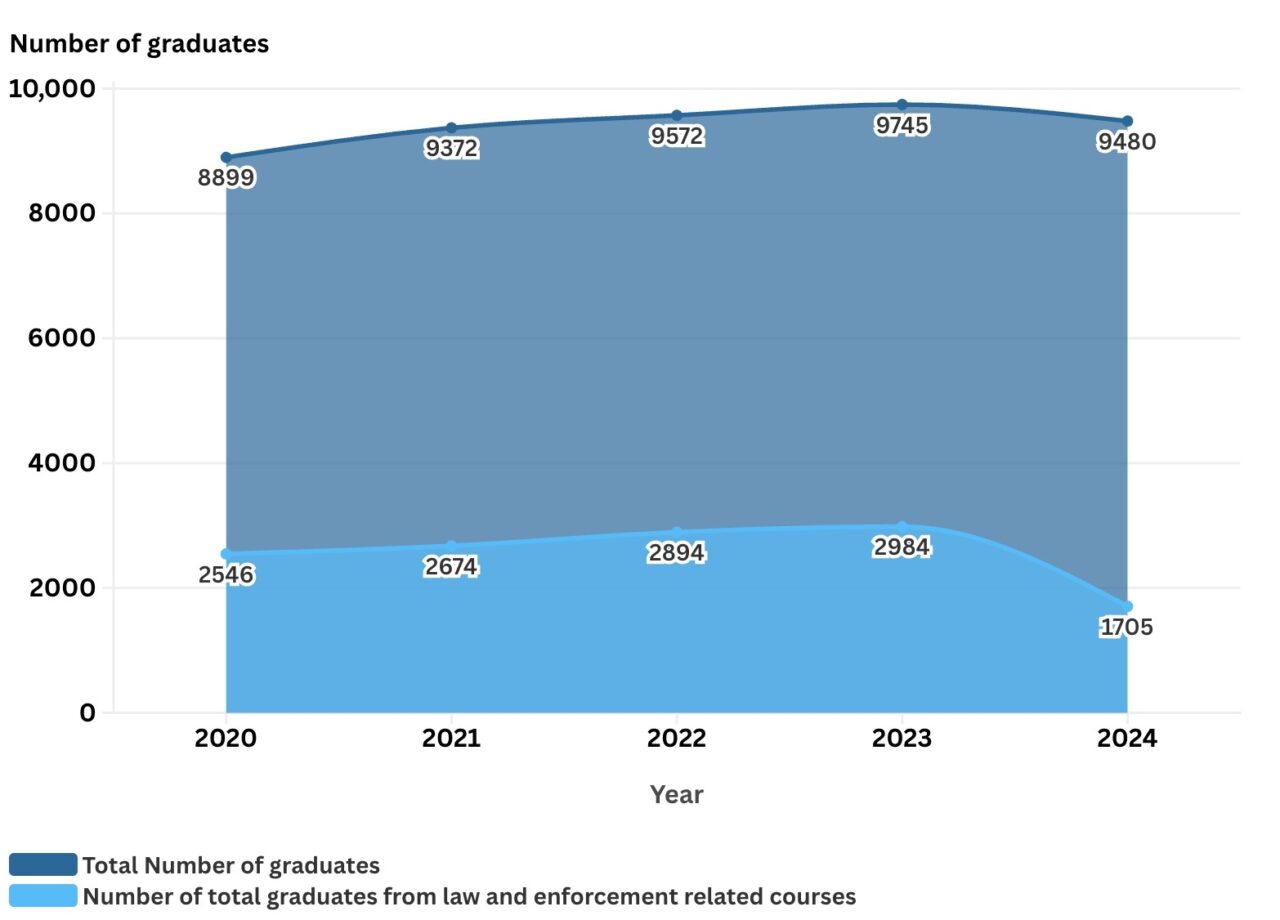
This bar graph illustrates the proportion of graduates in law and enforcement-related courses from 2020 to 2024. The number of graduates in these fields increased steadily from 2,546 in 2020 to 2,984 in 2023, before declining to 1,705 in 2024. Meanwhile, the total number of graduates fluctuated, rising from 3,972 in 2021 to 9,572 in 2022, then decreasing slightly to 9,480 in 2024. The proportion of graduates in law and enforcement-related courses also declined to approximately 18.0% in 2024.
SDG 16 Scholarly Output of Thammasat University
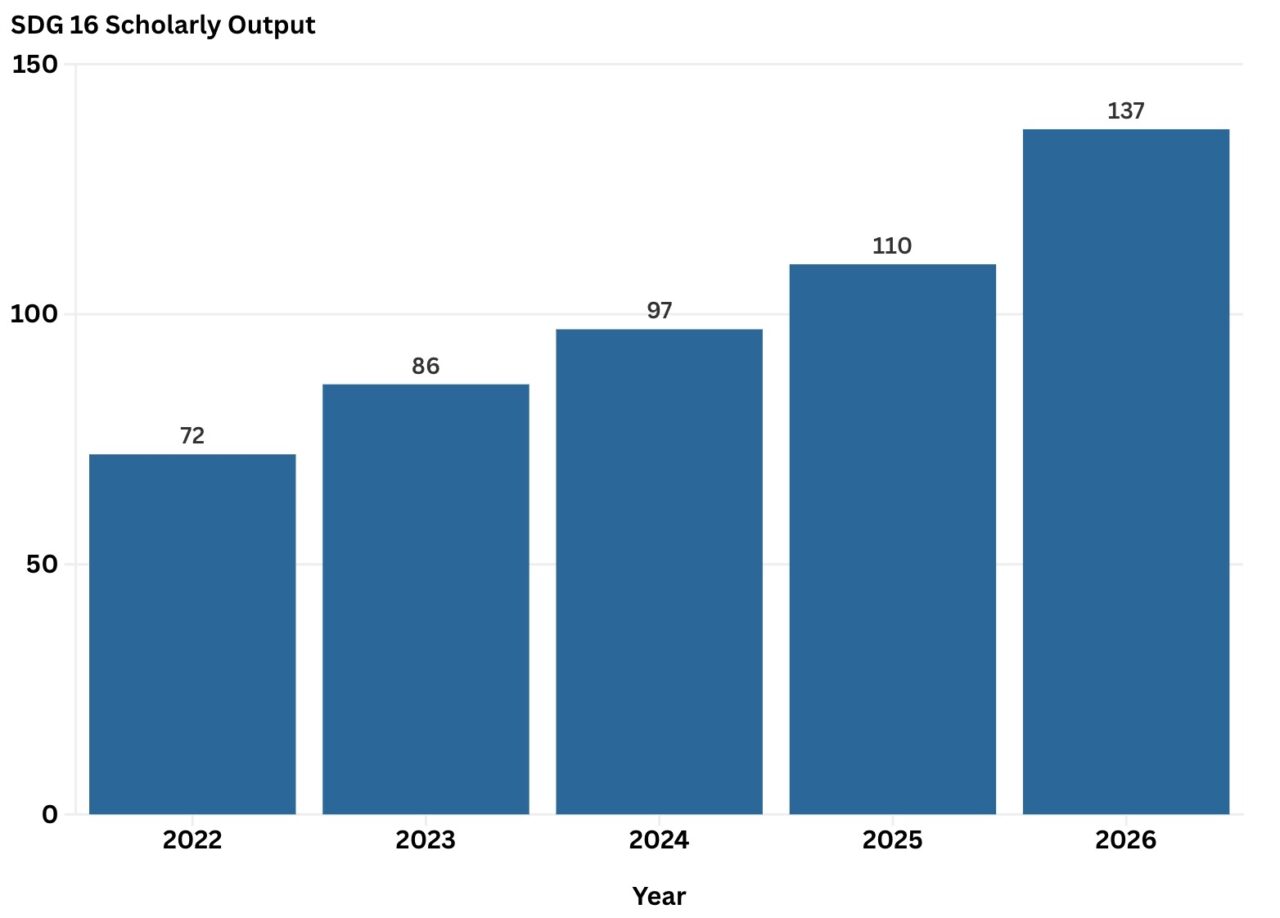
This bar graph illustrates the SDG 16 Scholarly Output of Thammasat University, focusing on research on peace and justice, from 2022 to 2026. The output increased steadily from 72 in 2022 to 86 in 2023 and 97 in 2024. This upward trend continued, reaching 110 in 2025 and peaking at 137 in 2026, indicating sustained growth in research output related to peace, justice, and strong institutions.
Research in SDG 16
Scopus classifies 135 publications by Thammasat University under Goal 16 of the Sustainable Development Goals (SDGs): Peace, Justice and Strong Institutions. Output rose from 16 publications in 2021 to 42 in 2025. A synthesis of titles and abstracts yields eight thematic clusters:
- Participatory urban and environmental planning (25; 16.7, 16.6): learning cities, community resilience to climate risk and stakeholder-driven carbon-neutral pathways.
- Community participation in health and social policy (24; 16.7, 16.b): participatory health impact assessment by local governments and health literacy for non-communicable diseases.
- Violence and protection of vulnerable groups (23; 16.1, 16.2, 16.a): sexual harassment on public transport, human trafficking, and bullying in schools and online.
- Public-sector governance and digital government (19; 16.5, 16.6, 16.10): transparency measures for public agencies and citizen-reporting platforms.
- Corporate governance and Environmental, Social and Governance (ESG) performance (16; 16.6, 16.7): board structure and sustainability reporting.
- Democracy, conflict and trust in government (12; 16.7, 16.1): youth political participation and the peace process in Thailand’s southern border provinces.
- Constitutionalism, rule of law and human rights (11; 16.3, 16.10, 16.b): Thai constitutionalism and the localisation of international human rights law.
- Technology for access to justice (5; 16.3, 16.2): an artificial intelligence chatbot that gives legal guidance to survivors of sexual violence, and forensic tools.
The disciplines behind the research
SDG 16 research at Thammasat draws on more than 30 faculties, colleges and institutes, spanning the social sciences, law, health sciences, business, engineering and design. Each cluster has an anchor unit:
- Faculty of Architecture and Planning: 15 of the 25 participatory planning publications, and 18 publications overall, the most of any unit.
- Thammasat Business School: 10 of the 16 corporate governance publications.
- Faculty of Law: 7 of the 11 constitutional and human rights publications.
- Faculty of Political Science: 5 of the 12 democracy and conflict publications.
- Faculty of Public Health and Faculty of Nursing: the main contributors to the community health cluster.
Collaboration between the Faculty of Engineering and the Faculty of Law on legal-guidance artificial intelligence shows how Thammasat combines disciplines to widen access to justice.
Source: SciVal/Scopus, Publications at Thammasat University within SDG 16 (2025), 2021–2025 (exported 27 September 2026).