Data and Performance
SDG 15 Scholarly Output of Thammasat University
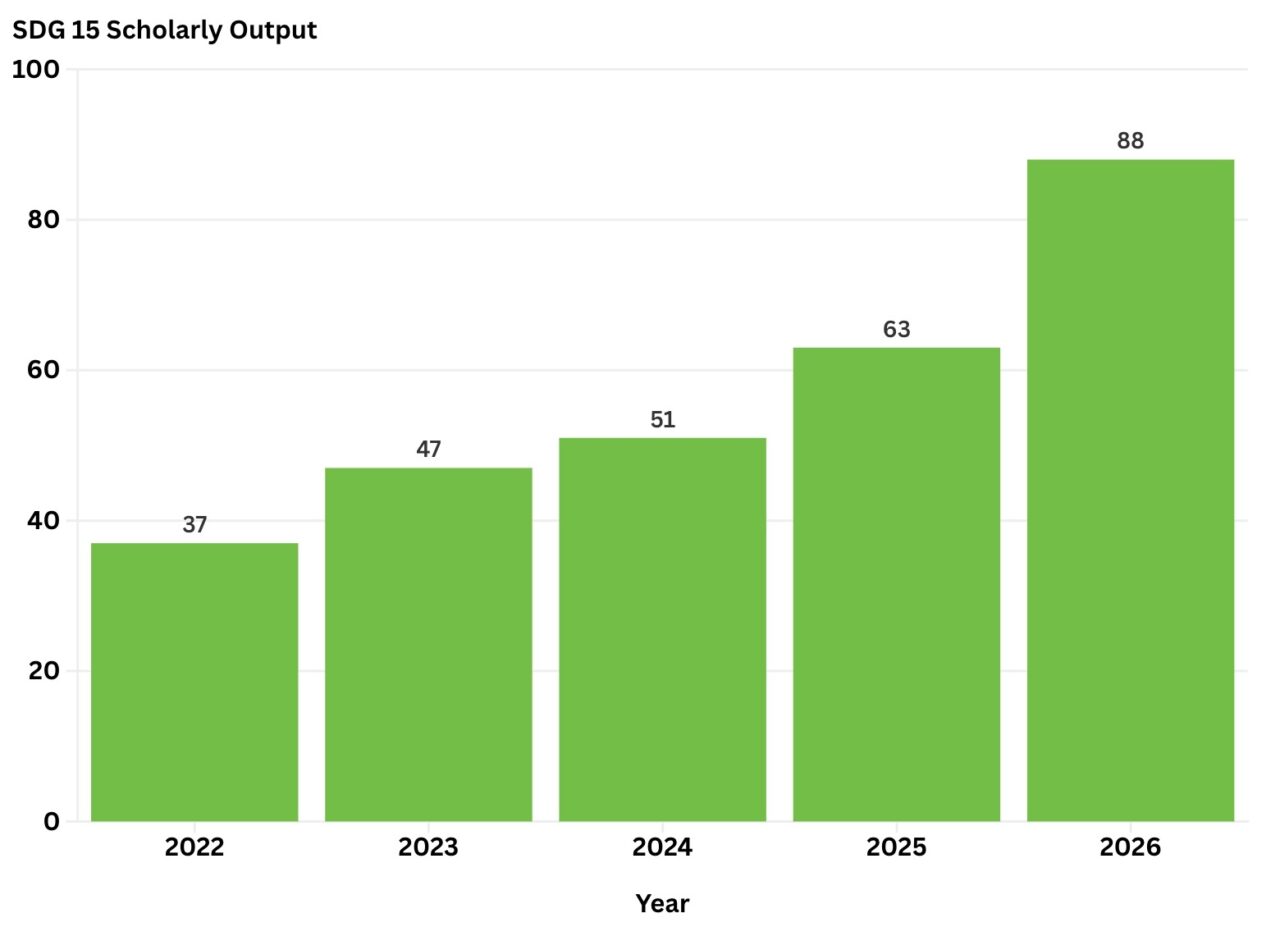
This bar graph illustrates the SDG 15 Scholarly Output of Thammasat University from 2022 to 2026, focusing on research on land ecosystems. Scholarly output increased steadily from 37 in 2022 to 47 in 2023 and 51 in 2024. The upward trend continued, reaching 63 in 2025 and peaking at 88 in 2026, a 39.7% increase from the previous year. This growth reflects increasing academic attention to terrestrial biodiversity, forest conservation, and sustainable land management.
Research in SDG 15
Thammasat University produced 87 publications in 2021–2025 under Sustainable Development Goal (SDG) 15, Life on Land. Output was 12 (2021), 14 (2022), 8 (2023), 20 (2024) and 33 (2025). A synthesis of titles and abstracts yields 6 thematic clusters:
- Land-use change, urban heat and green infrastructure (15; 15.1, 15.9): 36 years of urban heat island change in Bangkok, peri-urban ecosystem services, and nature-based solutions in housing and stormwater design.
- Soil, water and phytoremediation (13; 15.1, 15.3): lead-tolerant rhizobacteria, vetiver grass for moat water treatment, and soil erosion under crop cover.
- Biodiversity, species and wildlife genetics (12; 15.5, 15.7): a new Andaman rainforest plant species, the first rhino DNA reported in Thailand, and forensic genetics for trafficked turtles.
- Environmental governance, law and community resource rights (11; 15.2, 15.9): community forest management at Kok Edoi, recreation forest governance in Cambodia, and conservation agreements.
- Forest, mangrove and plantation carbon monitoring (9; 15.1, 15.2): forest carbon in Nan Province, mangrove species mapping, and rubber and teak plantation carbon.
- Environmental accounting, valuation and green economy (8; 15.9, 15.a): environmental management accounting in Thai firms and the green Gross Domestic Product (GDP) effects of biofuel crops.
The other 19 publications cover waste-based construction materials (7), food and bio-based products (7), and keyword-only links (5).
The disciplines behind the research
Seventeen Thammasat units contributed, spanning natural sciences, architecture and planning, engineering, liberal arts, law, business, economics and international studies. Each cluster has an anchor unit:
- Faculty of Science and Technology: 6 of the 12 biodiversity publications and 19 publications overall, the most of any unit
- Faculty of Architecture and Planning: 11 of the 15 land-use change publications
- Sirindhorn International Institute of Technology (SIIT): 4 of the 9 forest carbon publications
- School of Global Studies: 3 of the 11 governance publications
- Thammasat Business School: 3 of the 8 environmental accounting publications
- Faculty of Science and Technology and SIIT: the main contributors to the soil and phytoremediation cluster
The Faculty of Science and Technology and the Faculty of Economics jointly estimated biofuel crop effects on Thailand’s green GDP, bringing ecosystem values into national accounting (target 15.9).
Source: SciVal/Scopus, “Publications at Thammasat University within SDG 15: Life on Land (2025), 2021–2025” (Scopus data last updated 20 September 2026; exported 27 September 2026).