Data and Performance
Proportion of Output Co-Authored with Low or Lower-Middle Income Countries
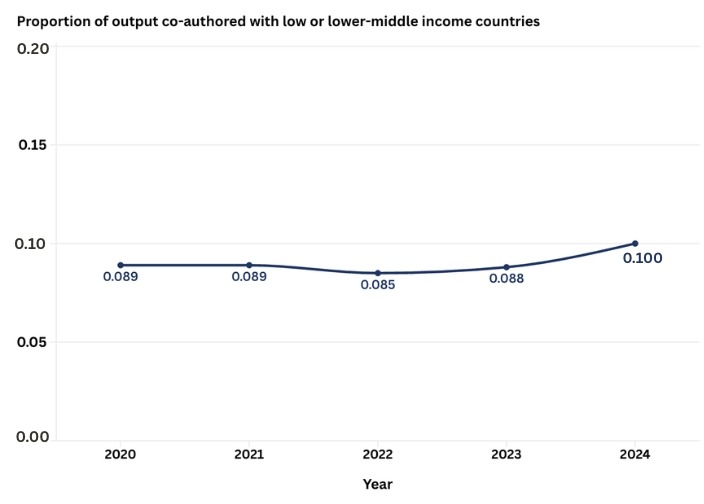
The horizontal bar chart illustrates the proportion of output co-authored with low or lower-middle income countries at Thammasat University from 2020 to 2024. The proportion remained stable at 0.089 in 2020 and 2021, before declining to 0.085 in 2022. It then recovered to 0.088 in 2023 and reached its highest value of 0.100 in 2024. Overall, the proportion increased by approximately 12.4% from 2020 to 2024, indicating an improvement in research collaboration with low or lower-middle income countries.
Sustainability Literacy Assessment
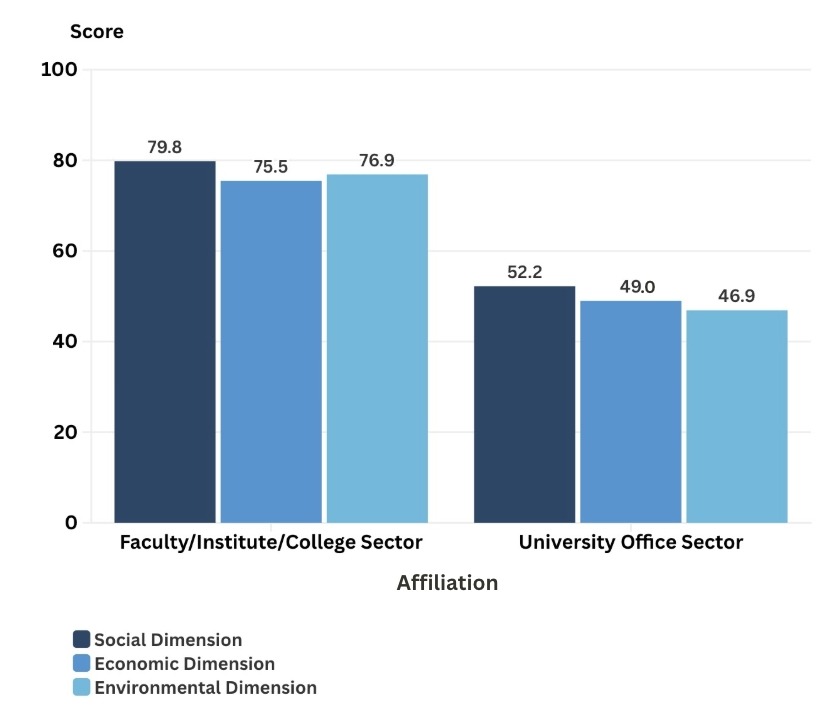
The Sustainability Literacy Assessment at Thammasat University reveals varying understanding across sustainability’s three dimensions. The social dimension achieved the highest score at 79.8, followed by the environmental dimension at 76.9 and the economic dimension at 75.5. These results reflect a relatively strong understanding of sustainability concepts among the Faculty, Institute, and College Sector. However, opportunities remain to strengthen the practical application of sustainability knowledge and its integration into interdisciplinary learning and university activities.
SDG 17 Scholarly Output of Thammasat University
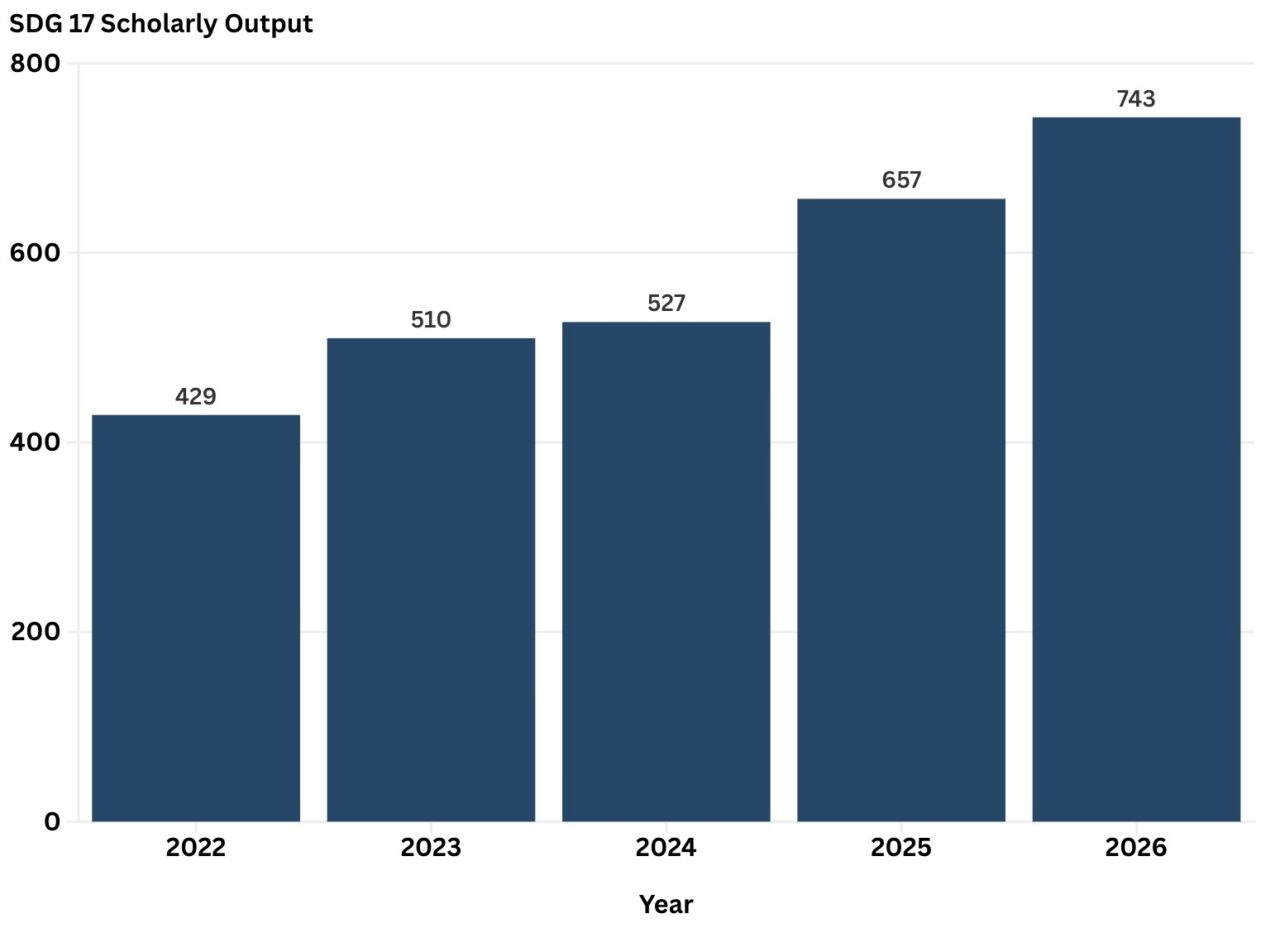
The bar chart presents the SDG 17 Scholarly Output of Thammasat University from 2022 to 2026, demonstrating an overall upward trend. The number of outputs increased from 429 in 2022 to 510 in 2023, followed by a modest rise to 527 in 2024. Growth accelerated in 2025, reaching 657 outputs, and continued to climb to 743 in 2026. Compared with 2025, scholarly output increased by approximately 13.1% in 2026, reflecting continued growth in research output related to global partnerships.
Research in SDG 17
Between 2020 and 2024, Thammasat University produced 2,970 publications related to Sustainable Development Goal (SDG) 17, Partnerships for the Goals. Times Higher Education (THE) uses research across SDGs 1–16 as the research measure for SDG 17. Annual output rose from 429 in 2020 to 511 in 2021, 626 in 2022, 658 in 2023 and 744 in 2024; 2 records carry a 2026 date. Grouping by SDG yields eight clusters; a publication may count in more than one cluster:
- Health and well-being (1,394; SDG 3): stroke risk and COVID-19 vaccine effectiveness.
- Economy, industry and innovation (583; SDGs 8, 9): Industry 4.0 capabilities in manufacturing firms and food supply chain digitalisation.
- Consumption, climate and ecosystems (560; SDGs 12, 13, 14, 15): microplastics in farmed mussels and carbon dioxide capture.
- Inequality and cities (502; SDGs 10, 11): low-income housing and migrant workers’ access to health services.
- Energy (367; SDG 7): biomass pyrolysis for biofuels and green hydrogen for Thailand’s energy system.
- Poverty, hunger, education and gender (338; SDGs 1, 2, 4, 5): microfinance outreach and women’s empowerment in organic farming.
- Water and sanitation (202; SDG 6): wastewater treatment and removal of per- and polyfluoroalkyl substances (PFAS).
- Peace, justice and institutions (107; SDG 16): public sector transparency measures and bullying of gender-diverse youth.
The disciplines behind the research
Thirty-three units contributed, spanning medicine and health sciences, engineering, sciences, planning, business, social sciences and the humanities. Each cluster has an anchor unit:
- Faculty of Medicine: 515 of the 1,394 health publications, and 531 publications overall, the most of any unit.
- Sirindhorn International Institute of Technology (SIIT): 165 of the 583 economy and industry publications and 158 of the 560 consumption and climate publications.
- SIIT and the Faculty of Engineering: the main contributors to the energy cluster (126 and 110 of 367).
- Faculty of Architecture and Planning: 142 of the 502 inequality and cities publications, and 17 of the 107 peace publications.
- Faculty of Engineering: 71 of the 202 water publications.
The Faculty of Public Health and the Faculty of Engineering jointly applied machine learning to predict sanitation management outcomes, serving SDG 6.
Source: SciVal/Scopus, “Publications at Thammasat University related to SDG 17: Partnerships for the Goals, 2020–2024” (Scopus data last updated 20 September 2026; exported 28 September 2026).