Data and Performance
Amount of Waste Sent to Landfill (Metric Tons)
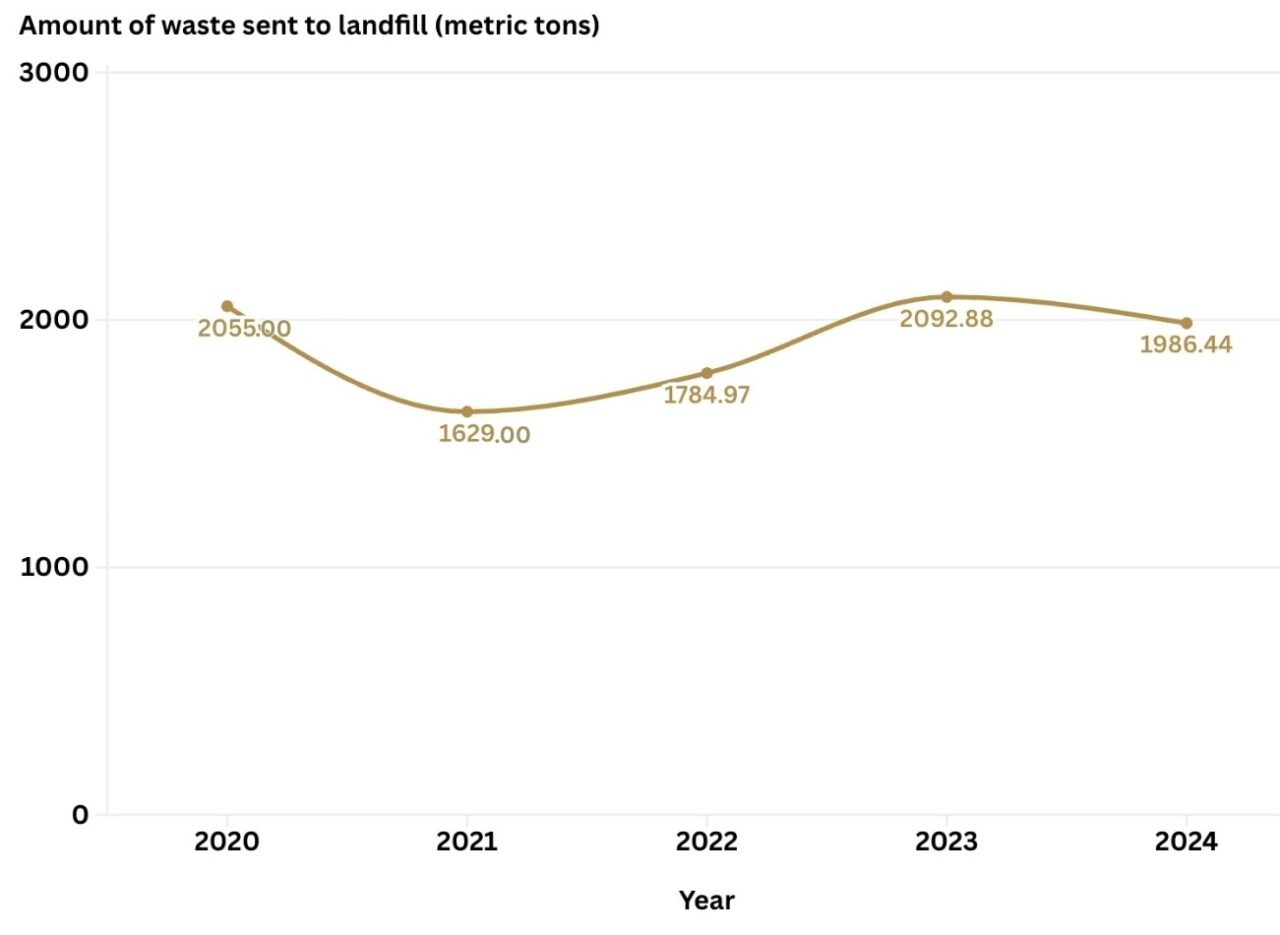
This graph illustrates changes in waste sent to landfill at Thammasat University from 2020 to 2024. The amount decreased from 2,055.00 metric tons (MT) in 2020 to 1,629.00 MT in 2021, before rising to 1,784.97 MT in 2022 and 2,092.88 MT in 2023. In 2024, the figure fell to 1,986.44 MT (down 5.1%). Despite this reduction, landfill waste remained 21.9% higher than 2021. These fluctuations highlight the importance of strengthening waste prevention, source separation, and recycling initiatives to support sustainable consumption.
Proportion of Waste Recycled
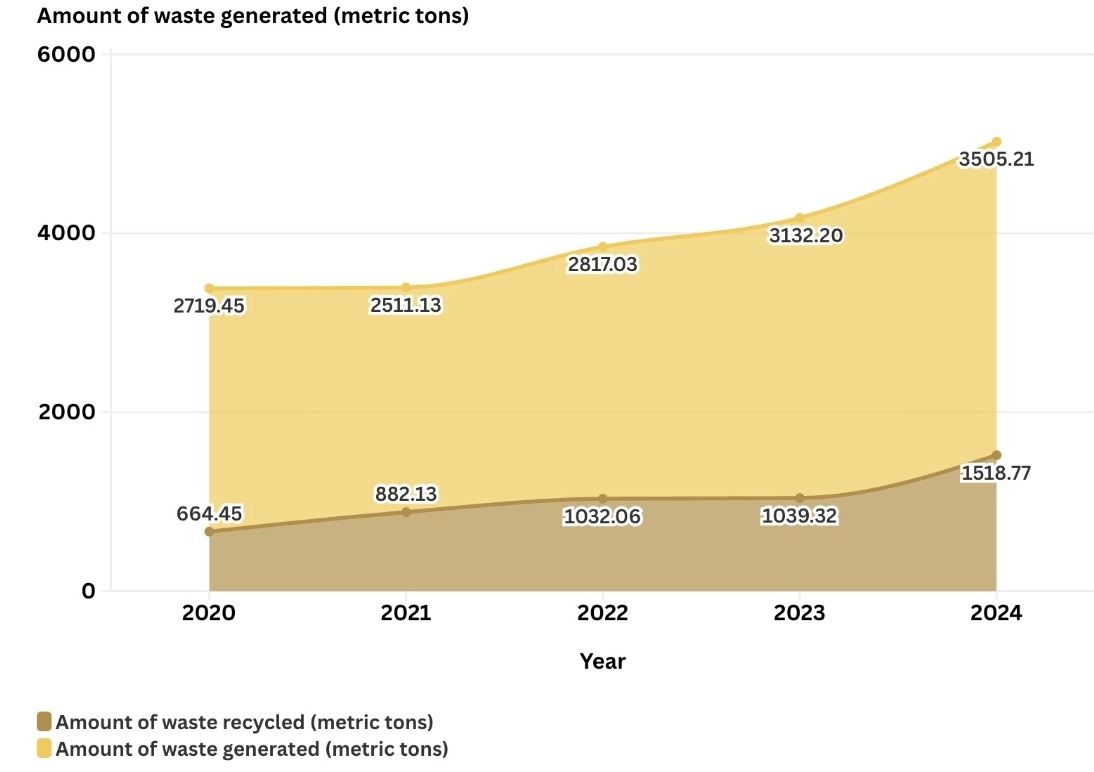
This stacked area chart illustrates the amount of waste generated and recycled at Thammasat University from 2020 to 2024, highlighting the proportion of waste recycled. The amount of waste recycled increased from 664.45 metric tons (MT) in 2020 to 1,032.06 MT in 2022, before stabilizing at 1,039.32 MT in 2023. In 2024, recycling rose sharply to 1,518.77 MT (up 46.1%). Meanwhile, waste generated fell to 2,017.03 MT in 2022 before rising to 3,505.21 MT in 2024.These trends highlight recycling progress alongside overall waste reduction challenges.
SDG 12 Scholarly Output of Thammasat University
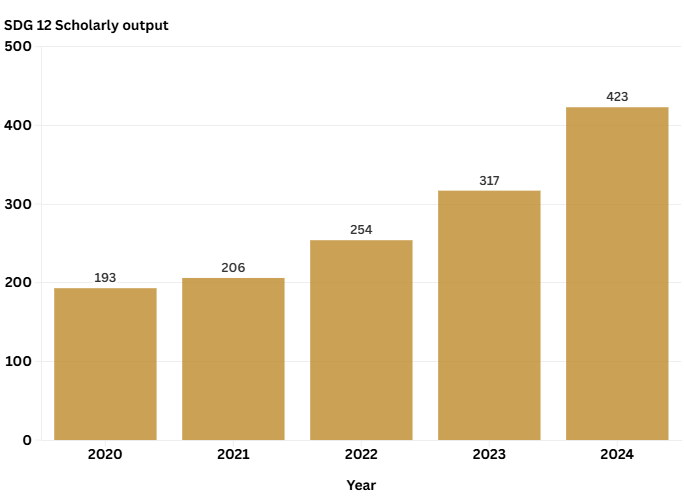
This vertical bar graph presents the SDG 12 Scholarly Output of Thammasat University from 2022 to 2026. The number of publications increased steadily from 193 in 2022 to 206 in 2023 and 254 in 2024. This upward trend continued, reaching 317 in 2025 and peaking at 423 in 2026, representing a 33.4% increase from the previous year. This sustained growth may reflect increasing academic engagement with responsible consumption and production, including research on resource efficiency, waste reduction, and sustainable practices.
Research in SDG 12
Thammasat University published 424 works mapped to Sustainable Development Goal (SDG) 12, Responsible Consumption and Production: 55 in 2021, 51 in 2022, 77 in 2023, 91 in 2024 and 150 in 2025. A synthesis of titles and abstracts yields eight thematic clusters:
- Sustainable consumption, tourism, education and public policy (79; 12.8, 12.b, 12.1): green purchasing, community-based tourism and campus sustainability.
- Sustainable supply chains, corporate responsibility and reporting (68; 12.6, 12.2): circular supply chain models, Environmental, Social and Governance (ESG) performance, and sustainability reporting.
- Recycling, upcycling and valorisation of plastics, biomass and other wastes (57; 12.2, 12.5): chemical recycling of plastic bottles and battery electrodes from rice straw.
- Solid waste management systems and waste-to-energy (53; 12.5, 12.4): waste-to-energy options for municipalities and construction waste management.
- Construction materials from waste and industrial by-products (46; 12.5, 12.2): concrete with fly ash, recycled brick and e-waste fibres.
- Chemicals, pollution, wastewater and health risks (46; 12.4): heavy-metal exposure near informal e-waste recycling and microplastics in wastewater.
- Food safety, food loss and sustainable agriculture (42; 12.3): foodborne pathogen detection and crop residue burning.
- Energy efficiency, low-carbon buildings and emissions assessment (33; 12.2): net-zero energy offices and carbon assessment of concrete construction.
The disciplines behind the research
Twenty-eight Thammasat units contributed, spanning engineering, sciences, planning, business, public health and social sciences. Each cluster has an anchor unit:
- Sirindhorn International Institute of Technology (SIIT): 92 publications overall, the most of any unit; with the Faculty of Architecture and Planning, the main contributors to energy efficiency (14 and 13 of 33).
- Faculty of Engineering: 25 of the 46 construction materials publications; with SIIT, the main contributors to solid waste (16 each of 53).
- Faculty of Science and Technology: 30 of the 57 recycling and 25 of the 42 food publications.
- Thammasat Business School: 26 of the 68 supply chain publications.
- Faculty of Architecture and Planning: 20 of the 79 consumption and tourism publications.
- Faculty of Public Health: 15 of the 46 chemicals and health publications.
Four papers co-authored by the Faculties of Public Health and Engineering link sanitation and municipal waste data to safe waste management (12.4, 12.5).
Source: SciVal/Scopus, “Publications at Thammasat University within SDG 12: Responsible Consumption and Production (2025), 2021–2025” (Scopus data last updated 20 September 2026; exported 27 September 2026).