Data and Performance
Number of Students Starting a Degree
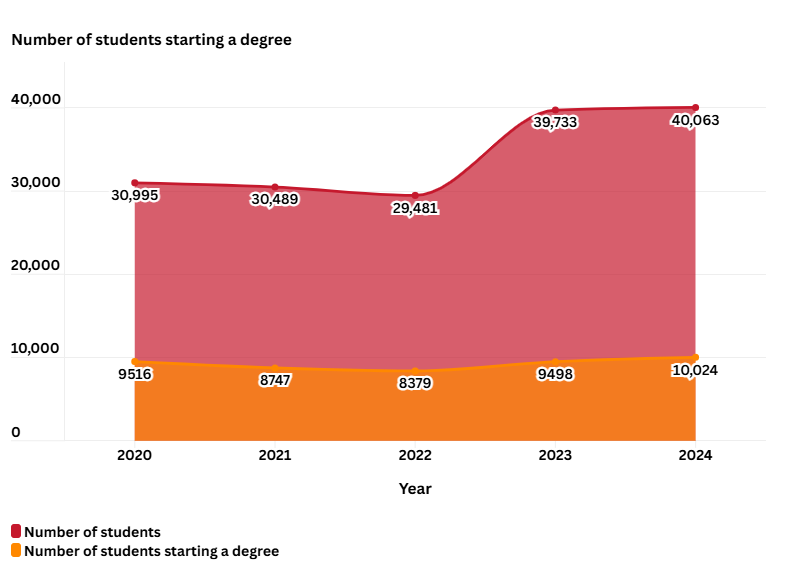
The line graph presents the number of students starting a degree at Thammasat University from 2020–2021 to 2024–2025. The number decreased from 9,516 students in 2020–2021 to 8,379 in 2022–2023, before increasing significantly to 9,498 in 2023–2024 and reaching 10,024 students in 2024–2025. The latest figure represents the highest level in the period shown, indicating a strong upward recovery in the number of students starting a degree and continued demand for higher education at the university.
Number of Graduates Who Gained a Qualification That Entitled Them to Teach at Primary School Level
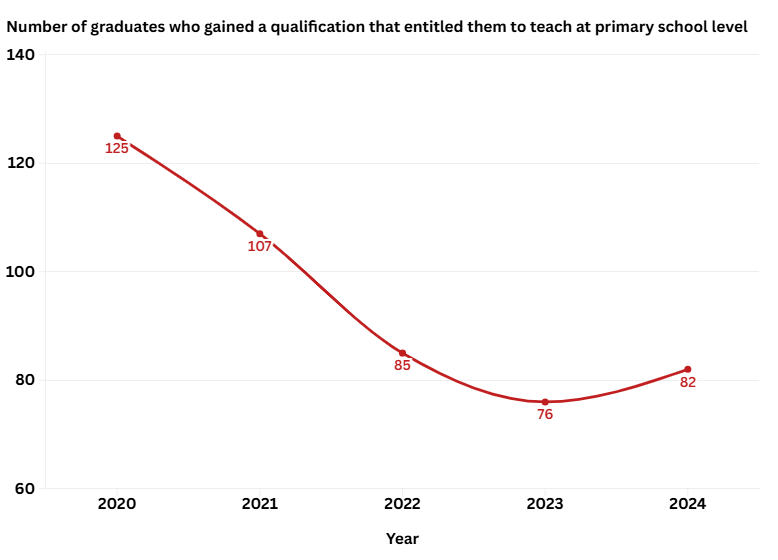
The line graph presents the number of graduates who gained a qualification that entitled them to teach at primary school level from 2020–2021 to 2024–2025. Numbers declined from 125 in 2020–2021 to 76 in 2023–2024, before increasing slightly to 82 in 2024–2025. The decline may reflect changes in teacher education programs and their intake over time, while the recent increase suggests renewed participation in primary teacher qualification programs.
SDG 4 Scholarly Output of Thammasat University
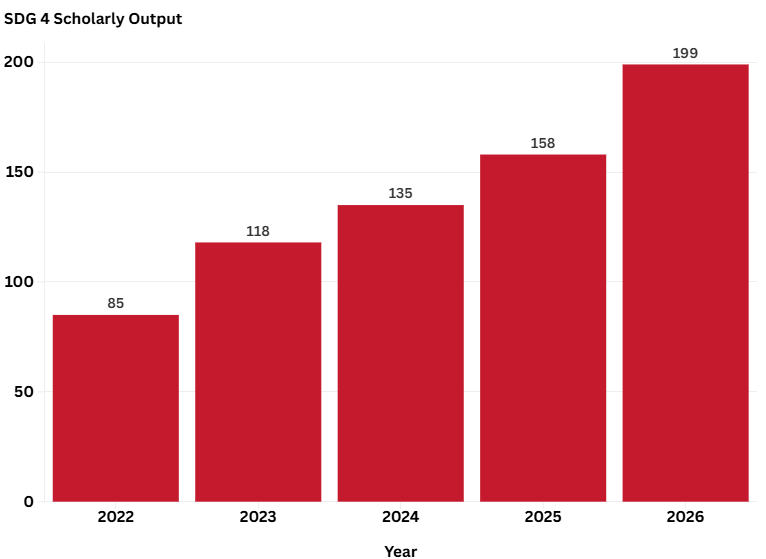
The bar chart presents the number of publications at Thammasat University from 2022 to 2026. The number of publications increased steadily from 85 in 2022 to 118 in 2023, 135 in 2024, 158 in 2025, and 199 in 2026. This consistent growth reflects the university’s expanding research contribution to education and related areas, demonstrating continued academic engagement.
Research in SDG 4
Thammasat University produced 198 publications on Sustainable Development Goal (SDG) 4: Quality Education between 2021 and 2025. Yearly output: 25 (2021), 40 (2022), 35 (2023), 42 (2024) and 56 (2025). A synthesis of titles and abstracts yields 8 thematic clusters:
- English and foreign-language teaching and learning (53; 4.1, 4.3, 4.c): extensive reading, genre-based writing instruction and pre-service teacher training.
- Learning technologies, game-based learning and STEM pedagogy (27; 4.1, 4.3, 4.4): virtual reality laboratories, metaverse classrooms, and gamified Massive Open Online Courses (MOOCs) in rural schools.
- Skills, employability and workforce development (26; 4.3, 4.4): employer skill demand, green skills, micro-credentials and practices for ageing workers.
- Health professions education and health training (24; 4.3, 4.4): virtual reality simulators for dental surgery and cardiopulmonary resuscitation training for lay responders.
- Educational equity, inclusion and learners at risk (20; 4.1, 4.5, 4.a): digital inequality, early reading disorders and learners with visual impairment.
- Learning cities, campuses and urban learning environments (15; 4.3, 4.a): lifelong learning city guidelines and indoor air quality in classrooms.
- Higher education, internationalisation and education for sustainable development (15; 4.3, 4.7, 4.b): SDG integration in business schools and the adaptation of international students.
- Engineering, environmental and health studies with indirect links to SDG 4 (18): keyword-mapped work such as concrete strength modelling and sanitation management.
The disciplines behind the research
The publications come from 24 Thammasat units across language studies, business, engineering, health sciences, social sciences, education, and architecture and planning. The anchor units are:
- Language Institute: 35 of the 53 language publications, and 37 publications overall, the most of any unit.
- Thammasat Business School: 14 of the 26 skills and employability publications.
- Faculty of Dentistry: 10 of the 24 health professions education publications.
- Faculty of Architecture and Planning: 11 of the 15 learning city and campus publications.
- Sirindhorn International Institute of Technology (SIIT) and the Faculty of Engineering: the main contributors to the learning technologies cluster (7 and 6 of 27).
The Faculty of Dentistry and the Faculty of Science and Technology tested a virtual reality simulator for endodontic training in a randomised controlled trial, serving target 4.4.
Source: SciVal/Scopus, “Publications at Thammasat University within SDG 4: Quality Education (2025)”, 2021–2025 (Scopus data last updated 20 September 2026; exported 27 September 2026).