When hearing the term ‘Green Office’, many often envision minor activities like planting trees around the building or switching to energy-saving lightbulbs. However, true success does not depend solely on equipment or physical facilities. At its heart lies an eco-conscious mindset, or a ‘Green Mindset’, embraced by every member of staff.
In terms of workflow, a Green Office involves managing the office environment through the PDCA (Plan-Do-Check-Act) cycle to minimise resource consumption and waste production. Yet, in principle, it serves as a tool focused on behavioural change and building a corporate culture—shifting from ingrained habits towards a keen awareness of resource efficiency.
From Green Mindset to Real Change: Why Sustainability Matters to Thammasat
Sustainability can only be achieved when there is a harmonious balance between the quality of life of our staff (People) and a sustainable environment (Planet). A healthy working environment directly enhances both the well-being and productivity of all personnel.
This aligns seamlessly with the vision of Professor Dr Supasawad Chardchawarn, Rector of Thammasat University, who emphasised:
‘We cannot drive the university by rankings alone; we must deliver Real Change.’
The TU Green Office initiative is therefore a vital mechanism in laying foundations for sustainability at faculty and departmental levels, ultimately enhancing the quality of life for the entire Thammasat community.
One Data, Many Uses: Single Dataset, Multifaceted Benefits, Linked with EdPEx
The TU Green Office drive has been designed under the ‘One Data, Many Uses’ concept to reduce work duplication. Environmental management data compiled by each department can be utilised and extended across three core dimensions:
- Quality Assurance: Statistical data and risk management insights from the Green Office can be directly referenced and utilised to support EdPEx reports, particularly in Category P (Organisational Profile), Category 1 (Leadership), Category 4 (Measurement, Analysis, and Knowledge Management), and Category 5 (Workforce).
- Budgeting: Enhancing resource efficiency helps reduce expenditure on utilities and consumables, enabling departments to manage budgets with maximum efficiency.
- Well-being: Creating a clean, safe, and pollution-free working environment promotes the physical and mental health of staff, who are the organisation’s most valuable asset.
This approach streamlines workflows by removing redundant steps and establishing a standardised, sustainable system. Regardless of future leadership transitions, this robust framework will continue to support quality assurance, save budgets, and safeguard the well-being of everyone at Thammasat.
Road to Gold Level: Exploring the 6 Criteria Towards National Green Office Status
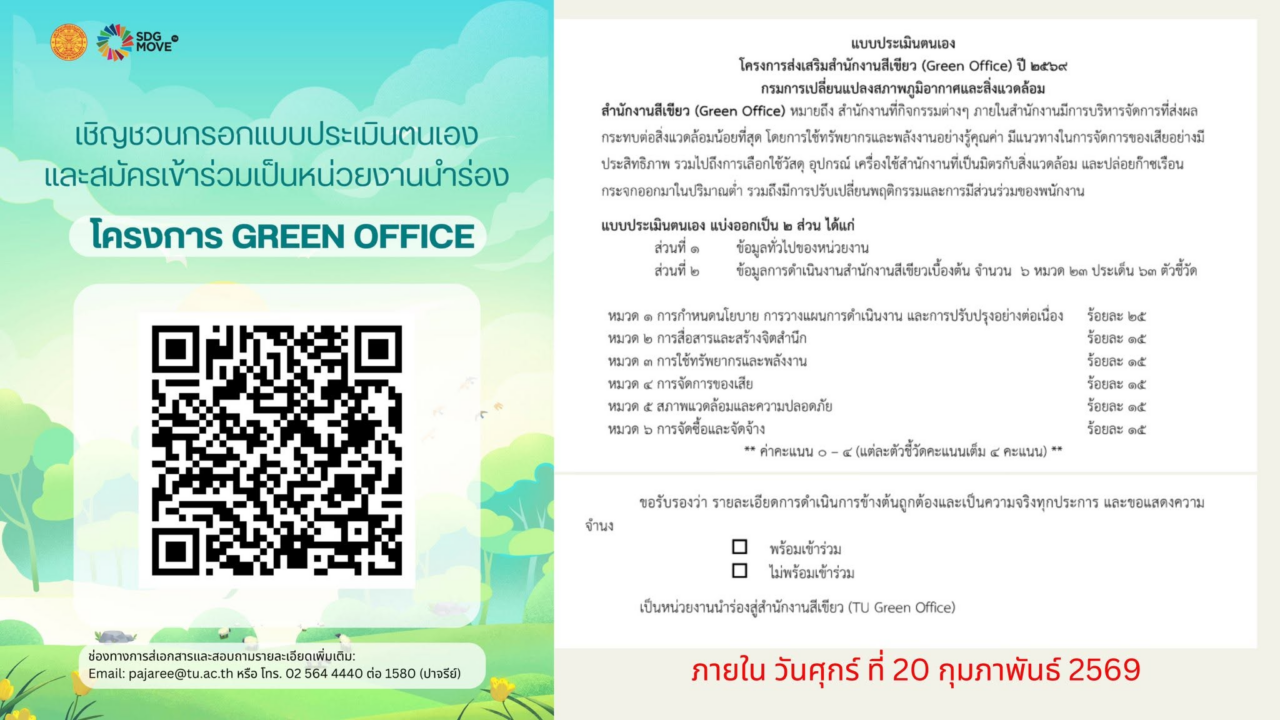
For departments within Thammasat aiming to elevate their office standards to international levels, they must undergo an evaluation based on the Green Office criteria established by the Department of Climate Change and Environment, Ministry of Natural Resources and Environment. Certification is awarded across three levels based on total percentage scores:
| Certification Level | Total Score Criteria |
| Excellent (G Gold) | 90% and above |
| Very Good (G Silver) | 80% – 89% |
| Good (G Bronze) | 60% – 79% |
The overall score is assessed based on management performance across six core categories:
- Category 1: Policy Formulation and Planning (25%): The most critical foundation. It requires a clear environmental policy signed by executives and the appointment of a working committee to drive plans systematically.
- Category 2: Communication and Awareness Raising (15%): Assessed on fostering awareness and understanding among staff through training and comprehensive policy communication.
- Category 3: Resource and Energy Consumption (15%): Evaluated on concrete conservation measures for energy (water, electricity, fuel) and resources (paper), alongside continuous statistical data collection for performance comparison.
- Category 4: Waste Management (15%): Assessed on proper sanitary waste segregation by type and explicit waste reduction targets.
- Category 5: Environment and Safety (15%): Evaluated on air quality management, lighting, green spaces, workplace neatness (5S), and emergency response readiness.
- Category 6: Green Procurement (15%): Assessed on promoting the procurement of eco-friendly products and services to support a sustainable supply chain.
While the details of these six categories may seem challenging, the true keys to success are data continuity and understanding across all levels of staff—from executives to operational personnel. By simply starting with an honest self-assessment and fostering internal collaboration, the goal of achieving national Green Office status is well within reach.