
HIGHLIGHTS
- Universities emerge as key drivers of sustainable development: The seminar showcased how Thai universities are moving beyond traditional academic roles to become active agents translating knowledge into real-world impact aligned with the SDGs.
- Mahidol University delivers policy impact and campus transformation: Mahidol advances “Real World Impact” through public-policy advocacy on health and environment, peace-building initiatives, green-campus development, curriculum reform, and sustainability leadership programmes.
- Siam University pioneers a ‘Sustainable District’ through community co-creation: With its Whole-Institution Approach and UPC4Local Action Model, Siam integrates SDGs across 90% of courses and co-develops tangible community solutions such as pedestrian-safety innovation and zero-waste circular economy projects.
- SDSN Thailand strengthens the national ecosystem for SDG action: Acting as a connector across sectors, SDSN Thailand empowers leadership, promotes Education for Sustainable Development, supports transdisciplinary research, and amplifies university-led solutions for broader societal change.
Universities, once viewed primarily as “intellectual powerhouses” confined to the classroom, are undergoing a radical transformation. Today, they are stepping up as critical “Key Players” in driving the United Nations’ Sustainable Development Goals (SDGs).
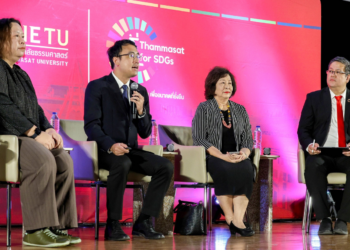
The recent seminar, “How Universities Drive Sustainable Development,” held at Thammasat University, painted a vivid picture of this paradigm shift. It showcased the distinct yet convergent strategies of Thailand’s leading institutions, proving that whether public or private, large or small, higher education has a pivotal role to play in saving the planet.
This article summarises the key takeaways and operational experiences from Mahidol University, Siam University, and the Sustainable Development Solutions Network (SDSN) Thailand.
Mahidol University: From ‘Wisdom of the Land’ to Real-World Impact
Mahidol University approaches the SDGs through its guiding vision of being the “Wisdom of the Land.” Rather than viewing the 17 goals in isolation, Mahidol adopts a holistic view, focusing on creating “Real World Impact.”
Asst. Prof. Dr Panon Latcharote presented Mahidol’s strategy, which leverages its historical strength in medicine and health sciences. The university uses “Well-being” as its central axis to drive its mission for the public good. Their journey is divided into two strategic phases:
Phase 1: External Impact (Society First)
Mahidol began by projecting its research outwards to influence public policy.
- Policy Advocacy: Pushing for the Low-Sodium Policy to improve national health and combating PM2.5 pollution through the development of the Air Quality Health Index (AQHI).
- Peace Building: engaging in sensitive peace-building projects in the three southern border provinces.
Phase 2: Looking Inward (The Green Campus)
More recently, Mahidol has turned its gaze back to its own “home”—a campus city with a population of over 80,000. They are embedding the SDGs into infrastructure and daily life:
- Green Infrastructure: Transitioning the internal transport system to 100% electric vehicles and aggressively installing solar panels.
- Curriculum Reform: Overhauling General Education (Gen Ed) to equip students with 21st-century survival skills.
- Health for All: Launching accessible physical and mental health services like MU Health and MU Friendsapplications.
Crucially, Mahidol is fostering a culture of sustainability through the “Mahidol Change Agent” project, incubating staff and students to become leaders who drive change from within.
Siam University: The Agile Model for a ‘Sustainable District’
Prof. Emeritus Dr Chanita Rukspollmuang, Vice President of Siam University, presented a contrasting but equally effective model. As a compact, private university—and the only one located in the Phasi Charoen District—Siam University utilises its agility to fulfil the specific mission: “Sustainable University, Sustainable District.”
Their philosophy is simple yet profound: “A university cannot be sustainable if its surrounding community is not.” They employ two core frameworks:
1. Whole-Institution Approach (WIA)
Sustainability is not an elective; it is the core curriculum. From policy to practice, the SDGs are woven into every fabric of the institution.
- Action for the Goals: This policy integrates sustainability into teaching, research, and campus management.
- The Result: Today, a staggering 90.72% of all courses at Siam University have integrated SDG concepts into their lessons.
2. The UPC4Local Action Model
Recognising that they cannot work alone, Siam University adopted the UPC model(University + Public/Private Sector + Communities). This collaboration operates through the “4Cos” Process:
- Co-Create: Identify problems together.
- Co-Design: Plan solutions together.
- Co-Produce: Implement together.
- Co-Reflect: Evaluate lessons learned together.
The ultimate goal is “Self-Reliance.” Success is defined not by how much the university helps, but by the community’s ability to sustain itself once the university withdraws.
Tangible Successes:
- S-Guard Barrier: An innovation co-developed with the district to prevent motorcycles from driving on pavements, ensuring pedestrian safety.
- Zero-Waste at Khlong Lat Phachi: Using Black Soldier Fly larvae to convert organic waste into high-protein animal feed, creating a circular economy and income for the community.
SDSN Thailand: The Ecosystem Builder
Khun Nanthinee Malanon, Network Manager of SDSN Thailand, highlighted the role of the Sustainable Development Solutions Network not as an implementer, but as a “Connector.”
SDSN acts as the central node linking academia, government, the private sector, and civil society. Their goal is to build an ecosystem where universities can thrive as drivers of the SDGs through 5 Strategic Pillars:
- Leadership Empowerment: Training executives and faculty to be change agents within their institutions.
- Education for Sustainable Development (ESD): Developing the potential of educators and pushing for ESD policy at the tertiary level.
- Local Intermediaries: Encouraging universities to act as the “middleman” in their provinces, bridging the gap between local problems and innovative solutions.
- Transdisciplinary Research: Promoting research that crosses academic boundaries to solve complex issues, such as sustainable food systems and the just energy transition.
- Knowledge Communication: Translating complex SDG knowledge for the public and providing a platform for universities to showcase their innovations.
Conclusion
The overarching message from the seminar is clear: Universities are no longer just “teachers” in a classroom. They have evolved into “Players” and “Creators” of significant change. By translating academic knowledge into tangible impact, they are the engines driving sustainable development at both the community and national levels.
Summarised from the seminar “How Universities Drive Sustainable Development? Experiences from Leading Public and Private Universities in Thailand,” held on 7 October 2025 at Thammasat University, Rangsit Centre.