HIGHLIGHTS
- Disaster Impacts Exacerbated by Governance & Data Gaps: The seminar revealed that the Hatyai flooding was intensified not only by extreme rainfall, but also by failures to utilise real-time data and outdated warning systems — leaving citizens without adequate time to protect lives and property.
- Breakdown of Crisis Management & Public Service Delivery: Frontline experiences showed a lack of preparedness, weak coordination across agencies, ineffective evacuation support, and no unified command — resulting in communities relying on themselves and private networks during the crisis.
- Legal Overlaps Create Accountability Challenges: Multiple laws enforced simultaneously caused confusion in the chain of command, while the Emergency Decree limited personal liability of state officials — complicating legal pathways for disaster victims seeking justice and remedies.
- Call for Rights-Based State Responsibility in Disasters: Scholars proposed that courts recognise the State’s constitutional duty to protect citizens. Where mismanagement worsens disaster impacts, the State should be liable for incremental damages — establishing stronger accountability and driving reform toward transparent, efficient disaster governance.
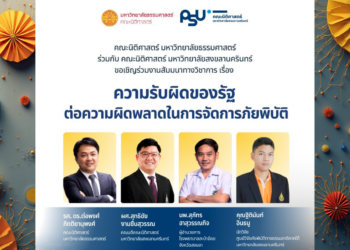
The Faculty of Law at Thammasat University, in collaboration with the Faculty of Law at Prince of Songkla University (PSU), recently hosted an academic seminar titled “State Liability for Failures in Disaster Management.” The event aimed to decode lessons learned from the severe flooding in Hatyai District, Songkhla Province, last November, which caused extensive damage to life and property. The panel highlighted structural issues, mismanagement, and compelling legal avenues to seek justice for the victims.
Key Takeaways from the Seminar
Data Crisis and Warning Systems: When Old Models Fail
Addressing the Hatyai flood situation, Khun Thitinant Inthanu, a researcher from the Natural Disaster Research Centre of Southern Thailand (PSU), highlighted that this event differed significantly from the past. The area experienced abnormally high cumulative rainfall, with heavy downpours occurring simultaneously in the city centre and surrounding areas. This deviated from the traditional pattern where water typically flows down from upstream sources. Consequently, the flag-based warning system (Green-Yellow-Red), which had been effective previously, failed to alert the public in time. Scientific data confirms that while the severe weather was a natural phenomenon, the magnitude of the damage was partly due to a failure to utilise existing data for effective management and warning, leaving citizens with insufficient time to relocate assets or evacuate.
Voices from the Ground: A Reflection of a ‘Failed State’ in Crisis
From the perspective of frontline operations, Dr Supat Hasuwannakit, Director of Sabayoi Hospital, painted a clear picture of state failure. He noted a distinct lack of preparedness by the government both before and during the incident. Communication systems collapsed, evacuation centres were ill-equipped, and—crucially—there was a lack of a unified incident commander. This led to chaotic and directionless relief efforts, forcing citizens to rely primarily on themselves and the private sector. This scenario reflects the fragility of a bureaucratic system unable to integrate cross-agency operations when people need it most.
The Legal Knot: Overlapping Powers and Liability
Loopholes regarding the legal structure, Asst. Prof. Suthichai Ngamchuen-suwan, Dean of the Faculty of Law (PSU), analysed the complications caused by complex and redundant law enforcement. During this single event, powers were exercised under three different laws: the State Administration Act, the Disaster Prevention and Mitigation Act, and the Emergency Decree. This created confusion within the chain of command. Furthermore, invoking the Emergency Decree carries legal implications that sever the personal liability of state officials, making it difficult to sue for damages. However, avenues remain to claim tort liability from state agencies if it can be proven that the damage was a direct result of neglecting duties prescribed by law.
Legal Proposals: The State Must Pay if it Neglects its Duty to Protect
Assoc. Prof. Dr Torpong Kittiyanupong from the Faculty of Law (TU) proposed a new approach to legal interpretation to ensure justice. He suggested that the Administrative Court should not hastily conclude that natural disasters are always “Force Majeure” (an irresistible force) exempting the state from responsibility. Instead, the court should consider the “State’s Duty” to protect fundamental rights under the Constitution. If the state is flawed in its warning systems or management, causing the damage to spread wider than it naturally would have, the state should be liable for that incremental damage. Filing an administrative case for compensation is not merely about remedial action for victims; it is about establishing a new precedent. It forces the state to realise its burden of duty in safeguarding public safety and stimulates a reform of the country’s disaster management system towards greater efficiency and transparency.