
Thammasat University Stadium Continues Collaboration with Tha Khlong Municipality, Fostering Well-being in the Surrounding Community

HIGHLIGHTS

  • Over Two Decades of Partnership: Thammasat University and Tha Khlong Municipality have sustained a 22-year collaboration through the “Healthy Tha Khlong Residents for All” project, promoting health awareness and active living.
  • Community Access to Sports Facilities: Residents of Tha Khlong have full access to Thammasat University’s extensive sports facilities, with non-university users making up 25% of attendees.
  • Joint Hosting of “Tha Khlong Games 2024”: The successful co-organization of the 38th Local Government Student Games showcased the strength of the university-municipality partnership and the quality of the university’s sports infrastructure.
  • Model for Health-Driven Community Engagement: Thammasat University’s commitment to becoming a “Healthy University for All” and a “Sport Community” reflects its broader mission to serve as a hub for public well-being and sustainable community development.

เลือก Page 2 เพื่ออ่านเป็นภาษาไทย

Thammasat University is reinforcing its role as a “university for society” by continuing its strong collaboration with Tha Khlong Municipality in Pathum Thani Province. They are moving forward with the “Healthy Tha Khlong Residents for All” project to promote health and build resilience among the people in the communities surrounding the university.

This project isn’t a new venture; it’s a robust partnership that has spanned over 22 years (since 2003). Its main goal is to empower the people of Tha Khlong with the knowledge and understanding to look after their health and to be able to apply this in their daily lives. Thammasat University itself has a clear aim to be a “Healthy University for All” and is committed to developing into a “Sport Community” so that exercise becomes a part of everyone’s daily routine.

Opening the Stadium, Creating Opportunities for the Community

A key aspect of this collaboration is Thammasat University’s decision to allow residents registered within the Tha Khlong municipal area full access to the sports facilities at Thammasat University, Rangsit Campus. Whether it’s the football pitches, indoor sports hall, swimming pool, or running tracks, everyone can come and use them for exercise and recreation. Currently, people from outside the university account for as much as 25% of users (statistics from the Property and Sports Management Office, Thammasat University, Rangsit Campus, 2021-2022).

“Tha Khlong Games 2024”: A Significant Collaboration

Another success that demonstrates the excellent cooperation is Thammasat University and Tha Khlong Municipality jointly hosting the 38th Local Government Student Games, Central Region Qualifying Round, under the name “Tha Khlong Games 2024”. This event took place between 14th and 23rd May 2024.

Tha Khlong Municipality took the lead in organising the games, with the Thammasat University, Rangsit Campus Sports Centre serving as one of the four main venues. The grand opening ceremony was held at Gymnasium 4 within the Sports Centre, presided over by the Governor of Pathum Thani Province, with the Mayor of Tha Khlong delivering a welcome address and outlining the objectives of the event. The municipality’s choice of the university’s sports facilities highlights their confidence in the standard and readiness of the venue.

University Ready to be a Space for Promoting Everyone’s Health

The main objective of this collaboration is to utilise the university’s existing resources, particularly its high-standard sports centre, to promote physical activity and sports at the community and regional levels. Tha Khlong Municipality hosting the student games and choosing Thammasat University’s sports facilities as the main venue is a concrete example of integrating resources between government agencies and educational institutions.

Thammasat University, Rangsit Campus, spans over 300 rai (a unit of land area) and has been developed into a comprehensive health and sports hub. It boasts a variety of modern facilities such as the main stadium, indoor sports hall, swimming pool, cycling paths, and various exercise areas, all of which are open to students, staff, and the general public.

Proud Achievements

The collaboration between Thammasat University and Tha Khlong Municipality has yielded many proud achievements. The successful hosting of the “Tha Khlong Games 2024” provided a standard level sports competition experience for students from across the central region. Furthermore, opening the university’s sports facilities to the community has encouraged more people to exercise, which will have long-term benefits for the overall health of the community.

Thammasat University remains committed to continuing its collaboration with Tha Khlong Municipality and is ready to create various activities to promote the health and well-being of the communities surrounding the university, firmly believing that a strong community starts with the good health of everyone.

Promoting interdisciplinary research across science disciplines

Serving Thailand’s societal needs has been Thammasat University’s guiding principle throughout its history, and presently it states its main strategic objective is to become “the University of the People, the Research University and the International University”.
The Centers of Excellence (CoE) form an ecosystem in which research collaborations can be established to help facilitate the multidisciplinary and interdisciplinary approaches that are needed when tackling social issues such as sustainability and healthcare.

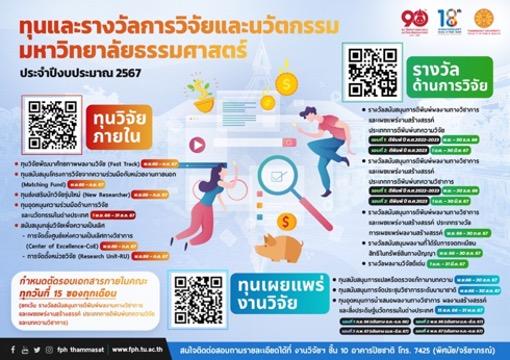
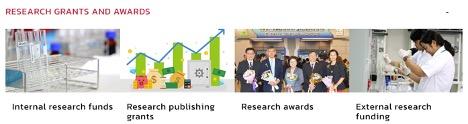
Thammasat University annually sets out the criteria, qualifications, and availability of research grants and awards, which are announced once a year in November for all disciplines with the focus on multidisciplinary research and international collaboration in science disciplines. Our articles in THE Research Hub could be the evidences.
Benefiting society with interdisciplinary and international collaboration
Thammasat University promotes multidisciplinary research to foster impactful research

This information is disseminated through the university’s research funds website at Thammasat University Research Division – Research Funds circulated memos to all departments, and meetings organized by the Research Administration Office of Thammasat University. On November 7, 2023, a meeting was held to explain the research funds, supports, awards and the allocation of the research funds. For the fiscal year 2024, the budget managed by the Research Division is 15 million baht, of which more than 50% is allocated for research among science disciplines. During this meeting, there was an exchange of information among research department managers, research executives, and research coordination officers regarding the available research funds and support awards for the upcoming fiscal year. This exchange aimed to enhance understanding of the criteria, guidelines, processes, and timelines for different types of research funding and promote the support system available year-on-year.

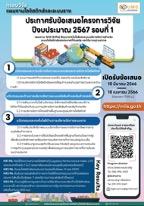
Applications for research funding are open annually, with interested individuals able to apply by the 20th of each month, followed by announcements of successful applicants every two months. The Research Administration Office disseminates information about successful applicants through departmental channels and the university’s website. Additionally, an online system called FAST TRACK is available for submitting research project proposals. Furthermore, information about research funding and upcoming national/international academic conferences organized by various units is shared through the Thammasat University Research Division’s Facebook page and the Research Administration Office of Thammasat University.

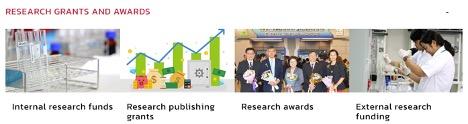
Among science disciplines, there are several research funds, grants, and awards allocated each year.

Grants:

  • Grant to support oversea research and innovation collaboration, focusing on international research collaboration
  • Funds to support research on sustainability development goals (SDGs) for Faculty of Nursing, Faculty of Public Health, and Faculty of Sciences & Technology
  • Grants to promote new researchers
  • Grants to develop research potential (Fast Track)

Research Support Awards Program:

  • Award for Supporting Academic Publication and Creative Work Dissemination – Research Article Publication Category
  • Award for Supporting Academic Publication and Creative Work Dissemination – Graduate Research Article Publication Category
  • Award for Supporting Academic Publication and Creative Work Dissemination – Academic Article Publication Category
  • Award for Supporting Academic Publication and Creative Work Dissemination – Creative Work Dissemination Award Category
  • Award for Supporting Intellectual Property Registered Works
  • Outstanding Research Work Award
  • Outstanding New Generation Researcher Award – Departmental Level
  • Outstanding Thesis Award – Thammasat University

Promoting Research Dissemination Program:

  • Support Fund for Article Translation or Language Editing
  • Sponsorship for International Academic Conference Organization
  • Grant for Showcasing Academic Works, Creative Works, and Innovative Inventions Abroad

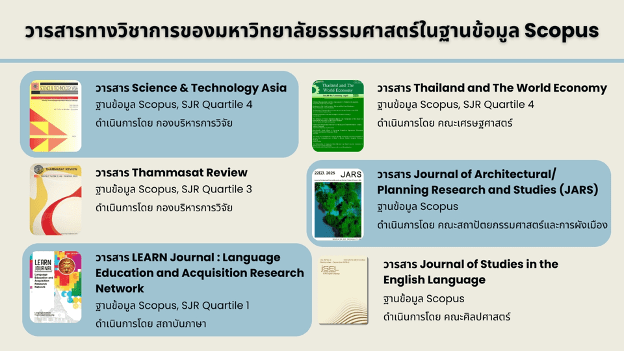
Moreover, Thammasat University is actively encouraging and disseminating the research endeavors of faculty members and staff to elevate to the international research university level. This initiative includes striving for university-level journals to be indexed in the Scopus database with a target of 5 editions and promoting them through the respective journal websites (Science & Technology Asia, Thammasat Review journals, LEARN Journal: Language Education and Acquisition Research Network, and Thailand and The World Economy).

TU-RAC (Thammasat University Research and Consultancy Institute) is an independent agency who provides services related to research management and administers research works conducted under Thammasat University.

TU-RAC promotes engagement by actively publicizing news and inviting project proposals across various domains to the research community at Thammasat University. This outreach is facilitated through online platforms such as the TU-RAC website, Facebook, Line Official, and Line research groups. Moreover, TU-RAC provides avenues for researchers to showcase their work, including the Social Research and Development Journal (JMARD) and the “NOW AND BEYOND” column by TU-RAC, published in both the Bangkok Business Newspaper and online platforms.

Additionally, TU-RAC fosters collaboration by organizing workshops where researchers collaborate to develop research topics in diverse areas. Furthermore, TU-RAC takes proactive measures by mobilizing university research teams to seek research funding, convene discussions on research development strategies, and offer research grants and consultation services through Thammasat University’s research institution (TU-RAC) on an annual basis. These initiatives are aimed at inspiring and empowering researchers in advancing their research endeavors.

Providing administrative supports to meet the needs of interdisciplinary research teams across various scientific disciplines.

The Thammasat University Research and Innovation Division employs a research coordination officer responsible for coordinating research-related activities. This role includes issuing calls for project proposals, ensuring the completeness of documents and applicant qualifications for funding, presenting proposals to the Research and Development Funding Committee for evaluation, notifying applicants of funding decisions, and monitoring research progress and funding disbursements to ensure adherence to contractual terms. The position is divided into three sub-divisions.

  1. Research Planning and Management Unit: This unit is responsible for developing research strategies, management plans, and annual budgets. Its functions include allocating and monitoring research funding, ensuring research standardization and ethics, cooperating with external funding agencies, and enhancing academic excellence through research and innovation. The unit supports interdisciplinary research through individual research grants, matching-funds, Centers of Excellence and Research Units. In 2024, Thammasat University granted supports a total of 20 Centers of Excellence across various interdisciplinary fields of research. This ecosystem for researcher collaborations has facilitated multidisciplinary and interdisciplinary approaches in research and development, human resource management and addressing social issues such as sustainability and healthcare.
  1. Research Promotion and Dissemination Unit: This unit assists researchers, faculty members, and graduate students in promoting their research, innovations, and publications. It also supports academic conferences, research training sessions, intellectual property data collection, and international research collaboration. This unit help promote the university’s interdisciplinary research through various research conventions honing research and innovations excellences and fostering collaborative research with other national research agencies.

  1. Academic Journals and Research Data Systems Unit: This unit oversees the university’s academic journals, research data systems, website, and related information outlets. By leveraging Thammasat University’s Scopus-indexed journals, the unit help promote interdisciplinary research and drives innovations.

Center of Excellence Research Eco-System for Interdisciplinary Research

With the goal of becoming a prominent Global and Frontier Research University, Thammasat University creates Centers of Excellence (CoE) as a research eco-system for researcher collaborations striving for multidisciplinary and interdisciplinary approaches in research and development, human resource management and addressing social issues. These centers are instrumental in driving research initiatives, nurturing innovation, promoting academic and research excellence. In addition, the Centers aim to establish a research hub for creating and sharing new knowledge in Thailand. They serve as collaborative spaces and research facilities where professors and researchers specializing in diverse fields come together to conduct research, develop innovations, and produce academic outputs. They also facilitate partnerships for research and innovation with government agencies, private companies, communities, civil society, and research institutions within the university, as well as with other higher education institutions both nationally and globally.

In 2024, Thammasat University granted supports a total of 23 Centers of Excellence across various interdisciplinary fields of research. Among these, the following Centers have gained national recognition and are located at Thammasat University.

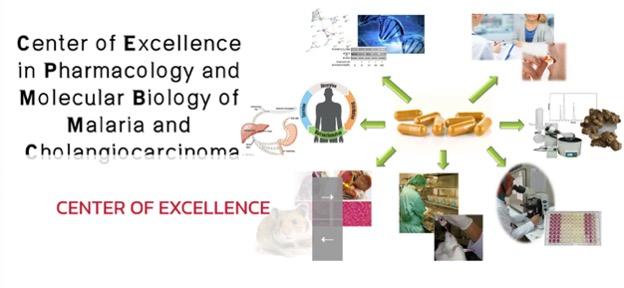
Center of Excellence in Pharmacology and Molecular Biology of Malaria and Cholangiocarcinoma

Malaria and Cholangiocarcinoma are major public health problems in Thailand. The increasing incidence of drug resistance of Malaria parasites has caused treatment problems and may result in patient mortality. Particularly, Malaria caused by Plasmodium falciparum infection can cause severe symptoms such as Cerebral malaria. The significant challenge is drug resistance of the parasite to many antimalarial drugs that are currently available (Multidrug resistance).

For Cholangiocarcinoma, although there is no incidence of drug resistance, and the parasite responds well to the standard Praziquantel treatment. However, it has been found that patients who were previously infected with human liver fluke develop Cholangiocarcinoma, which has a remarkably high mortality rate because there is no effective chemotherapy. Importantly, patients often show symptoms and seek treatment only when the disease has already progressed (Advanced stage). The center aims to conduct comprehensive research in applying knowledge of pharmacology and molecular biology to study pathology, patient factors, Malaria parasites and Cholangiocarcinoma, diagnostic methods, and pharmaceutical research to find the solution of the country’s public health problems sustainably.

Center of Excellence in Electromagnetic Energy Utilization in Engineering (CEEE)

The center is at the forefront of interdisciplinary research, operating on a multi-disciplinary and fully integrated approach. It delves into basic research using advanced mathematical modeling techniques and sophisticated numerical calculation methods developed in-house by the center. The center serves as a focal point for researchers specializing in electromagnetic energy within the realms of industrial and medical engineering applications nationwide. It stands out as a research hub with immense potential, fostering innovation, paving the way for patentable prototypes at both Pilot and Commercial scales, and making it a cornerstone in the field of electromagnetic energy in engineering.

Center of Excellence in Biomedical Engineering

The main objectives of the BioMed are to develop reliable and practical applications in the biomedical engineering, produce research papers, conduct an efficient collaborative supervision of graduate students and arrange for cooperation with other faculties of TU and other research groups and universities in the country. The unit attracts computer science experts working in the field of biomedical applications and researchers working in practical medicine to find common grounds and joint applications. The idea of this CoE is the multidisciplinary research when the computer scientists and medical experts offer their vision and contribute collaboratively. There is no discussion of what is more important: academic or application, medical experience or artificial intelligence. Every part of our joint knowledge must by combined appropriately.

Center of Excellence in Environmental Catalysis and Adsorption

The center aims to achieve excellence in research on catalysts and adsorbents across the areas of Activated Carbon, Carbon Nanotubes, Catalysts, Strong Reducing Agents, and Specialized Supercapacitors. The Center also foster collaboration in interdisciplinary research with leading research institutions in Thailand and abroad such as Computational Material Science and Catalysis (COMSCAT) Group, School of Chemistry, Suranaree University of Technology, Thailand, and Waste to Clean Energy Group, Institute of Energy and Power Engineering, Zhejiang University of Technology, China.

Center of Excellence in Creative Engineering Design and Development

The center aims to prpmote and create innovations to solve Thailand’s major problems through creative engineering design and development (Creative Engineering Design & Development, CED2). This involves integrating knowledge from various disciplines, with a particular emphasis on developing health-related innovations for underprivileged individuals in Thailand. The goal is to develop innovations that can be practically applied, generating value both commercially and in terms of public welfare. Initially, the focus will be on designing and developing health innovations for patients, people with disabilities, and the elderly. Additionally, the center aims to create pathways to commercialize these innovations, generating revenue that can be reinvested into research, thus creating a sustainable research cycle.

Thammasat University also has multiple research support units and facilities from various departments to drive towards becoming a research university. These include the Office of Advanced Science and Technology (SAT), which consists of the following facilities:

• The Center for Scientific Equipment for Advanced Research is tasked with offering scientific equipment and instrument services to specifically support interdisciplinary research, analysis/testing, and academic endeavors both within and beyond the university. This includes providing consulting, guidance, and organizing training/seminars to educate about scientific instruments.

• The Animal Laboratory Center is responsible for providing services to elevate the interdisciplinary research involving experimental animals at the university to internationally accepted standards. One of these international standards is the Association for Assessment and Accreditation of Laboratory Animal Care International (AAALAC International). The center serves as an educational, research, and training hub for basic and advanced knowledge in laboratory animal science. It provides services such as animal care for research, teaching, and bioproduct manufacturing purposes to both internal and external units of the university. Moreover, it offers consultation and ensures that users of experimental animals adhere to ethical principles in scientific research involving animals.

• Drug Research and Development Center is tasked with providing services in researching and developing new chemical substances from natural sources for the treatment of various diseases. This includes collaborative interdisciplinary research to support and facilitate researchers working in the field of medicine research and development.

• The Intellectual Property and Business Incubation Center focuses on fostering knowledge and disseminating activities related to intellectual property. It aims to stimulate and enhance research exploration, innovation development, and inventions within Thammasat University. The center oversees the university’s intellectual property to maximize its benefits, including safeguarding and preserving the university’s rights and benefits. Additionally, it nurtures entrepreneurship by assisting new entrepreneurs in establishing companies and supports the transfer of technology and beneficial knowledge to the community through clinical technology and community network science and technology initiatives.

In addition to the above facilities and support units, there are 77 research units, of which 67 research units are to promote, support, create, and disseminate science and medical innovations from interdisciplinary research. For more information on Thammasat University’s research units, please refer to this link. Thammasat University’s Research Units