HIGHLIGHTS
- Joining Forces to Create a Model Area: The Faculty of Public Health, Thammasat University, together with the Center of International Cooperation for Innovation and Safety for the Aged (CICISA), Khlong Si Subdistrict Administrative Organisation (SAO), Subdistrict Health Promoting Hospitals (SHPH), Village Health Volunteers (VHVs), and the public sector, has launched the project “Khlong Si: A Model Community for Holistic Well-being and a Safe Environment for Older Persons” to address non-communicable diseases (NCDs), dementia, and falls in an ageing society.
- Championing the “One Health” Concept: Elevating healthcare from fragmented problem-solving to integrating the health of humans, animals, the environment, and safe food systems, with the academic sector acting as a partner to harness the real potential of local residents.
- Driven by 3 Core Strategies and 5 Health Dimensions: Covering the dimensions of SAFE, BRAIN, NCD, ONE HEALTH, and FOOD SAFETY through proactive health screenings across 4 dimensions, comprehensive health promotion activities (physical, nutritional, cognitive, and mental), and the creation of age-friendly environments such as safe toilets, therapeutic stone walkways, therapeutic botanical gardens, and Brain-Based Learning (BBL) activity grounds.
- Building Sustainability through Tripartite Synergy: Operating continuously over three years (2024–2026) through collaboration among the academic sector, government and local authorities, and the public sector, while promoting a “Model Area Management Committee” formed by local residents to ensure sustainable self-care and future expansion to the provincial level.
Thailand’s transition into a “Complete Aged Society” poses significant challenges to the public health system and local authorities, stemming from the burden of non-communicable diseases (NCDs), dementia, and fall-related accidents that lead to injury, disability, and escalating medical expenses. Meanwhile, the rapid expansion of semi-urban, semi-rural communities has introduced new forms of risk regarding physical environments and safety that directly affect the quality of life of older persons.
Khlong Si: A Model Community for Holistic Well-being and a Safe Environment for Older Persons
The Khlong Si Subdistrict community in Khlong Luang District, Pathum Thani Province, is one of the areas experiencing rapid expansion, shifting people’s lifestyles from an agricultural society to an urban one. Consequently, the physical environment, dietary behaviours, and food systems within the community have also changed. Many older persons in the area face underlying health conditions such as hypertension, diabetes, and hyperlipidaemia, which are major risk factors leading to cardiovascular diseases and subsequent dementia.
The Faculty of Public Health, Thammasat University, in collaboration with the Center of International Cooperation for Innovation and Safety for the Aged (CICISA) under Thammasat University’s project for the development of excellence in higher education institutions and advanced manpower (TU-Reinventing University), “Creating an Environment and Enhancing Health Behaviours for Quality Ageing,” has joined forces with local partners—including the Khlong Si Subdistrict Administrative Organisation (SAO), Subdistrict Health Promoting Hospitals (SHPH), Village Health Volunteers (VHVs), the Senior Citizens Club, and the public sector—to launch the “Khlong Si: A Model Community for Holistic Well-being and a Safe Environment for Older Persons” project. The initiative aims to upgrade the community health system comprehensively through proactive fieldwork and the design of innovative spaces tailored to the lifestyles of older persons.
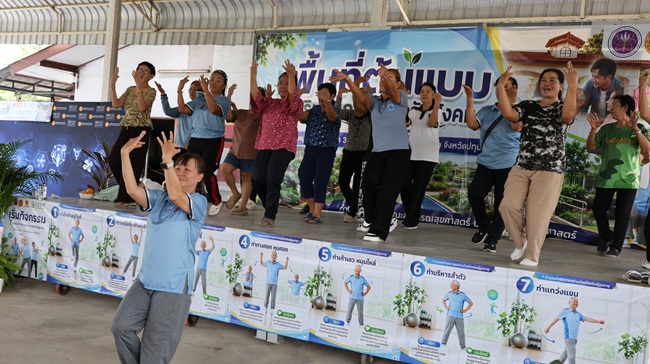
Championing the “One Health” Concept to Link Humans, Animals, the Environment, and Safe Food
A key highlight of this project is elevating public health operations from fragmented problem-solving to applying the international framework of “One Health,” promoted by the World Health Organization (WHO), which recognises the systemic interconnections among human health, animal health, the environment, and safe food systems.
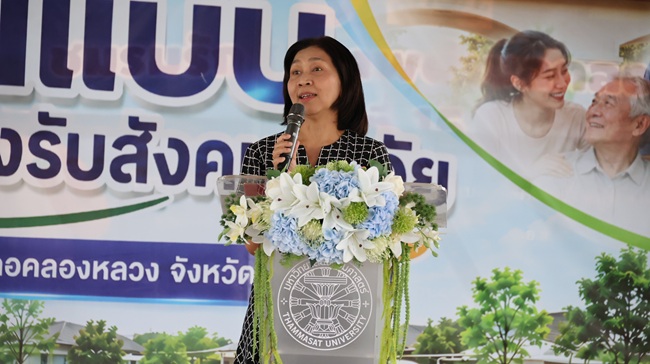
Assistant Professor Dr Soisuda Kesornthong, Dean of the Faculty of Public Health, Thammasat University, explained that the Faculty aims to apply bodies of knowledge and research to create tangible value and change in people’s daily lives. Rather than prescribing ready-made solutions for the community, the Faculty steps into the role of an “academic partner” ready to learn alongside and fully draw upon the potential of local residents.
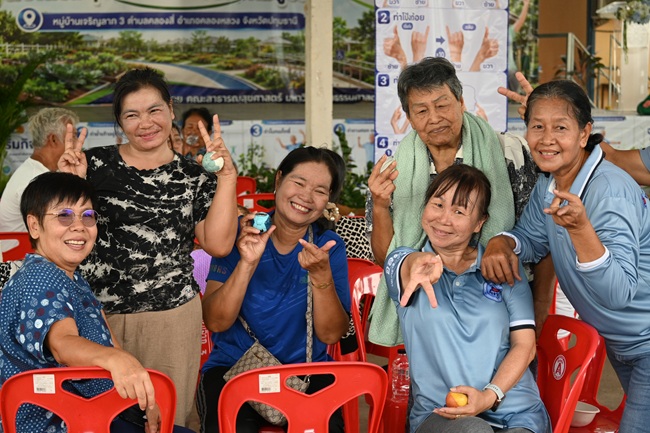
3 Core Strategies: Proactive Screening, Creating Innovative Spaces, and Organising Holistic Activities
To advance the goal of developing a 5-dimensional health system (SAFE, BRAIN, NCD, ONE HEALTH, and FOOD SAFETY), the project has established operational approaches in the area covering both healthcare and physical infrastructure development:
- Proactive Field Health Data Surveys
Collaborating with Village Health Volunteers (VHVs) to conduct body composition assessments for older persons in Khlong Si Subdistrict, alongside holistic health evaluations across all four dimensions: physical, mental, social, and cognitive. This establishes an accurate community-level health database used to design targeted, personalised care guidelines for older persons.
- Comprehensive Health Promotion Activities
- Physical Activity: Designing academic-based exercise and physical rehabilitation programmes tailored to the physical capabilities and limitations of each older person.
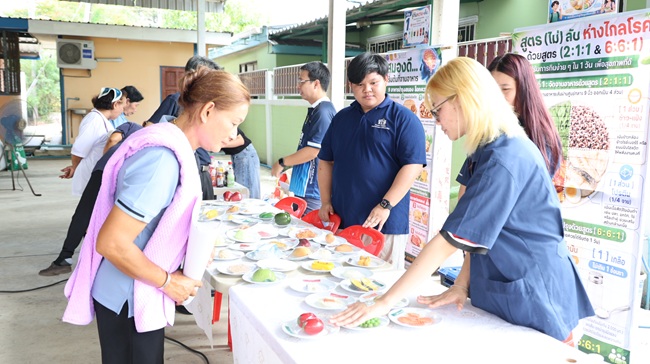
- Nutrition: Organising educational activities and demonstrations on consuming safe foods to control sugar and sodium intake, helping to reduce the risk of NCDs.
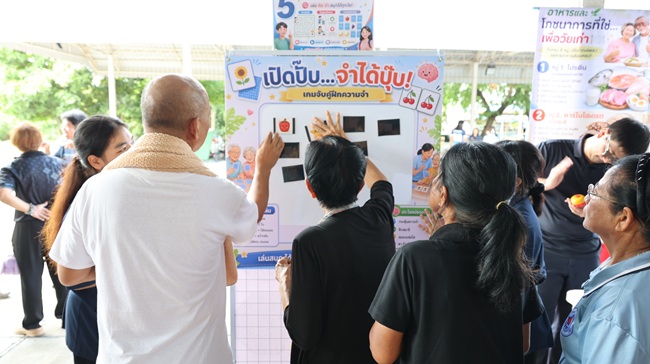
- Cognitive Stimulation: Arranging activities that promote cognitive and memory skills to prevent and delay dementia in older persons.
- Mental Health: Partnering with the “Pathum Thani Peer Support Team” (Thim Phuean Chai Pathum Thani) to organise activities that build psychological resilience, alongside screening for stress and depression to foster emotional well-being.
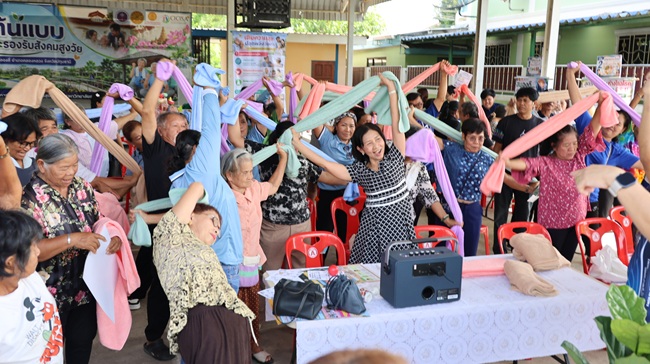
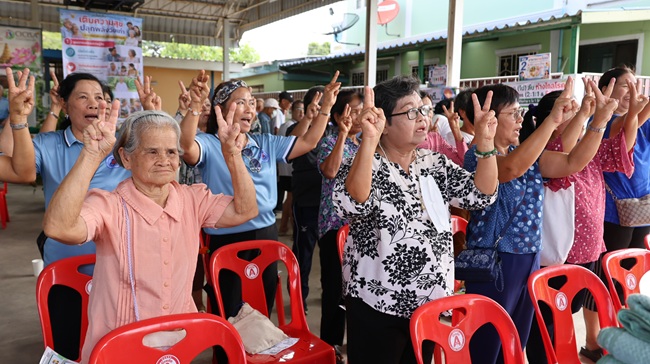
- Renovating and Creating Age-Friendly Environments
Focusing on improving the physical environment to ensure safety and promote well-being, such as renovating safe toilets in model households and public spaces; creating innovative therapeutic stone walkways for muscle exercise and stimulating blood circulation; establishing therapeutic botanical gardens (kitchen vegetable plots) for mental therapy and as a source of safe community food; and improving Brain-Based Learning (BBL) activity grounds to train cognitive and motor skills, safely accommodating shared activities for community members of all generations.
Success through “Tripartite Synergy” and Next Steps
This project reflects Thammasat University’s role as an impact-driven university of innovation, applying knowledge, research, and manpower development to tangibly address ageing society challenges through collaboration across three main sectors: the academic sector, responsible for generating knowledge, conducting research, developing innovations, and transferring technology; local administrative organisations and government agencies, responsible for policy-making, supporting resources, and driving local implementation; and the public sector, which serves as the heart of change by co-thinking, co-creating, co-learning, and taking shared ownership of development.
Throughout its three-year operation from 2024 to 2026, the project aims to reduce structural risk factors, prevent falls, and establish safe food security for the population of Khlong Si Subdistrict. It also seeks to establish a “Model Area Management Committee” comprising local residents so that care mechanisms can continue sustainably on their own, with lessons learned extracted for future expansion to the district and provincial levels.
Source: คณะสาธารณสุขศาสตร์ มธ. ผนึก อบต.คลองสี่ ชูโมเดล ‘พื้นที่ต้นแบบส่งเสริมสุขภาวะ’ รองรับสังคมสูงวัย