Data and Performance
Proportion of Students Taking Work Placements
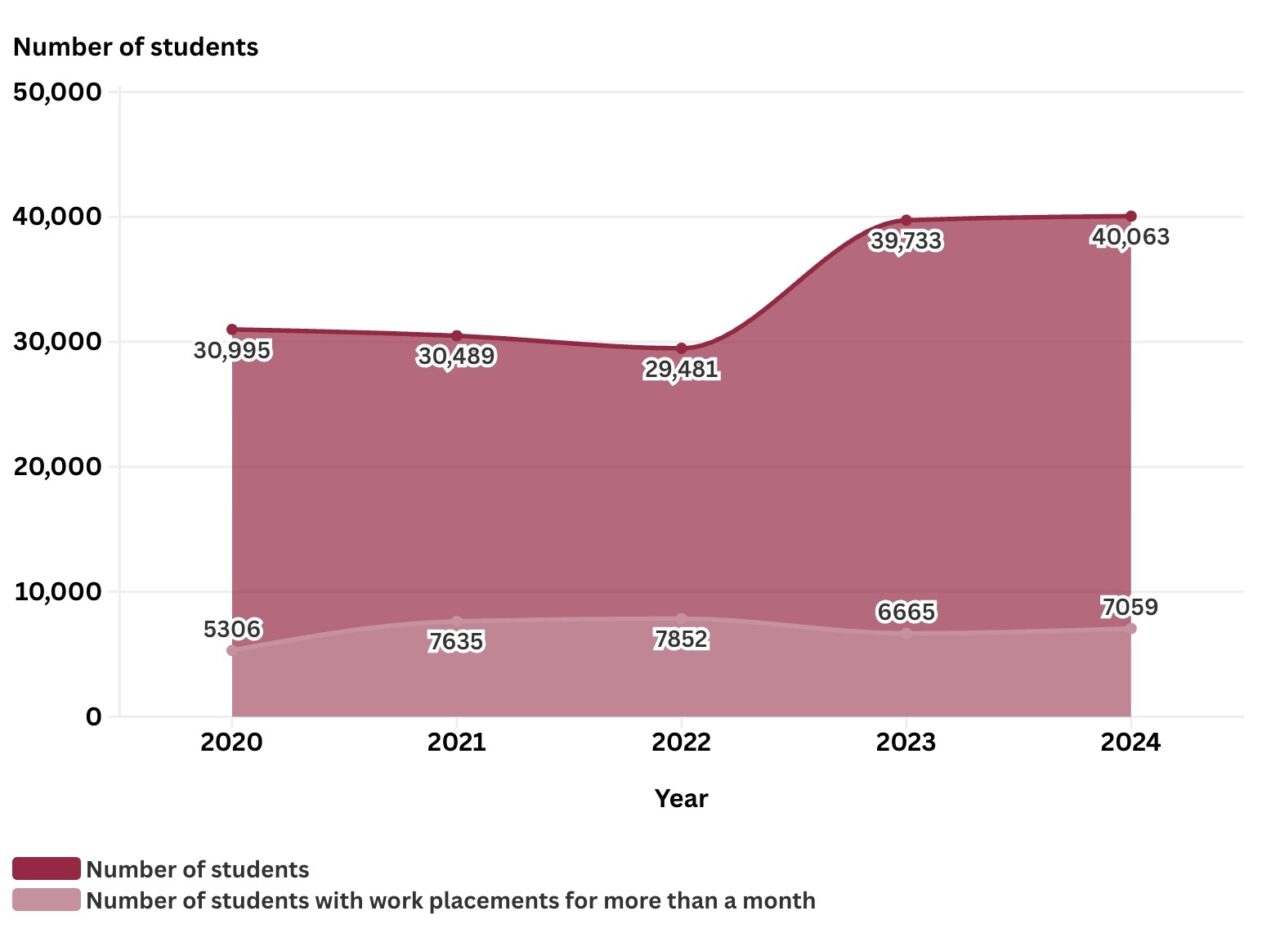
This area chart illustrates the total number of students at Thammasat University from 2020 to 2024, including those with work placements lasting more than one month. Placement participation increased from 5,306 students in 2020 to 7,635 in 2021, peaking at 7,852 in 2022. It then declined to 6,665 in 2023 before rising to 7,059 in 2024, a 5.9% increase. The proportion of students with work placements also grew in 2024, reflecting a recovery in longer-term placement participation and supporting students’ career readiness.
Proportion of Employee on Secure Contracts
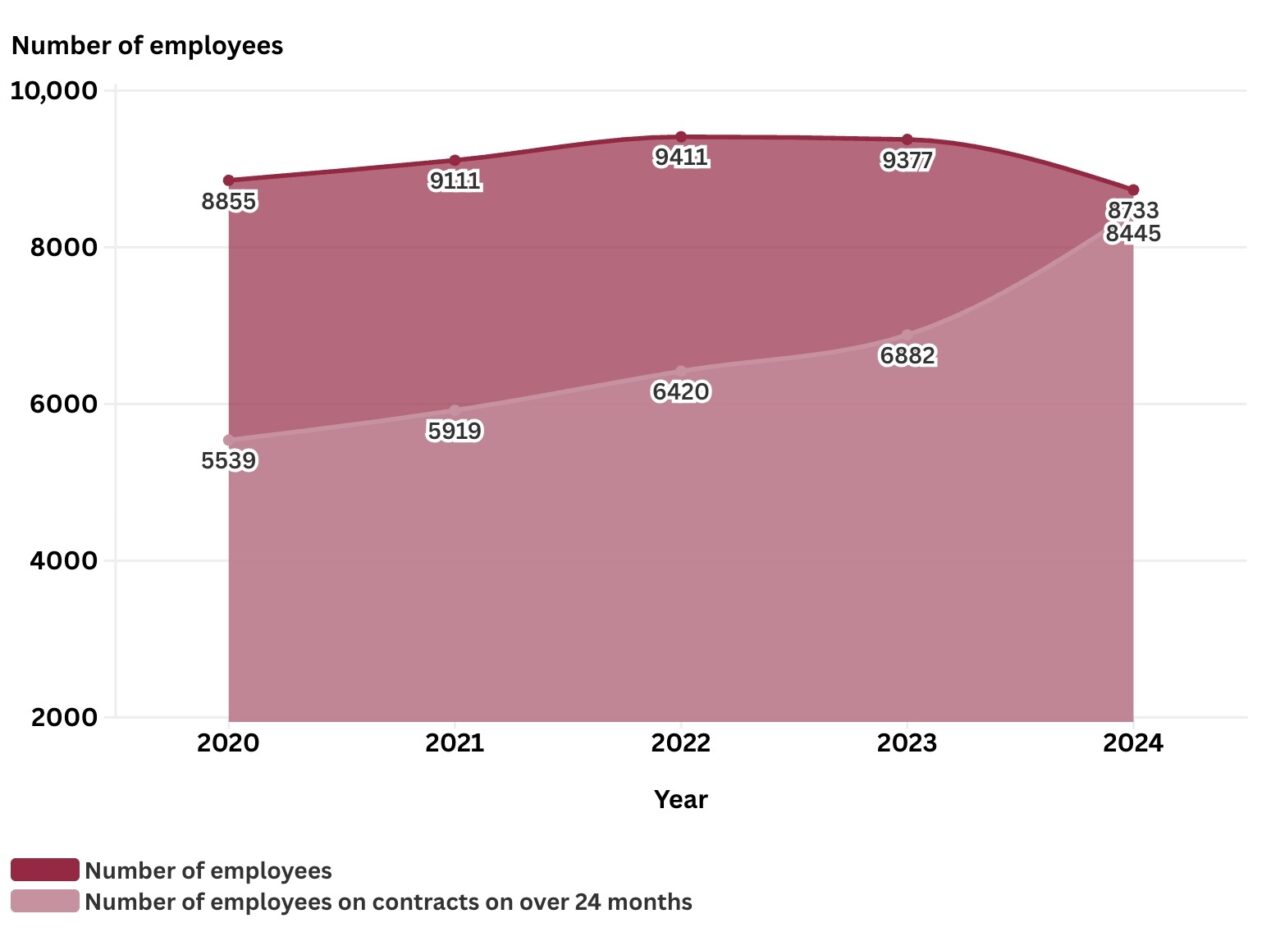
This area chart illustrates the number of employees at Thammasat University and the proportion of employees on secure contracts lasting over 24 months from 2020 to 2024. The number of employees on these contracts increased from 5,539 in 2020 to 5,919 in 2021, 6,420 in 2022, and 6,882 in 2023, reaching 8,445 in 2024. Total employment peaked at 9,411 in 2022 before declining to 8,733 in 2024. Consequently, the proportion of employees on secure contracts rose from 73.4% to 96.7%, indicating a substantial increase in longer-term arrangements.
SDG 8 Scholarly Output of Thammasat University
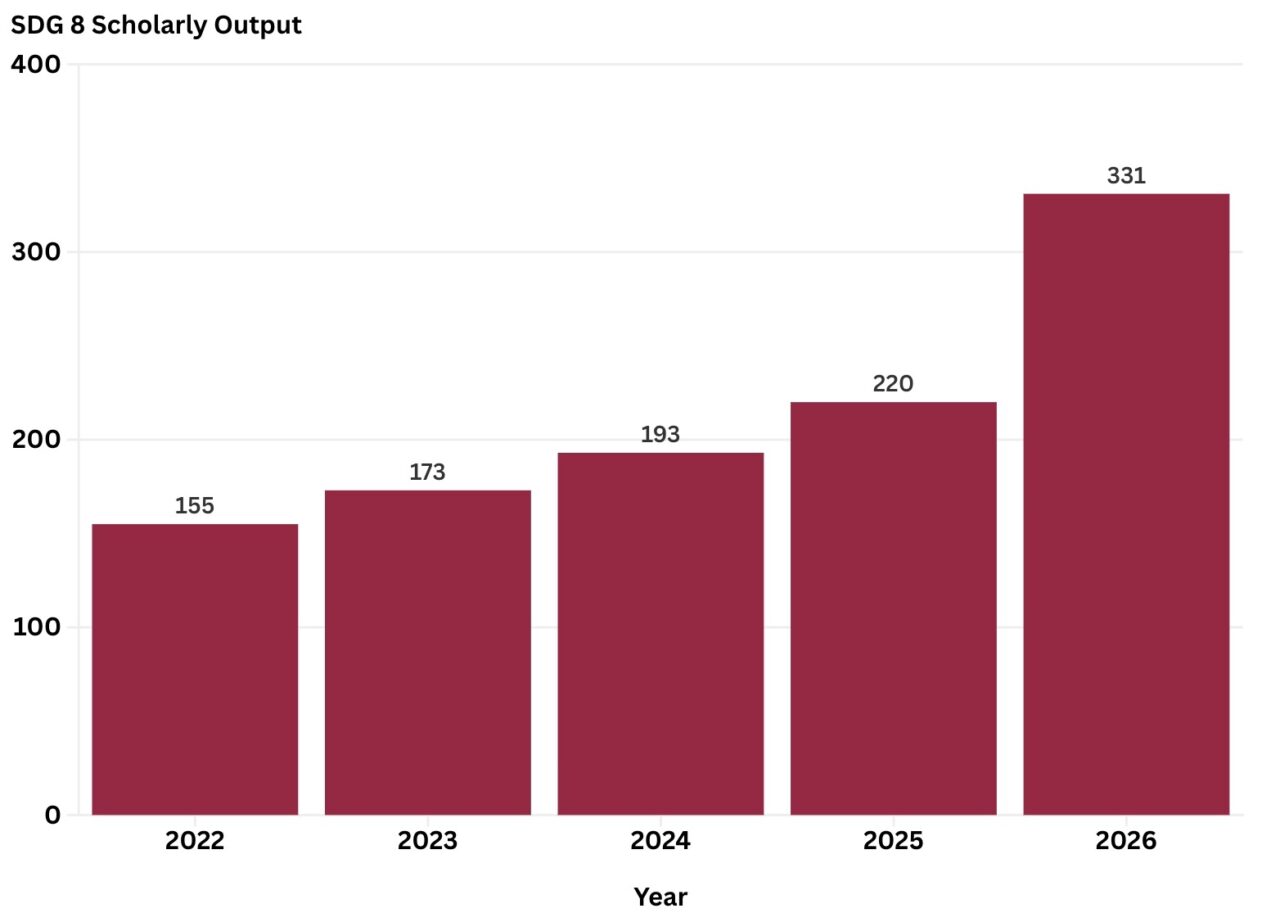
This bar chart illustrates the growth of SDG 8 scholarly output at Thammasat University from 2022 to 2026, highlighting an upward trend in research on economic growth and employment. The number of scholarly outputs increased from 155 in 2022 to 173 in 2023 and 193 in 2024, before rising to 220 in 2025. In 2026, output reached 331, representing a 50.5% increase from the previous year and the largest annual increase in the period. Overall, scholarly output grew by 113.5% from 2022 to 2026, reflecting an expanding body of research related to economic growth and employment.
Research in SDG 8
Thammasat University produced 330 publications on Sustainable Development Goal (SDG) 8: Decent Work and Economic Growth between 2021 and 2025: 33 in 2021, 44 in 2022, 54 in 2023, 61 in 2024 and 138 in 2025. A synthesis of titles and abstracts yields 9 thematic clusters:
- Resource efficiency, circular economy and waste (53; 8.4): life cycle assessment of used cooking oil and electric vehicle batteries.
- Energy transition, climate change and the economy (44; 8.4, 8.1): economy-wide effects of Thailand’s net-zero target.
- Labour markets, skills and employment (41; 8.5, 8.6, 8.8): parenthood wage penalties, green skills and platform riders.
- Economic growth, regional development and trade (40; 8.1, 8.2, 8.3): the Eastern Economic Corridor and border economic zones.
- Sustainable cities, mobility and spatial planning (38; 8.4, 8.9): suburban car dependency and transport access.
- Agriculture, food and environmental health (37; 8.2, 8.4): mycotoxins and incentives to end sugarcane burning.
- Business, finance and corporate governance (30; 8.3, 8.10): green bonds, microfinance boards and central bank digital currencies.
- Sustainable tourism, culture and the creative economy (29; 8.9): Phuket’s tourism-led urbanisation and community-based tourism.
- Occupational health, safety and worker protection (18; 8.7, 8.8): farmers’ chemical exposure, weavers’ musculoskeletal health and human trafficking.
The disciplines behind the research
Twenty-six Thammasat units contributed, spanning engineering, business, economics, architecture and planning, natural and health sciences, social sciences, law and humanities. The anchor units are:
- Sirindhorn International Institute of Technology (SIIT): 20 of 53 resource efficiency and 19 of 44 energy transition publications, and 52 publications overall, the most of any unit.
- Thammasat Business School: 14 of 41 labour market and 16 of 30 business and finance publications.
- Faculty of Architecture and Planning: 23 of 38 cities and 12 of 29 tourism publications.
- Faculty of Economics: 12 of the 40 economic growth publications.
- Faculty of Science and Technology: 18 of the 37 agriculture and food publications.
- Faculty of Public Health: 9 of the 18 occupational health publications.
The Faculty of Public Health and the Faculty of Engineering co-authored 5 publications: machine learning for waste and sanitation management (8.4) and an ergonomic device for handloom weavers (8.8).
Source: SciVal/Scopus, “Publications at Thammasat University within SDG 8: Decent Work and Economic Growth (2025)”, 2021–2025 (Scopus data last updated 20 September 2026; exported 27 September 2026).