HIGHLIGHTS
- Institutional Strategic Commitment: Under Thammasat University’s Strategic Plan No. 13 (Revised FY2025), approved by the University Council on January 24, 2025, Strategic Plan 1.1.3 explicitly mandates the revision of all undergraduate curricula to incorporate the Sustainable Development Goals (SDGs), targeting 70% of programs in 2025, 80% in 2026, and 90% by 2027.
- Universal Graduation Requirement: Operationalized through the General Education Program (B.E. 2566, approved Meeting No. 12/2565), every undergraduate student across all faculties and four regional campuses must complete at least 30 credits of interdisciplinary core study.
- Institutionalized Competency (PLO C2): Enforces an institutional learning outcome requiring all graduates to cultivate “sustainable responsibility toward oneself, surrounding individuals, society, and the environment”.
- Credit-Bearing SDG & ESG Coursework: Embeds accredited courses spanning climate resilience, circularity, social equity, and ESG governance into regular academic pathways.
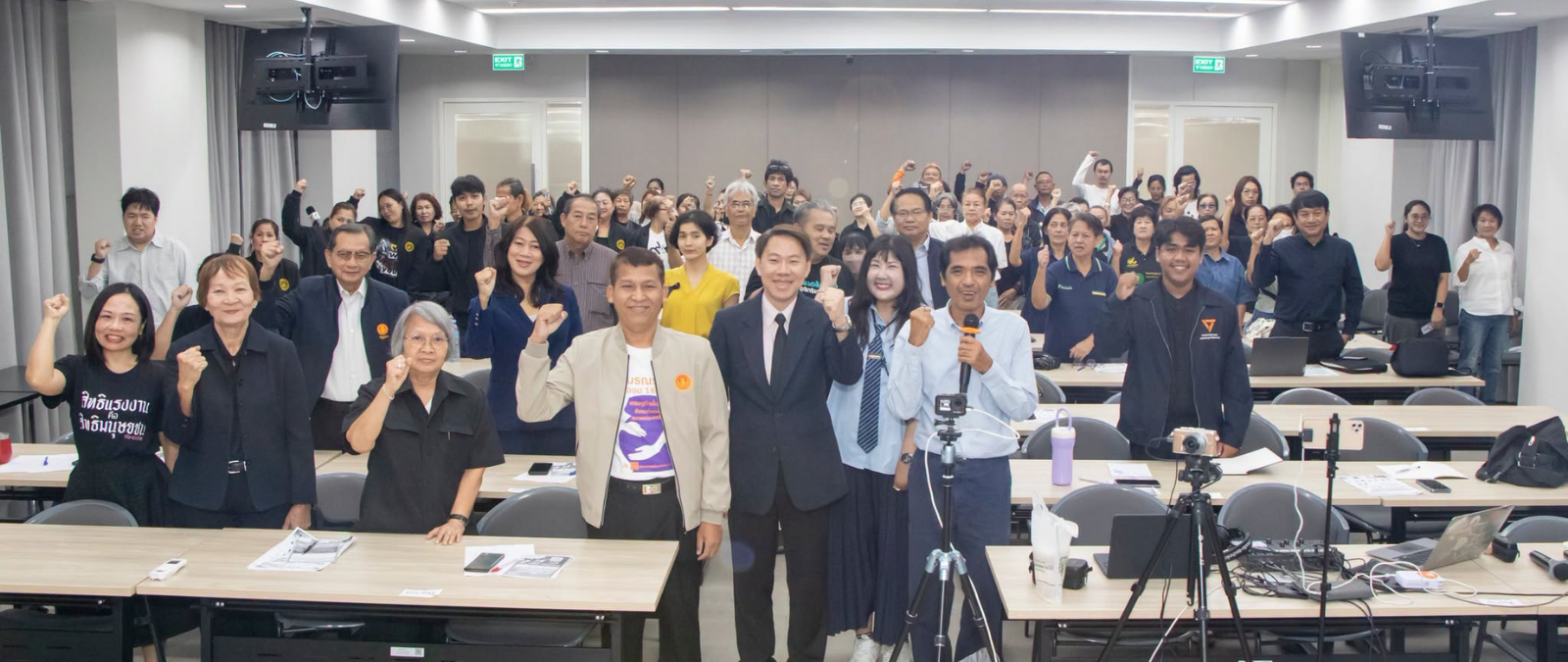
- Experiential & Civic Action: Translates classroom theory into grassroots problem-solving through problem-based learning (PBL), interdisciplinary teamwork, and community-based campaigns.
At Thammasat University, sustainability education is neither an extracurricular option nor confined to specialized environmental faculties. It is anchored in high-level institutional governance and embedded into the core academic requirements of every degree.
From Strategic Mandate to Universal Implementation
Under Thammasat University’s Strategic Plan No. 13 (Revised FY2025), ratified by the University Council on January 24, 2025 (Meeting No. 1/2568), sustainability education is formalized as an institutional priority under Strategic Work Plan 1.1.3. Jointly overseen by the Academic Affairs Division and the University SDGs Committee, Project 1.1.3.1 establishes binding milestones to embed sustainable development principles across all undergraduate programs, setting concrete targets to transition 70% of all programs in 2025, 80% in 2026, and 90% by 2027.
This top-down strategic commitment is operationalized at the foundational level through the revised General Education Program (B.E. 2566), ratified by the University Council (Meeting No. 12/2565). Administered across Tha Prachan, Rangsit, Lampang, and Pattaya campuses, the curriculum mandates that 100% of undergraduate students complete a minimum of 30 credits across five multidisciplinary clusters before graduation:
- Global Mindset and Society
- Aesthetics and Communication Skills
- Mathematics, Science, and Technology
- Well-being and Future Skills
- Civic Engagement and Experiential Learning
By making sustainability literacy a universal graduation requirement, Thammasat ensures that students in law, health sciences, engineering, business, and liberal arts alike acquire essential competencies to address 21st-century global challenges.
Embedding Sustainability in Learning Outcomes
The curriculum institutionalizes sustainable development through designated Program Learning Outcomes (PLOs). Most prominently, PLO C2 requires all graduates to cultivate “sustainable responsibility toward oneself, surrounding individuals, society, and the environment”.
Instructional designs deliberately move away from rote memorization toward problem-based learning (PBL) and project-based investigations. Through core experiential courses such as Civic Engagement (TU100) and the Multidisciplinary Service Learning Project (TU300), student teams from different faculties analyze local challenges and execute practical community-based campaigns, grounding theoretical frameworks in tangible social action.
Multidisciplinary SDG Alignment
Sustainability concepts are woven directly into accredited course syllabi across multiple fields:
- Health and Civic Action: Civic Engagement in Health Science (CMM120) requires students to conduct community health and environmental projects linked explicitly to the Sustainable Development Goals (SDGs).
- Law and Governance: Business Basics for Lawyers in Sustainable Future (LB115) trains future legal professionals in Corporate Social Responsibility (CSR) and the Environmental, Social, and Governance (ESG) framework.
- Social Equity and Policy: Reducing Social Inequality (TU241) investigates systemic disparities through United Nations sustainable development guidelines, while East Asia in the Transforming World (IEA 101) addresses regional transitions through SDG-aligned cooperation.
- Environmental and Circular Systems: Courses such as Circularity for Sustainable Development (GTS131) and Life and Sustainability (TU103) examine lifecycle thinking, closed-loop resource models, climate mitigation, and sustainable consumption.
By anchoring sustainable development within its compulsory academic architecture, Thammasat ensures that its graduates enter the workforce equipped with the ethical mindset, analytical capacity, and practical tools to build resilient communities.
Appendix: Representative General Education Courses Mapped to the SDGs
| Course Code | Course Title | Primary SDG Alignment | Key Sustainability Focus in Syllabus |
|---|---|---|---|
| CMM120 | Civic Engagement in Health Science | SDG 3, SDG 13, SDG 17 | Community health fieldwork and environmental interventions linked directly to the Sustainable Development Goals (SDGs). |
| IEA 101 | East Asia in the Transforming World | SDG 10, SDG 16, SDG 17 | Regional socio-political developments and multilateral cooperation through SDG-focused issue areas. |
| TU241 | Reducing Social Inequality | SDG 1, SDG 4, SDG 10 | Analysis of social and economic inequality with solutions aligned with United Nations sustainable development guidelines. |
| RT366 | Sustainable Development | SDG 8, SDG 12, SDG 13 | Theoretical principles of sustainable development and application alongside the Sufficiency Economy Philosophy. |
| CIS111 | Concepts and Theories on Sustainability | Integrated SDGs | Exploration of development philosophies, socio-ecological interactions, and sustainability strategies. |
| GTS131 | Circularity for Sustainable Development | SDG 12, SDG 13, SDG 15 | Circular economy business models, waste elimination, resource scarcity, and biodiversity conservation. |
| TU103 | Life and Sustainability | SDG 7, SDG 12, SDG 13 | Systems-level analysis of energy, resource consumption patterns, and sustainable lifestyle modifications. |
| LB115 | Business Basics for Lawyers in Sustainable Future | SDG 8, SDG 12, SDG 16 | Corporate social responsibility and the Environmental, Social, and Governance (ESG) framework in modern legal practice. |
| CHE106 | Sustainability of Natural Resources and Energy | SDG 7, SDG 12, SDG 13 | Ecological conservation, clean and renewable energy systems, and sustainable technological design. |
| ES329 | Environment and Energy | SDG 7, SDG 13 | Energy resource management, pollution mitigation, and national and international environmental policies. |
| BT116 | Biodiversity for Sustainable Life | SDG 14, SDG 15 | Balancing biodiversity conservation, sustainable bio-resource utilization, and international treaties. |
| TU143 | Man and Environment | SDG 12, SDG 13, SDG 15 | Natural ecosystem dynamics, climate change drivers, and environmental pollution mitigation. |
| CM296 | Hazardous Waste Management | SDG 3, SDG 12 | Campus and household waste management strategies aligned with the Bio-Circular-Green (BCG) model. |
| CM276 | Plastic Unwrapped | SDG 12, SDG 14 | Plastic waste lifecycles, polymer recycling processes, and eco-friendly material alternatives. |
| AP166 | Sustainability and Built Environmental Design | SDG 9, SDG 11, SDG 12 | Eco-efficient infrastructure, urban ecosystem management, and sustainable architecture. |
| AP164 | Economics of Built Environment | SDG 8, SDG 11 | Integrating micro/macroeconomics with design thinking for resilient, livable urban spaces. |
| RT296 | Fundamental of Landscape Design and Smart Gardening | SDG 7, SDG 11, SDG 15 | Drone and GIS surveying, automated water conservation, and solar energy in landscape design. |
| RT277 | Geospatial Visual Analytics for Actuarial Science and Risk Area Assessment | SDG 11, SDG 13 | Geospatial mapping for agricultural flood-risk modeling and hazard risk assessment. |
| GS209 | Foundations of Social Innovation and Social Entrepreneurship | SDG 8, SDG 9, SDG 10 | Multidisciplinary social enterprise frameworks addressing systemic inequality and ecological decline. |
| CIS101 | Community Capital for Economic and Social Upgrading | SDG 1, SDG 8, SDG 11 | Managing cultural and natural resources to advance grassroots economic empowerment. |
| GV200 | Introduction to Thai Rural Society and Rural Societies in ASEAN | SDG 1, SDG 2, SDG 10 | Fieldwork and comparative analysis of rural transitions and alternative development models. |
| PCD200 | Economics for Development | SDG 1, SDG 8, SDG 10 | Structural economics, income distribution, resource degradation, and equitable development policy. |
| SA240 | Gender and Sexuality in Contemporary World | SDG 5, SDG 10 | Anthropological and sociological inquiry into gender diversity, equity, and institutional inclusion. |
| CMM121 | Applied Medical Sciences and Sustainability | SDG 3, SDG 11 | Social determinants of health, population well-being, and community resilience against global environmental shifts. |
| PE240 | Volunteerism and Social Development | SDG 10, SDG 11, SDG 17 | Civic movement theory paired with hands-on social volunteer practicums in community settings. |
| TU100 | Civic Engagement | SDG 11, SDG 16, SDG 17 | Active global citizenship fostered through practical, student-led public problem-solving campaigns. |
| TU300 | Multidisciplinary Service Learning Project | SDG 11, SDG 17 | Collaborative, cross-faculty experiential projects addressing complex community issues. |