
With the goal of becoming a prominent Global and Frontier Research University, Thammasat University creates Centers of Excellence (CoE) as a research eco-system for researcher collaborations striving for multidisciplinary and interdisciplinary approaches in research and development, human resource management and addressing social issues. These centers are instrumental in driving research initiatives, nurturing innovation, promoting academic and research excellence. In addition, the Centers aim to establish a research hub for creating and sharing new knowledge in Thailand. They serve as collaborative spaces and research facilities where professors and researchers specializing in diverse fields come together to conduct research, develop innovations, and produce academic outputs. They also facilitate partnerships for research and innovation with government agencies, private companies, communities, civil society, and research institutions within the university, as well as with other higher education institutions both nationally and globally.
In 2024, Thammasat University granted supports a total of 23 Centers of Excellence across various interdisciplinary fields of research. Among these, the following Centers have gained national recognition and are located at Thammasat University.
Center of Excellence in Pharmacology and Molecular Biology of Malaria and Cholangiocarcinoma
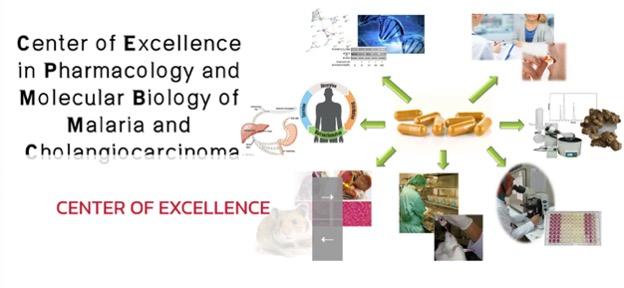
Malaria and Cholangiocarcinoma are major public health problems in Thailand. The increasing incidence of drug resistance of Malaria parasites has caused treatment problems and may result in patient mortality. Particularly, Malaria caused by Plasmodium falciparum infection can cause severe symptoms such as Cerebral malaria. The significant challenge is drug resistance of the parasite to many antimalarial drugs that are currently available (Multidrug resistance).
For Cholangiocarcinoma, although there is no incidence of drug resistance, and the parasite responds well to the standard Praziquantel treatment. However, it has been found that patients who were previously infected with human liver fluke develop Cholangiocarcinoma, which has a remarkably high mortality rate because there is no effective chemotherapy. Importantly, patients often show symptoms and seek treatment only when the disease has already progressed (Advanced stage). The center aims to conduct comprehensive research in applying knowledge of pharmacology and molecular biology to study pathology, patient factors, Malaria parasites and Cholangiocarcinoma, diagnostic methods, and pharmaceutical research to find the solution of the country’s public health problems sustainably.
Center of Excellence in Electromagnetic Energy Utilization in Engineering (CEEE)
The center is at the forefront of interdisciplinary research, operating on a multi-disciplinary and fully integrated approach. It delves into basic research using advanced mathematical modeling techniques and sophisticated numerical calculation methods developed in-house by the center. The center serves as a focal point for researchers specializing in electromagnetic energy within the realms of industrial and medical engineering applications nationwide. It stands out as a research hub with immense potential, fostering innovation, paving the way for patentable prototypes at both Pilot and Commercial scales, and making it a cornerstone in the field of electromagnetic energy in engineering.
Center of Excellence in Biomedical Engineering
The main objectives of the BioMed are to develop reliable and practical applications in the biomedical engineering, produce research papers, conduct an efficient collaborative supervision of graduate students and arrange for cooperation with other faculties of TU and other research groups and universities in the country. The unit attracts computer science experts working in the field of biomedical applications and researchers working in practical medicine to find common grounds and joint applications. The idea of this CoE is the multidisciplinary research when the computer scientists and medical experts offer their vision and contribute collaboratively. There is no discussion of what is more important: academic or application, medical experience or artificial intelligence. Every part of our joint knowledge must by combined appropriately.
Center of Excellence in Environmental Catalysis and Adsorption
The center aims to achieve excellence in research on catalysts and adsorbents across the areas of Activated Carbon, Carbon Nanotubes, Catalysts, Strong Reducing Agents, and Specialized Supercapacitors. The Center also foster collaboration in interdisciplinary research with leading research institutions in Thailand and abroad such as Computational Material Science and Catalysis (COMSCAT) Group, School of Chemistry, Suranaree University of Technology, Thailand, and Waste to Clean Energy Group, Institute of Energy and Power Engineering, Zhejiang University of Technology, China.
Center of Excellence in Creative Engineering Design and Development
The center aims to prpmote and create innovations to solve Thailand’s major problems through creative engineering design and development (Creative Engineering Design & Development, CED2). This involves integrating knowledge from various disciplines, with a particular emphasis on developing health-related innovations for underprivileged individuals in Thailand. The goal is to develop innovations that can be practically applied, generating value both commercially and in terms of public welfare. Initially, the focus will be on designing and developing health innovations for patients, people with disabilities, and the elderly. Additionally, the center aims to create pathways to commercialize these innovations, generating revenue that can be reinvested into research, thus creating a sustainable research cycle.
Thammasat University also has multiple research support units and facilities from various departments to drive towards becoming a research university. These include the Office of Advanced Science and Technology (SAT), which consists of the following facilities:
• The Center for Scientific Equipment for Advanced Research is tasked with offering scientific equipment and instrument services to specifically support interdisciplinary research, analysis/testing, and academic endeavors both within and beyond the university. This includes providing consulting, guidance, and organizing training/seminars to educate about scientific instruments.
• The Animal Laboratory Center is responsible for providing services to elevate the interdisciplinary research involving experimental animals at the university to internationally accepted standards. One of these international standards is the Association for Assessment and Accreditation of Laboratory Animal Care International (AAALAC International). The center serves as an educational, research, and training hub for basic and advanced knowledge in laboratory animal science. It provides services such as animal care for research, teaching, and bioproduct manufacturing purposes to both internal and external units of the university. Moreover, it offers consultation and ensures that users of experimental animals adhere to ethical principles in scientific research involving animals.
• Drug Research and Development Center is tasked with providing services in researching and developing new chemical substances from natural sources for the treatment of various diseases. This includes collaborative interdisciplinary research to support and facilitate researchers working in the field of medicine research and development.
• The Intellectual Property and Business Incubation Center focuses on fostering knowledge and disseminating activities related to intellectual property. It aims to stimulate and enhance research exploration, innovation development, and inventions within Thammasat University. The center oversees the university’s intellectual property to maximize its benefits, including safeguarding and preserving the university’s rights and benefits. Additionally, it nurtures entrepreneurship by assisting new entrepreneurs in establishing companies and supports the transfer of technology and beneficial knowledge to the community through clinical technology and community network science and technology initiatives.
In addition to the above facilities and support units, there are 77 research units, of which 67 research units are to promote, support, create, and disseminate science and medical innovations from interdisciplinary research. For more information on Thammasat University’s research units, please refer to this link. Thammasat University’s Research Units