Data and Performance
Measure and Set Targets for Sustainable Commuting Total Distance Traveled by Bikes Sharing (km)
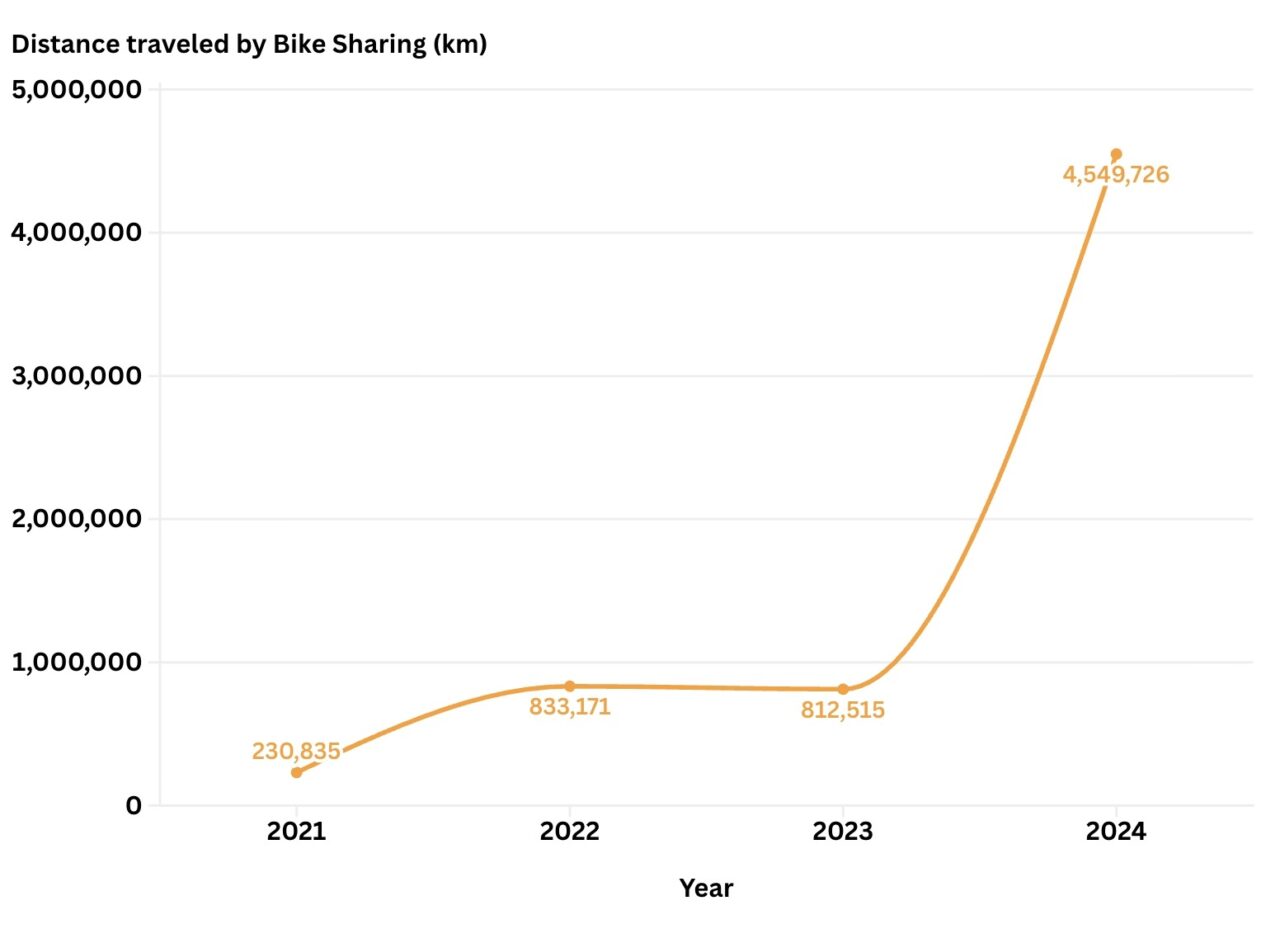
This line graph illustrates the distance traveled by electric bicycles and electric motorcycles, highlighting Thammasat University’s commitment to sustainable practices and low-carbon commuting. The distance increased from 230,835 km in 2021 to 833,171 km in 2022, before slightly declining to 812,515 km in 2023. In 2024, the figure surged to 4,549,726 km due to expanded data collection that included electric motorcycles used for transportation, including those driven by security personnel free of charge. This inclusion significantly increased recorded electric vehicle distance.
Art and Heritage Expenditure
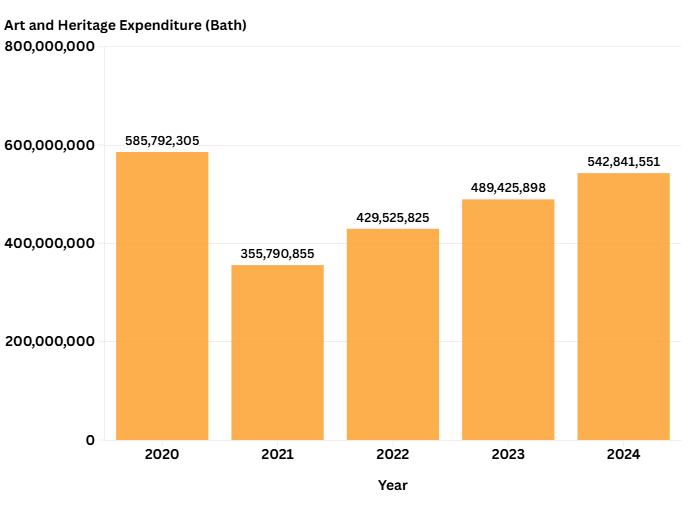
This vertical bar graph presents Thammasat University’s art and heritage expenditure from 2020 to 2024. Expenditure declined from 585.8 million baht in 2020 to 355.8 million baht in 2021, before rising to 429.5 million baht in 2022 and 489.4 million baht in 2023. In 2024, spending increased further to 542.8 million baht, approaching the 2020 level. The upward trend in recent years reflects the university’s continued financial support for arts and cultural heritage,demonstrating its commitment to preserving cultural activities.
SDG 11 Scholarly Output of Thammasat University
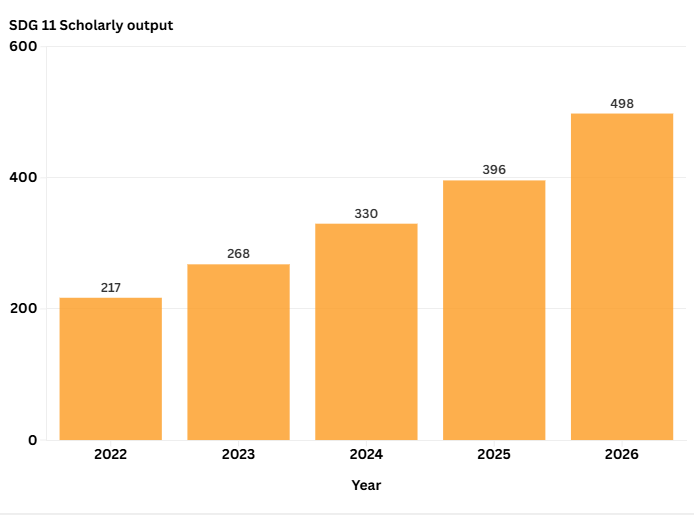
This vertical bar graph illustrates the SDG 11 Scholarly Output of Thammasat University from 2022 to 2026, focusing on research on sustainable cities and communities. The output shows a consistent upward trend, increasing from 217 in 2022 to 268 in 2023 and 330 in 2024. It continued to rise to 396 in 2025 before reaching 498 in 2026, representing a 25.8% increase compared with the previous year. This growth reflects an expanding body of research in this area.
Research in SDG 11
Thammasat University produced 498 publications mapped to Sustainable Development Goal (SDG) 11, Sustainable Cities and Communities, between 2021 and 2025. Output rose each year: 69 in 2021, 80 in 2022, 88 in 2023, 108 in 2024 and 153 in 2025. A synthesis of titles and abstracts yields eight thematic clusters:
- Urban transport, mobility and road safety (103; 11.2): road accident hotspots, transit-oriented development, and carpooling and electric vehicle adoption.
- Urban waste, wastewater and pollution control (86; 11.6): municipal solid waste and waste-to-energy options, microplastics in wastewater treatment plants, and faecal sludge management.
- Disaster risk, flooding and structural safety (85; 11.5, 11.b): flood forecasting in Bangkok, seismic hazard and building vulnerability, and evacuation planning games.
- Urban air quality, heat and low-carbon buildings (60; 11.6, 11.b): fine particulate matter (PM2.5) exposure and health, surface urban heat islands, and building envelope design for lower emissions.
- Urban planning, land use and smart cities (51; 11.3, 11.a): urban sprawl and land expansion, learning cities, and the Traffy Fondue citizen-reporting platform.
- Cultural heritage and tourism cities (41; 11.4): digital documentation of heritage sites in Ayutthaya and Sukhothai, and creative districts.
- Housing, inclusive communities and urban health (38; 11.1, 11.3): slum dwellers’ relocation and housing prices for older people.
- Green space, parks and nature-based solutions (34; 11.7): inclusive parks for people with disabilities and older people, and nature-based solutions in informal settlement upgrading.
The disciplines behind the research
Twenty-three Thammasat units contributed, spanning architecture and planning, engineering, natural sciences, health sciences, business, economics, social sciences and humanities. Each cluster has an anchor unit:
- Faculty of Architecture and Planning: 168 publications overall, the most of any unit, and the anchor of six clusters, including 29 of the 34 green space publications and 38 of the 103 transport publications.
- Faculty of Engineering: 38 of the 85 disaster risk publications.
- Faculty of Engineering and Sirindhorn International Institute of Technology (SIIT): the main contributors to the waste cluster, with 26 publications each.
The Faculty of Public Health and the Faculty of Engineering co-authored four publications on wastewater, faecal sludge and municipal waste management, serving target 11.6.
Source: SciVal/Scopus, “Publications at Thammasat University within SDG 11: Sustainable Cities and Communities (2025), 2021–2025” (Scopus data last updated 20 September 2026; exported 27 September 2026).