Data and Performance
Total Energy Used (GJ)
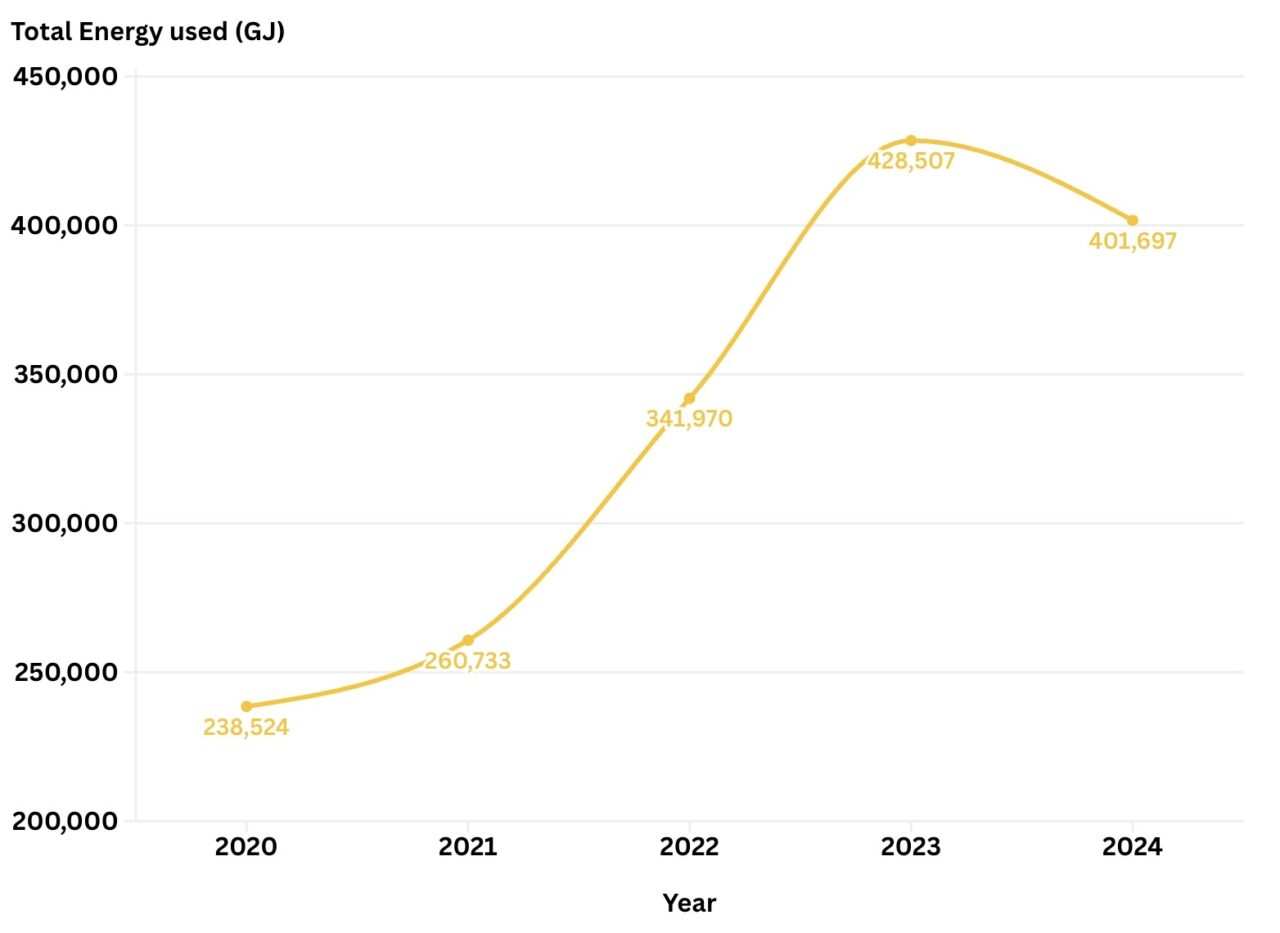
The line graph illustrates the university’s total energy used from 2020 to 2024, showing an overall upward trend followed by a recent decline. Total energy consumption increased from 238,524 GJ in 2020 to 260,733 GJ in 2021, then rose significantly to 341,970 GJ in 2022 and peaked at 428,507 GJ in 2023. In 2024, consumption decreased to 401,697 GJ, representing a 6.3% reduction compared with the previous year. This decline reflects improved energy efficiency and more effective energy management, indicating progress toward reducing the university’s overall energy consumption.
Total Energy Used from Low-Carbon Sources
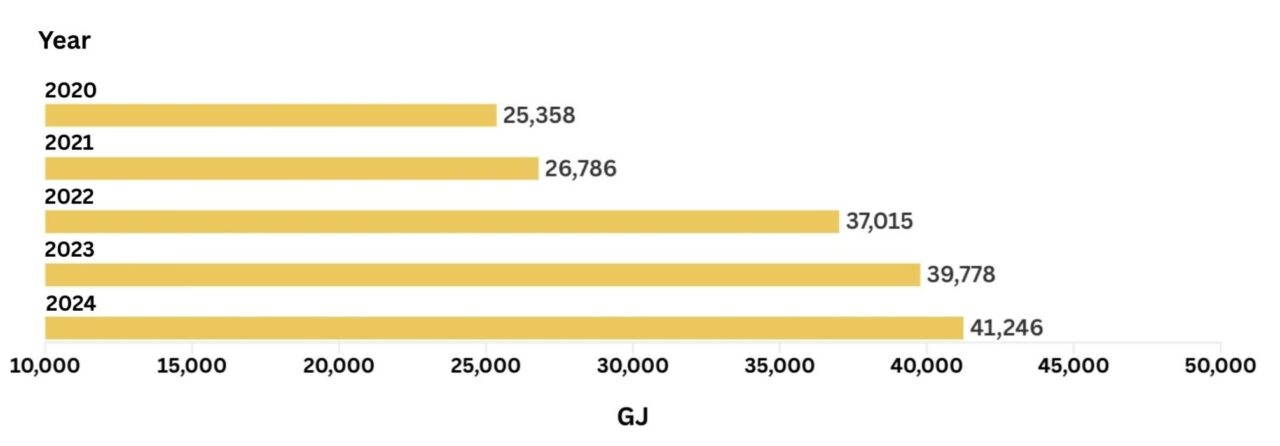
This bar chart illustrates total energy used from low-carbon sources from 2020 to 2024, showing a consistent upward trend. Low-carbon energy use increased from 25,358 GJ in 2020 to 39,778 GJ in 2023, before rising further to 41,426 GJ in 2024, representing a 4.1% increase compared with the previous year. Overall, low-carbon energy use grew by 63.4% from 2020 to 2024. This continued growth reflects the university’s increasing use of low-carbon energy sources, supporting the transition toward cleaner energy
SDG 7 Scholarly Output of Thammasat University
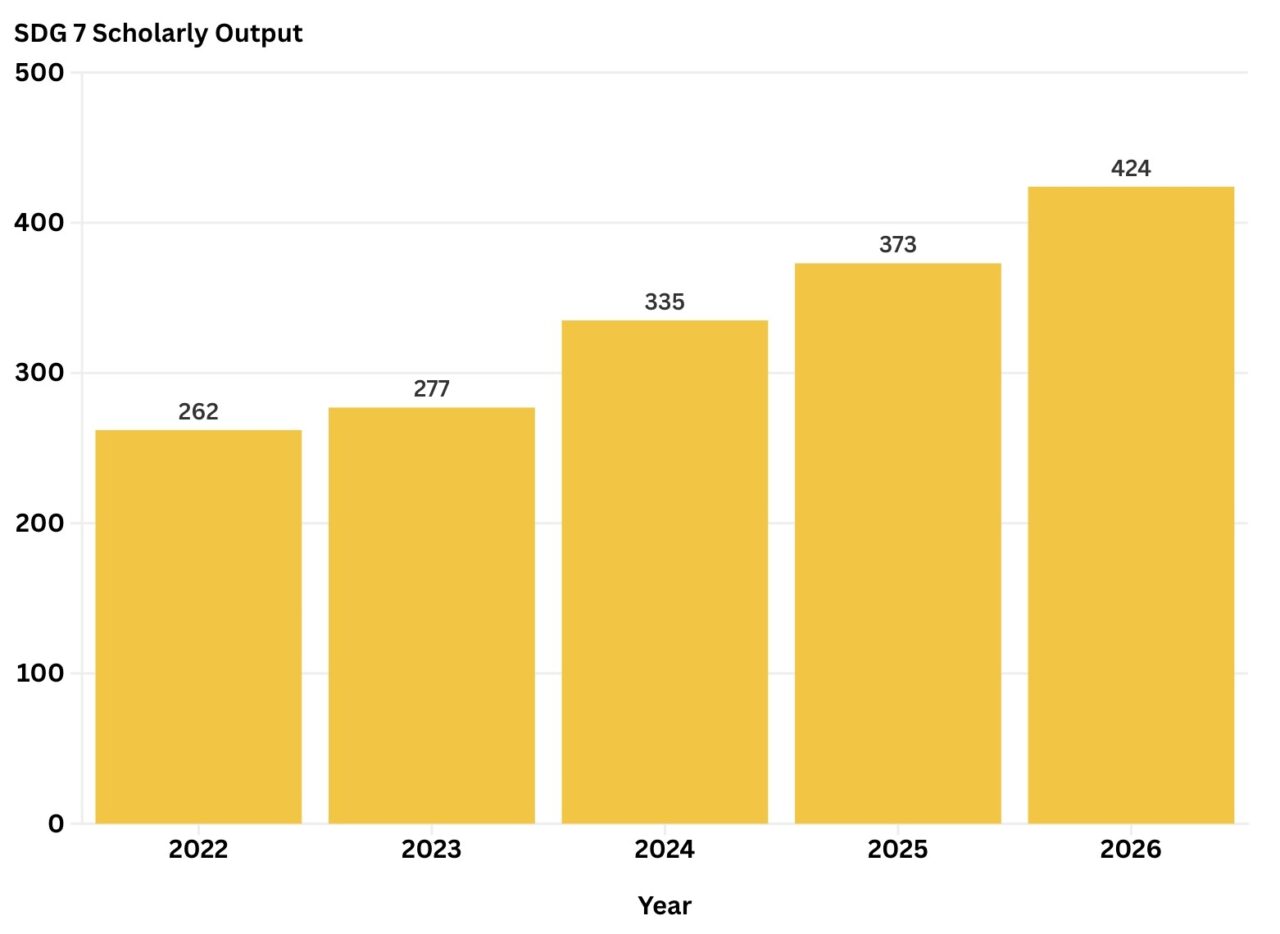
This bar chart illustrates the SDG 7 scholarly output of Thammasat University from 2022 to 2026, showing a consistent upward trend. Scholarly output increased from 262 in 2022 to 277 in 2023, then rose to 335 in 2024 and 373 in 2025. In 2026, output reached 424, representing a 13.7% increase compared with the previous year. Overall, scholarly output grew by 61.8% from 2022 to 2026. This sustained growth indicates an expanding body of academic research on clean energy, contributing to knowledge development and supporting the objectives of SDG 7.
Research in SDG 7
Thammasat University produced 424 publications on Sustainable Development Goal (SDG) 7, Affordable and Clean Energy, between 2021 and 2025: 60 in 2021, 62 in 2022, 101 in 2023, 88 in 2024 and 113 in 2025. A synthesis of titles and abstracts yields 8 thematic clusters:
- Bioenergy, biofuels and waste-to-energy (88; 7.2): catalytic pyrolysis of crop residues, waste-oil biodiesel and hydrochar from faecal sludge.
- Other studies mapped to SDG 7 by keywords (69): indirect links, such as fire-resistant concrete.
- Power systems, smart grids and electric mobility (48; 7.1, 7.2, 7.b): grid scheduling with renewables, vehicle-to-grid school buses and charging station siting.
- Energy transition, decarbonisation policy and economics (47; 7.2, 7.3, 7.a): Thai net-zero pathways, biofuel subsidy reform and household willingness to pay for renewables.
- Batteries, supercapacitors and energy storage (46; 7.2, 7.b): lithium-metal battery electrolytes, battery cooling and oil-palm-leaf supercapacitors.
- Energy efficiency in buildings, industry and cities (44; 7.3): net-zero energy offices, kinetic façades and power plant boilers.
- Hydrogen, fuel cells and electrocatalysis (42; 7.2, 7.a): microbial fuel cells treating wastewater and hydrogen evolution catalysts.
- Solar and other renewable generation technologies (40; 7.1, 7.2): dye-sensitised and perovskite solar cells, floating solar and a low-cost rural solar tracker.
The disciplines behind the research
Eighteen Thammasat units contributed, mainly in engineering and the natural sciences, with architecture and planning, business, economics, political science and health sciences. The anchor units are:
- Sirindhorn International Institute of Technology (SIIT): 26 of the 48 power systems, 26 of the 47 energy transition and 26 of the 42 hydrogen publications, and 141 publications overall, the most of any unit.
- Faculty of Engineering: 23 of the 44 energy efficiency publications.
- Faculty of Science and Technology: 21 of the 46 energy storage publications.
- Faculty of Engineering and Faculty of Science and Technology: the main contributors to the bioenergy cluster, with 41 and 37 of 88.
- Faculty of Science and Technology, Faculty of Engineering and SIIT: the main contributors to the solar cluster, with 14, 12 and 11 of 40.
SIIT and the Faculty of Economics co-authored 2 general equilibrium studies on reallocating Thailand’s biofuel subsidies, serving target 7.2.
Source: SciVal/Scopus, “Publications at Thammasat University within SDG 7: Affordable and Clean Energy (2025)”, 2021–2025 (Scopus data last updated 20 September 2026; exported 27 September 2026).