Data and Performance
Percentage of Female Senior to Total Senior Academic
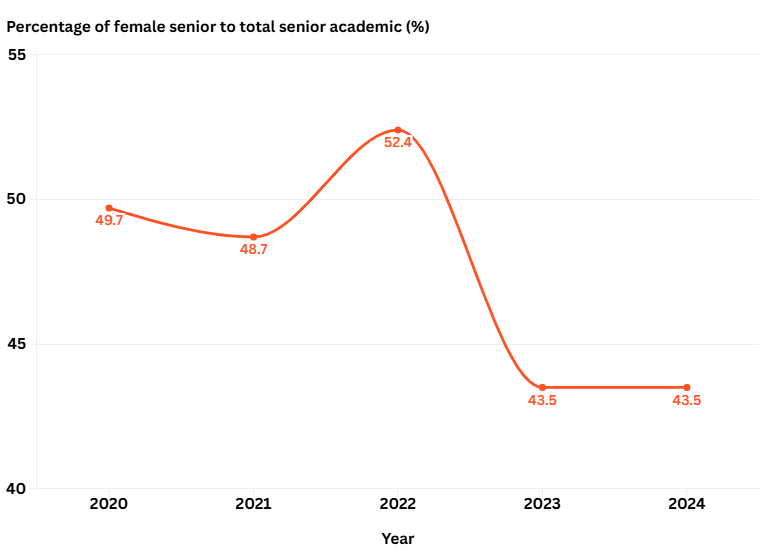
The line graph presents the percentage of female senior academic staff in relation to total senior academic staff from 2020 to 2024. The percentage decreased slightly from 49.7% in 2020 to 48.7% in 2021, before rising to 52.4% in 2023. It then declined to 43.5% in 2023 and increased slightly to 44.0% in 2024, indicating a modest recovery in the representation of female senior academic staff.
Total Number of Female Graduates by Subject Area (STEM, Medicine, Arts & Humanities / Social Sciences)
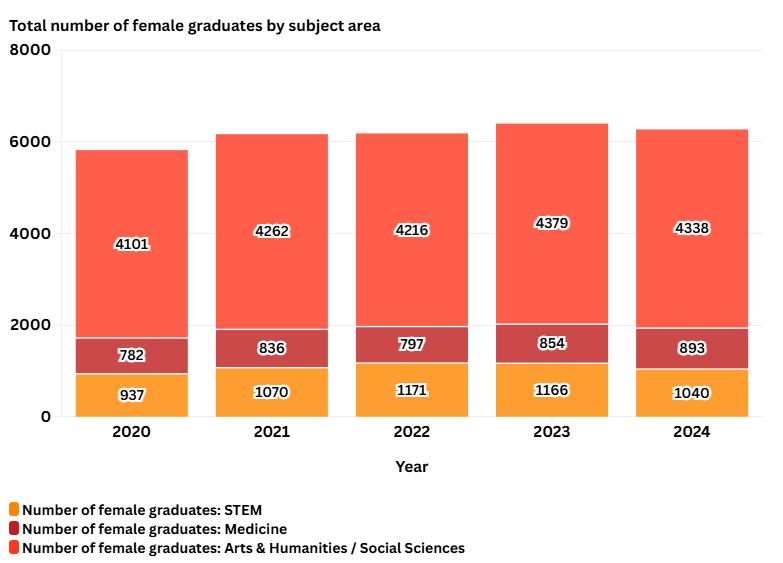
The stacked bar chart presents the number of female graduates by subject area from 2020 to 2024, providing insights into the proportion of female degrees awarded across different disciplines. The total number of female graduates increased from 5,820 in 2020 to 6,399 in 2023, before declining slightly to 6,271 in 2024. Arts, Humanities, and Social Sciences consistently recorded the highest numbers, while Medicine showed an overall upward trend from 782 to 893. STEM graduates fluctuated, peaking at 1,171 in 2022. This distribution highlights differences in women’s academic representation.
SDG 5 Scholarly Output of Thammasat University
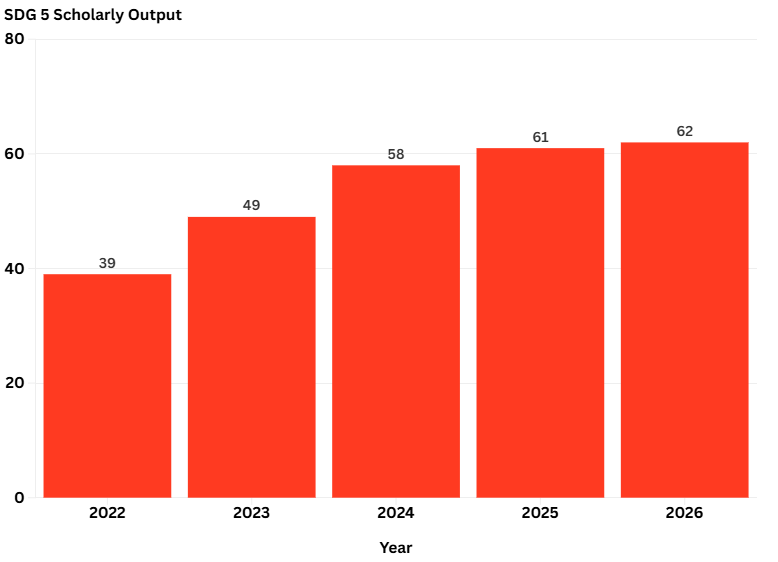
The bar chart illustrates Thammasat University’s gender equality research output, measured by the number of publications from 2022 to 2026. Publications increased steadily from 39 in 2022 to 62 in 2026. Growth continued each year, rising to 49 in 2023, 58 in 2024, and 61 in 2025, before reaching its highest level in 2026. This consistent upward trend reflects the university’s growing research output and sustained contribution to gender equality scholarship, supporting the advancement of SDG 5.
Research in SDG 5
Between 2021 and 2025, Thammasat University produced 62 publications mapped to Sustainable Development Goal (SDG) 5: Gender Equality. Annual output was 6 in 2021, 14 in 2022, 16 in 2023, 9 in 2024 and 17 in 2025. A synthesis of titles and abstracts yields six thematic clusters:
- Sexual and reproductive health (17; 5.6): adolescent pregnancy prevention among Thai Muslim girls, reproductive health access for Myanmar migrant women, and HIV pre-exposure prophylaxis for men who have sex with men and transgender women.
- Women’s work, wages and livelihoods (12; 5.4, 5.5, 5.a, 5.b): the parenthood penalty and occupational feminisation in Thai wages, women in organic farming, and Thai women in online marketplaces.
- Gender norms in language, media and history (10; 5.1, 5.c): femininity discourse on girls’ school websites, women’s rights in nineteenth-century Siam, and gender bias in AI-generated narratives.
- Gender diversity in corporate and professional leadership (9; 5.5): board gender diversity and executive conduct, workplace welfare of lesbian, gay, bisexual and transgender (LGBT) employees, and gender parity in medical leadership.
- Gender-based violence, harassment and trafficking (7; 5.2): sexual harassment on urban public transport, domestic violence in Bangladesh, and trafficking of Thai women to Europe.
- Sexual and gender diversity and inclusion (7; 5.1): bullying linked to sexual orientation and gender identity in Thai schools, drag queens’ experiences, and LGBT representation in political news.
The disciplines behind the research
Seventeen Thammasat units contributed, spanning health sciences, business, economics, social sciences, humanities, education and engineering. The anchor units are:
- Faculty of Nursing: 5 of the 17 reproductive health publications.
- Faculty of Liberal Arts: 7 of the 10 gender norms publications, and 11 publications overall, the most of any unit.
- Thammasat Business School: 7 of the 9 leadership publications.
- Faculty of Economics and School of Global Studies: the main contributors to the work and livelihoods cluster, with 3 publications each.
- Faculty of Learning Sciences and Education: 3 of the 7 inclusion publications.
The Faculty of Medicine and the Faculty of Learning Sciences and Education jointly examined three decades of gender parity in Thai rheumatology training and leadership, serving target 5.5.
Source: SciVal/Scopus, “Publications at Thammasat University within SDG 5: Gender Equality (2025)”, 2021–2025 (Scopus data last updated 20 September 2026; exported 27 September 2026).