Data and Performance
Number of Graduates in Agriculture and Aquaculture Including Sustainability Aspects
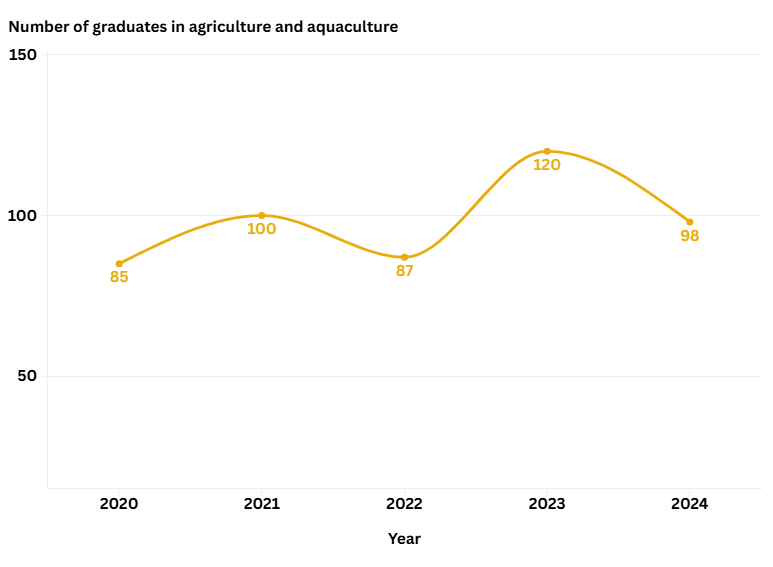
This line chart presents the proportion of graduates in agriculture and aquaculture from 2020 to 2024, based on the number of graduates from agriculture and aquaculture courses including sustainability aspects. The number of graduates increased from 85 in 2020 to 120 in 2023, before decreasing to 98 in 2024. Despite this recent decrease, the number of graduates remains higher than in 2020, indicating continued participation in agriculture and aquaculture courses including sustainability aspects.
SDG 2 Scholarly Output of Thammasat University
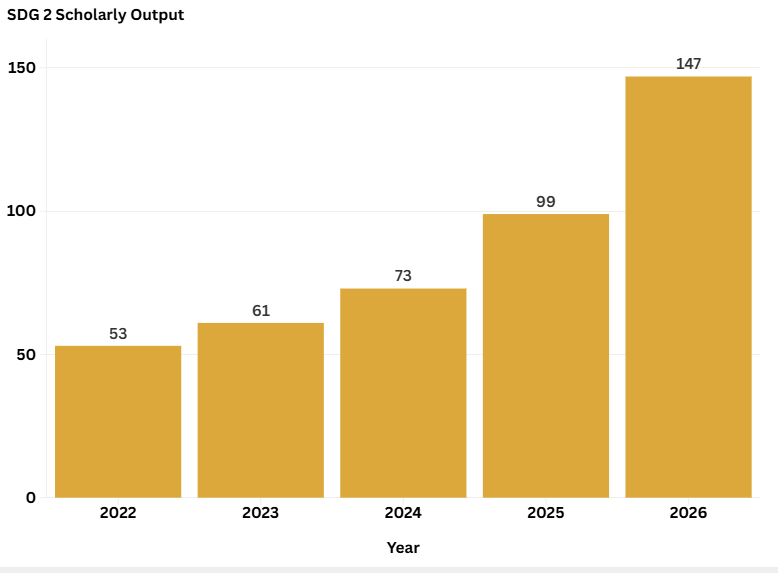
The chart presents Thammasat University’s research publications related to Zero Hunger from 2022 to 2026. The number of publications increased to 99 in 2025 and continued to rise to 147 in 2026, representing an increase of approximately 48.5% compared with the previous year. This growth reflects an expansion in research output addressing hunger, food security, sustainable agriculture, and related issues.
Research in SDG 2
Thammasat University published 147 works on Sustainable Development Goal (SDG) 2: Zero Hunger in 2021–2025, rising from 15 in 2021 to 16 in 2022, 24 in 2023, 36 in 2024 and 56 in 2025. A synthesis of titles and abstracts yields eight thematic clusters:
- Crop, livestock and aquaculture production and plant health (31; 2.3, 2.4, 2.5): biological control of rice blast, nutrient management for cassava, shrimp breeding lines.
- Agricultural residues, water and carbon management (21; 2.4): rice straw for carbon reduction, fuels from food waste, carbon stocks in rubber plantations.
- Climate change, disasters and resilient agriculture (20; 2.4): climate effects on farm output, coastal vulnerability, paddy field burning.
- Agri-food value chains, markets and technology adoption (17; 2.3, 2.a, 2.c): smart farming adoption, rice export competitiveness, rubber price forecasting.
- Malnutrition, food insecurity and clinical nutrition (16; 2.1, 2.2): malnutrition among older adults and patients; income insecurity.
- Smallholder livelihoods, land and rural communities (16; 2.3): women in organic farming, Geographical Indication (GI) products, land redistribution.
- Food safety, mycotoxins and agrochemical risks (16; 2.1, 2.4): mycotoxins in feed and fermented foods, pesticide exposure and residues.
- Digital agriculture and remote sensing (10; 2.4, 2.a): unmanned aerial vehicle (UAV) imaging of rice disease and oil palm condition.
The disciplines behind the research
Twenty Thammasat units contributed, spanning natural sciences, engineering, health sciences, economics and business, social sciences, humanities, and architecture and planning. The anchor units are:
- Faculty of Science and Technology: 24 of the 31 production publications, 9 of the 16 food safety publications, and 49 publications overall, the most of any unit
- Faculty of Medicine: 8 of the 16 nutrition publications
- Faculty of Public Health: 6 of the 20 climate publications
- Thammasat Business School: 6 of the 17 value chain publications
- Sirindhorn International Institute of Technology (SIIT): 5 of the 10 digital agriculture publications
- Faculty of Science and Technology and Faculty of Liberal Arts: the main contributors to the smallholder cluster
In 2025, SIIT and the Faculty of Liberal Arts combined UAV imaging with deep learning to detect bacterial leaf blight in rice, serving target 2.4 on sustainable food production.
Source: SciVal/Scopus, “Publications at Thammasat University within SDG 2: Zero Hunger (2025)”, 2021–2025 (Scopus data last updated 20 September 2026; exported 27 September 2026).