Data and Performance
Percentage of Students Receiving Financial Aid to Attend University Because of Poverty
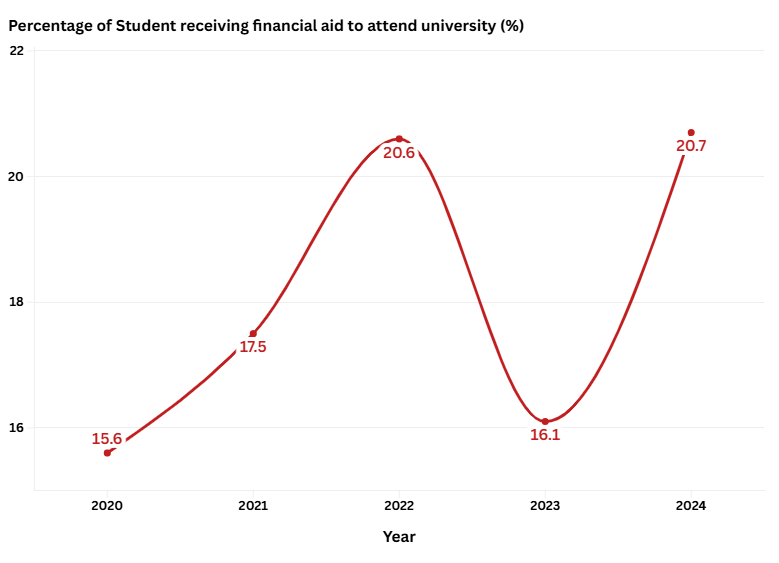
This line graph illustrates the percentage of students receiving financial aid to attend university because of poverty at Thammasat University from the 2020 to the 2024 academic year. The percentage fluctuated over the period, increasing from 15.6% in 2020 to a peak of 20.6% in 2022. It then declined to 16.1% in 2023 before rising again to 20.7% in 2024. This increase may reflect continued financial pressures among students and their families, including rising living and education costs and persistent household financial burdens, despite the broader post-pandemic economic recovery.
Number of Students Receiving Financial Aid to Attend University Because of Poverty
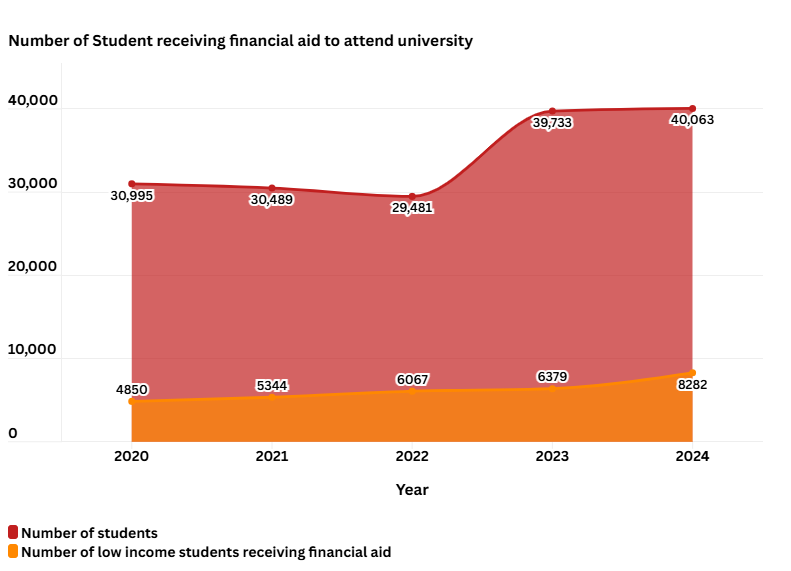
This chart illustrates the proportion of students receiving financial aid to attend university because of poverty by comparing the total enrollment with low-income aid recipients from 2020 to 2024. The number of low-income students receiving financial aid grew steadily from 4,850 to 8,282. Meanwhile, total enrollment remained relatively stable before surging to 39,733 in 2023 and 40,063 in 2024. This continuous rise in aid recipients indicates that the university has expanded its assistance to address students’ growing financial needs.
SDG 1 Scholarly Output of Thammasat University
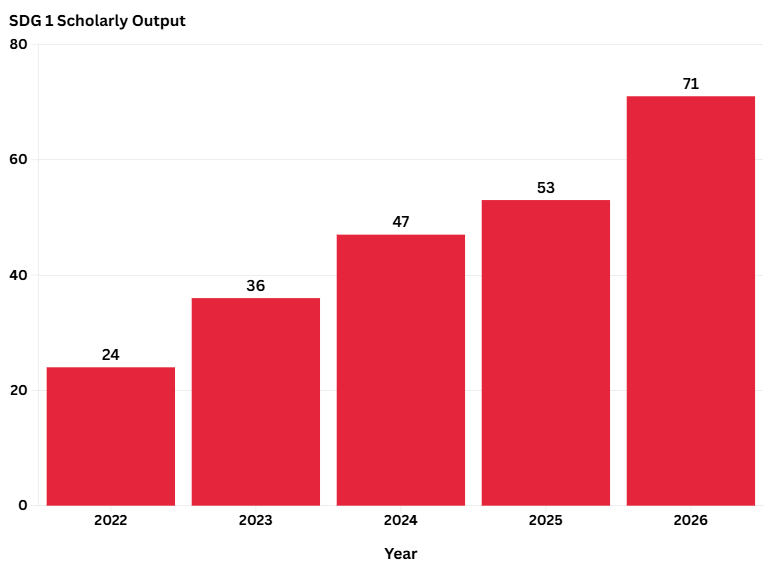
This bar chart highlights Thammasat University’s growing scholarly contribution to no poverty from 2022 to 2026. The number of publications related to this topic increased consistently from 24 publications in 2022 to 71 publications in 2026. This upward trend demonstrates the university’s strengthening academic engagement and continued commitment to addressing poverty as a critical global challenge.
Research in SDG 1
From 2021 to 2025, Thammasat University published 71 works mapped to Sustainable Development Goal (SDG) 1: No Poverty. Output was 7 in 2021, 13 in 2022, 14 in 2023, 11 in 2024 and 26 in 2025. A synthesis of titles and abstracts yields 8 thematic clusters:
- Health care access and financial protection (16; 1.3, 1.4): impoverishing health spending in Cambodia, dental service inequality under Thailand’s Universal Coverage Scheme, and migrant workers’ access to care.
- Financial inclusion, livelihoods and inclusive value chains (12; 1.4, 1.b): microfinance governance, machine-learning credit scoring, and household income from Geographical Indication (GI) products.
- Climate change, disasters and vulnerability (11; 1.5): coastal vulnerability in Nakhon Si Thammarat and Krabi, and satellite-based flood risk analysis.
- Inequality, income distribution and labour markets (9; 1.2, 1.4): land rent and redistribution, returns to skills and regional income inequality.
- Social protection and vulnerable workers (9; 1.3, 1.b): informal workers during COVID-19, older workers and the State Welfare Card.
- Skills, human resource management and responsible business (5; 1.b): green skills and sustainable human resource management in Thai firms.
- Transport access and other keyword-mapped topics (5; 1.4): paratransit for people with disabilities and ride-hailing services.
- Poverty measurement and mapping (4; 1.2): machine-learning poverty mapping and the Years of Good Life well-being indicator.
The disciplines behind the research
Twenty Thammasat units contributed, spanning economics, business, social administration, health sciences, engineering, the humanities, law and the arts. The anchor units are:
- Faculty of Economics: 8 of the 9 inequality publications and 14 overall, the most of any unit.
- Faculty of Social Administration: 6 of the 9 social protection publications.
- Thammasat Business School: all 5 skills and human resource management publications, and 4 of the 12 financial inclusion publications.
- Sirindhorn International Institute of Technology (SIIT) and the Faculty of Public Health: the main contributors to the climate cluster, 3 of 11 each.
- Faculty of Economics and Faculty of Pharmacy: the main contributors to the health cluster, 4 and 3 of 16.
Cross-unit work is rare: only 1 of 71 publications combines two Thammasat units, SIIT and the Faculty of Science and Technology, on low-cost water quality testing.
Source: SciVal/Scopus, “Publications at Thammasat University within SDG 1: No Poverty (2025)”, 2021–2025 (Scopus data last updated 20 September 2026; exported 27 September 2026).