HIGHLIGHTS
- Universities must evolve from isolated operations to Collective Impact ecosystems: The seminar highlighted that sustainability in higher education requires breaking down silos and integrating knowledge, resources, and values to generate meaningful, scalable transformation aligned with the SDGs.
- Leadership, shared values, and curriculum reform form the backbone of change: Speakers emphasised the importance of strong institutional leadership, intrinsically motivated teams, and Gen Ed curriculum redesign to cultivate a sustainability mindset and empower students to solve real-world problems.
- Community partnership over project extraction: Universities are encouraged to shift from short-term, top-down interventions to long-term “living lab” relationships that listen to community needs, reduce community fatigue, and co-create sustainable solutions.
- Network synergy and common agendas amplify national-level impact: Collaborative university networks — aligned through shared missions such as Education for Sustainable Development and youth engagement platforms — can create greater social impact than institutions working alone.
Driving the Sustainable Development Goals (SDGs) has become a mission that tests the readiness and maturity of higher education institutions around the world. In the past, university operations were often fragmented — faculties, departments, and research centres working independently, each driven by its own KPIs and priorities. While such efforts created localised benefits, they rarely translated into systemic change.
Today, however, the global climate, social inequality, environmental crises, and structural vulnerabilities confronting society demand a different approach. Universities can no longer operate as isolated units; they must evolve into interconnected ecosystems capable of generating Collective Impact — a collaborative force that integrates knowledge, resources, and values to produce meaningful, scalable, and sustainable transformation.
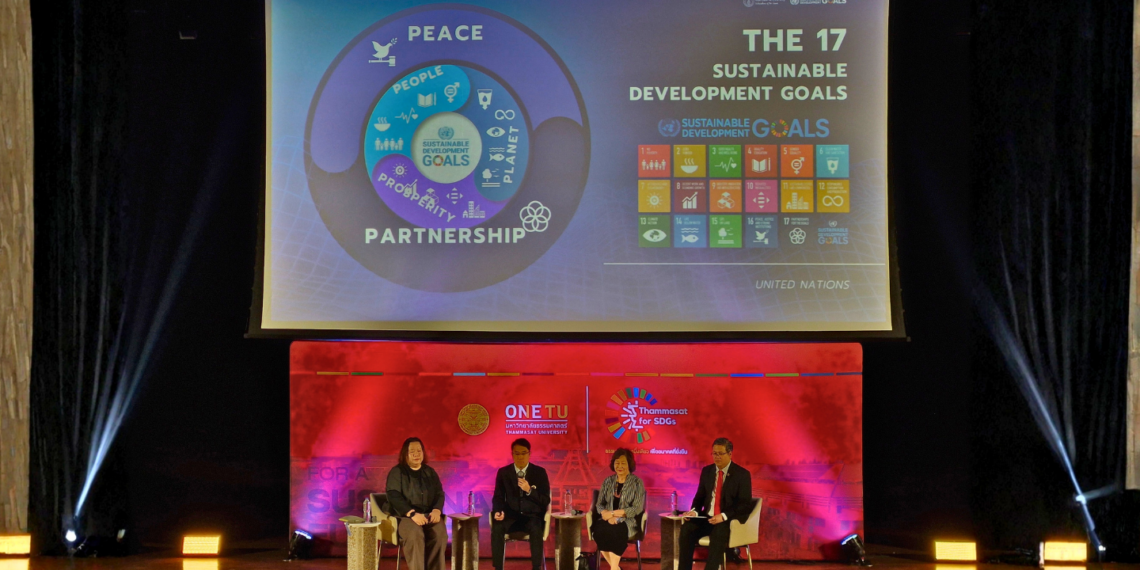
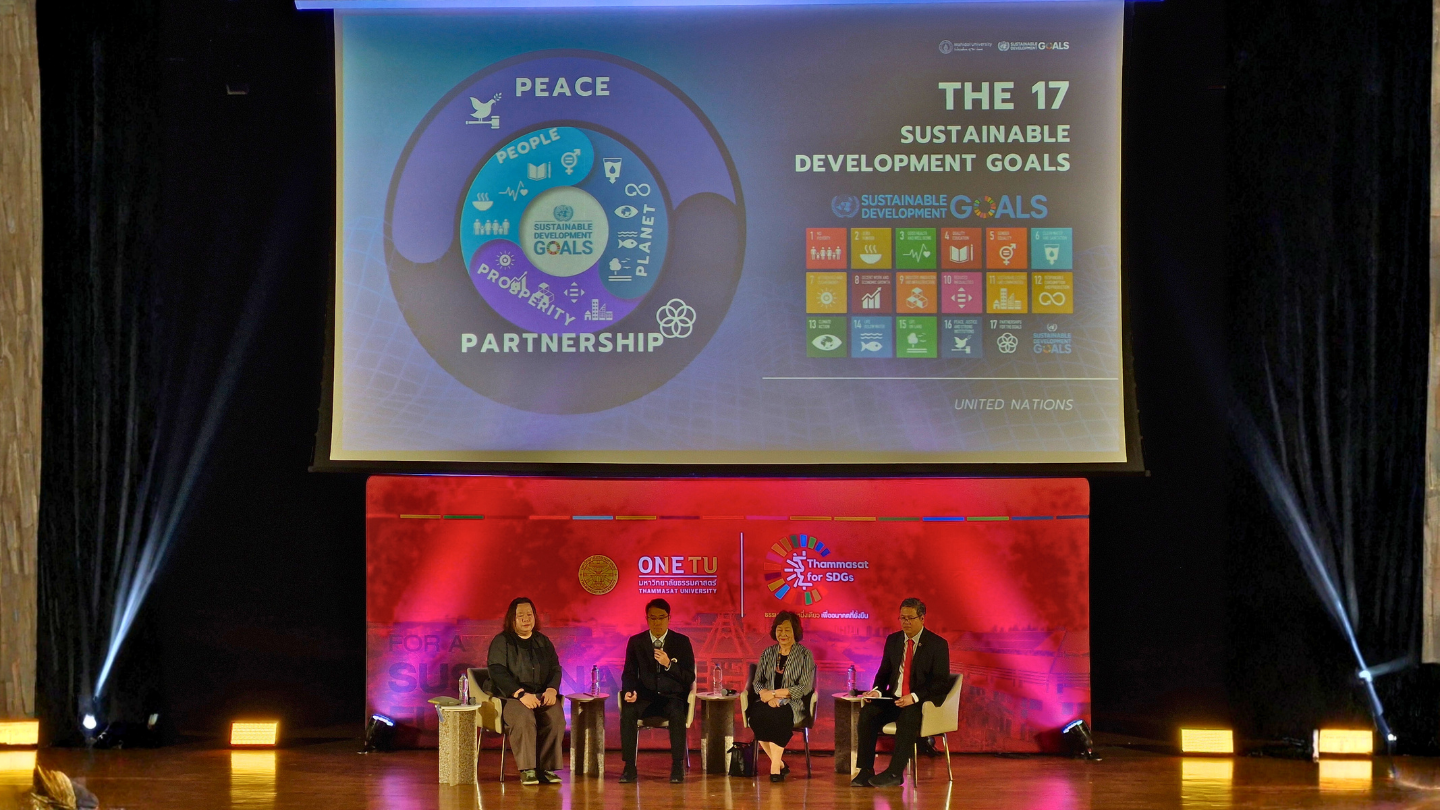
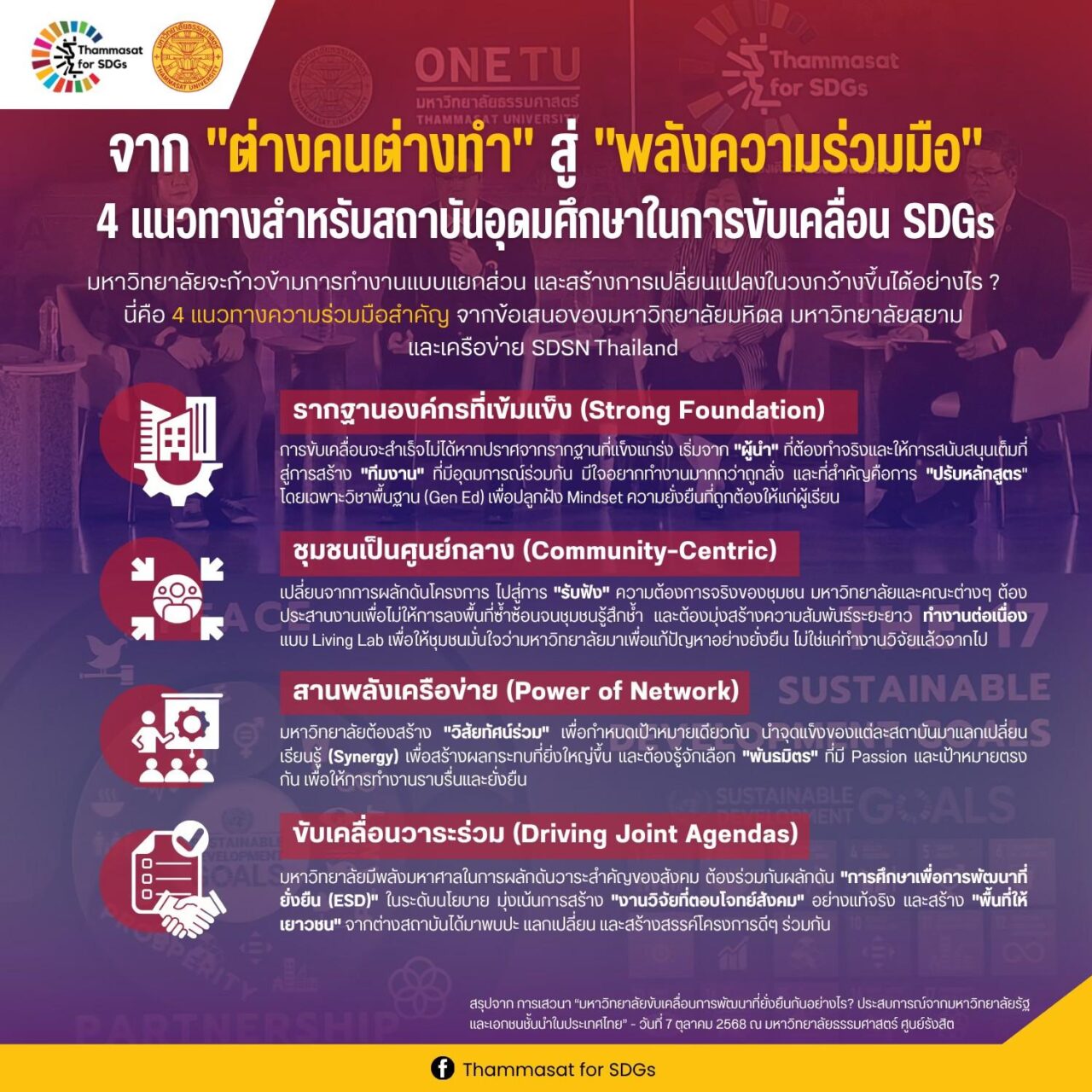
The seminar “How Universities Drive Sustainable Development” brought together real operational experiences from Mahidol University, Siam University, and SDSN Thailand. The discussion distilled four essential pathways that illustrate how universities can transcend siloed working cultures and move toward a model of development grounded in collaboration, continuity, and social commitment.
Strong Organisational Backbone
Before an institution can hope to change the world outside, it must first ensure its internal foundation is solid. Prof. Emeritus Dr Chanita Rukspollmuang (Siam University) emphasised that “Leadership is paramount.” If university leaders are serious and provide full, unwavering support, the drive for sustainability becomes a reality rather than just a policy on paper.
Furthermore, successful movements require a team united by shared ideology—staff and faculty who come with a “heart for the work” (intrinsic motivation). This passion yields far superior results compared to work done merely to satisfy a top-down command.
Another crucial element is the “Curriculum Overhaul,” particularly in General Education (Gen Ed) subjects. The goal is to cultivate a “Sustainability Mindset” in every student, regardless of their major. Siam University, for instance, has revamped its Gen Ed curriculum to ensure students witness real-world problems, realising that their ideas have the power to create actual change.
The Community-Centric Approach
A significant issue echoed by all speakers is the phenomenon of “Community Fatigue” (or ‘Chumchon Chum’). Asst. Prof. Dr Panon Latcharote (Mahidol University) illustrated a common scenario: multiple faculties from the same university—or even different universities—descend upon the same community to conduct research without coordination. This redundancy burdens the locals and creates negative sentiment.
The solution requires a paradigm shift: moving from “Pushing” university-led projects onto a community, to “Listening” and allowing the community to signal their true needs to the university.
Prof. Emeritus Dr Chanita added that Siam University employs a strategy of “Sticking with the Community.” This means using community problems as the starting point and committing to a continuous, long-term relationship—a “Living Lab” model. It is not about finishing a course and leaving; it is about staying until the problem is solved. This consistency builds trust and proves that the university is a partner in sustainable solutions.
Synergising Networks
When working alone has its limits, “Synergising Networks” is the way forward. Khun Nanthinee Malanon (SDSN Thailand) pointed out that while many university networks exist at various levels, the missing piece is often a lack of alignment. The challenge is: How do we bring these networks together to “set a shared vision”?
Creating “Synergy” is key. Asst. Prof. Dr Panon cited the initiative between Mahidol University and Thammasat University as a prime example. By combining the unique strengths of two major institutions, they can generate a “Real World Impact” that neither could achieve alone.
Meanwhile, Prof. Emeritus Dr Chanita advised that choosing the right partners is crucial. Collaborating with partners who share the same Passion and Vision ensures that the joint effort is smooth, resilient, and successful.
Driving a Common Agenda
Once a strong network is established, the next step is to formulate a “Common Agenda” to push for widespread change. Khun Nanthinee proposed two critical agendas that universities should advocate for together:
- Education for Sustainable Development (ESD): Pushing ESD into national higher education policy. This is a collective mission from which every university benefits.
- Creating “Youth Spaces”: establishing platforms where students from different universities can meet, exchange ideas, and conduct activities together. This solves the problem of student groups working in isolation and amplifies their positive impact.
This “Common Agenda” can operate at both the national policy level and the local level. A tangible example is how Siam University drove the “Safe Pavement” agenda with the Phasi Charoen District, resulting in the S-Guard Innovation—a practical solution for pedestrian safety derived from shared goals.
Conclusion — Collaboration as the Pathway to Meaningful Sustainability
The insights drawn from this seminar underscore a fundamental truth: universities can no longer operate as separate entities pursuing isolated achievements. To drive sustainability in a meaningful and enduring way, they must cultivate strong internal structures, embrace communities as genuine partners, leverage network synergies, and push forward collective agendas that extend beyond institutional boundaries.
Only through this transformation can the wisdom, intellectual capital, and moral responsibility of higher education institutions evolve into real, measurable, and lasting sustainability — not only for academic communities, but for society as a whole.
Summarised and expanded from the seminar “How Universities Drive Sustainable Development? Experiences from Leading Public and Private Universities in Thailand,” held on 7 October 2025 at Thammasat University, Rangsit Centre.