

HIGHTLIGHTS
- Comprehensive Startup Ecosystem: Thammasat has developed an integrated support system for low-carbon and green-tech startups, covering every stage from idea generation and prototype development to business incubation and IP protection.
- Innovation Infrastructure at Thammasat Creative Space (TCS): Equipped with advanced tools such as 3D printers and laser cutters, TCS provides the physical and collaborative environment needed for students and entrepreneurs to turn low-carbon technology ideas into tangible products.
- Business and Intellectual Property Support via TU IPI: The Thammasat University Intellectual Property and Business Incubation Center offers end-to-end services, including IP registration, business consulting, and financial mentoring, to help green startups become sustainable enterprises.
- Living Lab Model: Solar Café: The on-campus Solar Café showcases practical application of low-carbon innovation, operating entirely on solar power and zero-waste principles, serving as a real-world example that inspires and validates green entrepreneurship.
Thammasat University has positioned itself as a leading higher education institution that not only generates theoretical knowledge but also plays an active role in supporting and nurturing startups driven by innovation for sustainability and a low-carbon economy. The University has built a “startup ecosystem” that empowers students and entrepreneurs to transform green technology ideas into viable businesses — from inspiration and prototype development to business and intellectual property consultation.
Inspiring Ideas: Platforms for Sustainable Startup Creation
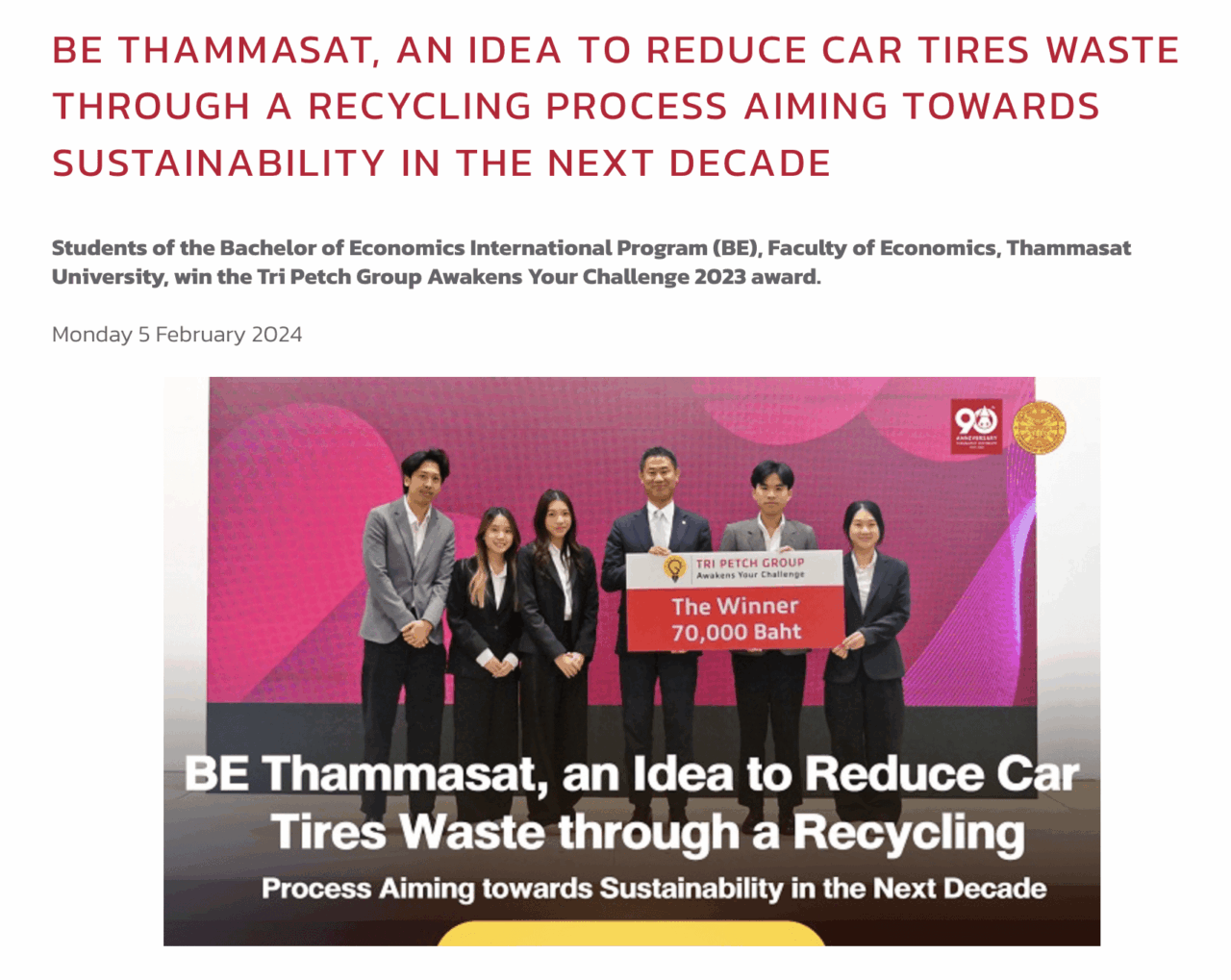
Thammasat University encourages its students to participate in national-level competitions to spark creativity and innovation that address environmental challenges. A recent success story is Uzusi Consulting, a team of students from the Faculty of Economics (International Programme – BE), who won the Tri Petch Group Awakens Your Challenge 2023 competition with their project on tyre waste management through upcycling and circular economy solutions. This achievement demonstrates that Thammasat can cultivate sustainable business concepts with real commercial potential right from the classroom.
Creative Infrastructure: Turning Ideas into Prototypes at Thammasat Creative Space (TCS)
To ensure that great ideas do not remain only on paper, Thammasat University established Thammasat Creative Space (TCS) at Puey Ungphakorn Library, Rangsit Campus — a physical hub for innovation with key facilities including:
- Maker Space: The heart of prototype development, equipped with advanced technology such as 3D printers and laser cutters. These investments underline Thammasat’s commitment to hardware-based innovation — essential for green technology (GreenTech) startups that often develop tangible products like smart sensors or energy-saving devices.
- Co-working Space: A collaborative area where students and entrepreneurs can exchange knowledge and ideas, network, and develop their business concepts further.
TCS thus serves as an incubating ground that lowers barriers for low-carbon technology startups, enabling them to develop prototypes and test concepts quickly and efficiently.
Business Support Mechanisms: Thammasat University Intellectual Property and Business Incubation Center (TU IPI)
Once a startup has developed a ready-to-market prototype, the Thammasat University Intellectual Property and Business Incubation Center (TU IPI) steps in as a key mechanism to transform research and innovation into sustainable businesses. The center provides comprehensive services, including:
- Intellectual Property Support: Consulting and assisting startups in protecting their innovations through patent, petty patent, and copyright registration.
- Business Incubation: Providing in-depth guidance on business operations, marketing, and finance — from the early stages until entrepreneurs can stand independently.
Real-Life Success Model: Solar Café – A Clean Energy Business on Campus
Beyond structural support mechanisms, the University also uses its own campus as a living laboratory to demonstrate that green businesses can thrive in practice. Solar Café at the Rangsit Campus, supported by the Office of Property and Sports Management, exemplifies this vision. The café operates on genuine low-carbon principles — powered by solar energy from rooftop panels, adopting zero-waste waste management, and maintaining a sustainable supply chain. It serves as a tangible model that inspires other entrepreneurs to follow suit.
Thammasat University has built a comprehensive ecosystem to support startups in the low-carbon economy and green technology sectors — from idea generation through competitions, to prototype creation at TCS, business and IP consulting via TU IPI, and successful real-world implementation through campus-based models. Altogether, these efforts reaffirm the University’s strong commitment to driving a sustainable, low-carbon society.