

HIGHLIGHTS
- Global Recognition: Ranked 64th worldwide in the THE Impact Rankings 2025, marking Thammasat’s second consecutive year in the global Top 100.
- Interdisciplinary Integration: By 2027, 90% of undergraduate programmes will embed SDG-related knowledge, making sustainability a core lens for every graduate.
- Innovative Pathways: Flagship programmes such as SUMA, SGS, SCI-TU, and PSDS equip students to become leaders in sustainable management, social innovation, technology, and community development.
- Accessible Sustainability Learning: General education courses such as TU103 Life and Sustainability is open to all students, ensuring opportunities to build sustainability literacy across every discipline.
เลือก Page 2 เพื่ออ่านเป็นภาษาไทย
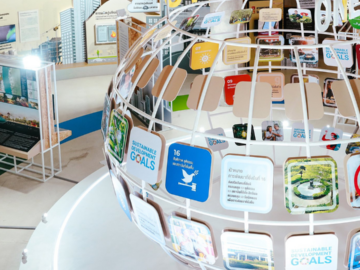
In an era where the world faces increasingly complex environmental, social, and economic challenges, knowledge of sustainable development has become central to shaping the leaders of the future. Thammasat University has reaffirmed its position as a leading academic institution committed to advancing this agenda in earnest. This is reflected in its recent achievement of being ranked among the world’s Top 100 in the THE Impact Rankings 2025 for the second consecutive year, moving up to 64th globally. This stands as concrete proof of the University’s vision to be a “World-Class University for the People”—not merely a slogan, but a principle put into practice.
Behind this success lies a clear strategy: embedding the Sustainable Development Goals (SDGs) into Thammasat University Strategic Development Plan No. 13 (2022–2027). For Thammasat, sustainability is not simply a discipline, but a “lens” through which every graduate, regardless of faculty, must view the world. To achieve this, the University has designed a diverse learning ecosystem that connects knowledge across disciplines.
Multiple Pathways to Sustainability: Thammasat’s Approach to the Future
Thammasat recognises that multiple professional fields can contribute to advancing sustainability. Accordingly, the University has designed its curricula with varied pathways to match the diverse interests and aptitudes of students. The following are key examples of this approach:
1. The Leadership Pathway: SUMA
Thammasat’s flagship new programme is the Bachelor of Science in Sustainable Management (SUMA), designed to meet the demands of a business world increasingly focused on ESG (Environmental, Social, and Governance). This interdisciplinary programme is a collaboration between five key units: the College of Interdisciplinary Studies, the Faculty of Social Administration, the Puey Ungphakorn School of Development Studies, the Faculty of Science and Technology, and the Faculty of Engineering.
Its unique strength lies in producing professional sustainability managers with expertise spanning circular economy, green finance, and the use of AI for sustainability. With a strong emphasis on practical learning, including no fewer than 1,000 internship hours, it equips graduates to become leaders in business and organisational sustainability.
2. The Global Change-Maker Pathway: School of Global Studies (SGS)
The School of Global Studies serves as a hub for students interested in the social, political, and economic dimensions of sustainability from a global perspective. It also acts as a regional leader in social innovation. At undergraduate level, it offers programmes in global studies and social entrepreneurship, preparing students to develop 21st-century skills through courses such as Social Enterprise and Entrepreneurship and Human-Centred Design for Social Innovation. At postgraduate level, the programmes in Social Innovation and Sustainability train practitioners and researchers to tackle global challenges directly through the SDG framework, with courses such as Sustainability and the Global Political Economy.
3. The Technology Innovator Pathway: Faculty of Science and Technology (SCI-TU)
The Faculty offers both undergraduate and postgraduate programmes in Sustainable Development Technology. These are designed for those wishing to address sustainability challenges through science and technology, with a philosophy rooted in the Sufficiency Economy. Students gain strong foundations in mathematics and science, enabling them to create innovations that respond to global needs.
4. The Social Development Pathway: Puey Ungphakorn School of Development Studies (PSDS)
This pathway is ideal for students focused on community development, social justice, and public policy. The School aligns its mission with all 17 SDGs, producing graduates with strong public consciousness. Beyond degree programmes, it also provides specialised training for professionals, such as the Executive Programme in Sustainable Organisational Transition and courses in Social Impact Assessment (SIA/SROI).
Additionally, PSDS has pioneered the teaching of Introduction to ESG (ESG 101), in collaboration with the Stock Exchange of Thailand, to build essential ESG knowledge for all students.
Weaving Sustainability into the DNA of Every Graduate
Perhaps the clearest testament to Thammasat’s commitment is its policy of embedding sustainability into the very foundation of every student’s education through an “inclusive integration” approach. The 13th Strategic Plan sets an ambitious target: by 2027, 90% of Thammasat’s undergraduate programmes must incorporate SDG-related knowledge into their curricula.
In practice, students from all faculties are offered opportunities to study foundational general education courses such as TU103 Life and Sustainability and Introduction to ESG, providing essential entry points into sustainability knowledge. Deeper engagement is also encouraged through specialised electives and cross-disciplinary minors. For example, the Faculty of Science and Technology offers courses such as Environment and Sustainable Development and Carbon Trading, while the Faculty of Social Administration offers a minor in Community Development, allowing students from other faculties to acquire grassroots development skills.
This strategy ensures that every Thammasat graduate—whether an accountant, engineer, or journalist—carries with them a foundation of sustainability literacy, equipping them to become agents of change across all sectors of society.