
Culturally Significant Buildings and Monuments in Thammasat University
Thammasat University is one of the oldest Universities in Thailand that has played an important role in national politics or governance. The campuses of Thammasat University, especially Tha Prachan Campus, is home to several buildings and monuments of historical and cultural significance that are completely open to the public.
On the second floor of Dome Building, the inaugural building of the University of Moral and Political Science, is Prof. Dr. Pridi Banomyong’s office. During the Second World War, this room was the headquarter for the Free Thai Movement led by Prof. Pridi Banomyong in collaboration with the Free Thai Movement in the UK and the US.
In memory of Prof. Pridi Banomyong, a senior statesman, a leader of the Free Thai Movement and an important figure in the University of Moral and Political Science, Thammasat University constructed Pridi Banomyong Plaza at Tha Prachan Campus and participated in the establishment and preservation of Pridi Banomyong Memorial at his childhood home in Phra Nakhon Si Ayutthaya province.
Bhodi Court at Tha Prachan Campus became a symbol of democratic struggle of Thammasat and the Thai society after the events of 14 October 1973 when students and civilians gathered here to demand constitution and democracy. Bhodhi Court is still used nowadays during demonstrations of the new generation of youths who are anti-government as a platform to express their opinions on the politics.
As a physical memory space with characteristics of both a monument for the remembrance of the event and a memorial to the deceased, the 6 October 1976 memorial commemorates Thammasat University’s battle for democracy. It now serves as the main site for religious rites for the deceased during the annual memorial events.
Libraries within Thammasat University
Public Library at Puey Ungphakorn Centenary Hall is established in 2020. It requires only identifications, such as national ID card or passport, for access. The major purposes of this public library are to be a learning resource for people of all ages and to develop a learning network for the communities around the University. This public library offers books from various fields, such as literature, art, religion, and philosophy, to serve a wide range of people. A key highlight of this public library is the kids and youth book zone.
In the campuses of Thammasat University, there are libraries that are specific for various fields which focus on facilitating students and staff’s research, while public access is available with an access fee of 20 THB or approximately 0.60 USD.
- The Pridi Banomyong Library, Tha Prachan Campus
- Sanya Dharmasakti Library (Faculty of Law), Tha Prachan Campus
- Puey Ungphakorn Library (Faculty of Economics), Tha Prachan Campus
- Professor Sangvian Indaravijaya Library (Thammasat Business School), Tha Prachan Campus
- Professor Direk Jayanama Library (Faculty of Political Science), Tha Prachan Campus
- Faculty of Journalism and Mass Communication Library, Tha Prachan Campus
- Puey Ungphakorn Library, Rangsit Campus
- Nongyao Chaiseri Library (Health Fields Library), Rangsit Campus
- Thammasat University Library, Pattaya Campus
- Boonchoo Treethong Library, Lampang Campus
Public museums at Thammasat University
Thammasat Museum of Anthropology is a project which was initiated by the Faculty of Sociology and Anthropology in 1986 when the faculty received artifacts from the Ban Chiang excavation project at Ban Om Kaeo and Ban That in Udon Thani, led by Assoc. Prof. Sumitr Pitiphat during 1972-1974. All antiquities and cultural objects exhibited at the museum were compiled by the Faculty of Sociology and Anthropology from those that already belonged to the faculty and those that were donated, such as the donation from Dr. Winit Winitnaiyaphak in 1987.
The commissions of Thammasat Museum of Anthropology are to exhibit objects for education and research and encourage the understanding of humanity in various dimensions through cultural objects. This leads to the understanding of humanity and groups of people amidst the diversity of their culture and interaction with the world.
In addition to the museum being a learning space for students in anthropology and sociology, Thammasat Museum of Anthropology is also open to the public, serving as a learning opportunity for people of all ages. The museum is indeed a new cultural space for Thammasat University, the surrounding communities, and Thai society.
Pridi Banomyong Monument Room was built in 1992 to commemorate the life and contributions of Professor Banomyong to the development of Thai politics. The exhibition in the monument room is divided into 6 wings, titled “Democracy idealist and revolutionist”, “Early life and socialization”, “A great commoner”, “Political turbulence”, “Late life: living in exile and the crystallization of thought”, and “Reinstating the honor to the good man that Thailand did not want”.
Thammasat University Hall of Fame tells the story of Thammasat University from its inception until the present, starting from “Tha Prachan area development before the establishment of University of Moral and Political Science” which used to be Wang Na (Palace of the Crown Prince). The exhibition inside is divided into 5 sections, titled “The Era of the University Establishment”, “The Era of Education Transformation before the End of the Knowledge Market”, “The Era of Ideological Struggle and Restoration”, “The Era of Education Expansion”, and “Chamber of Fame of Thammasat University”, which mainly features Professor Pridi Banomyong, Professor Sanya Dharmasakti, and Professor Puey Ungphakorn, who are major contributors of Thammasat University.
Thammasat University Archives was established to be the agency that stores the information resources related to the history and origin of Thammasat University. The main missions are to manage the archival documents to keep up with the dynamic of world situations and to facilitate students, researchers, and the public in their studies and research.
In the archives is an exhibition “Puey the Commoner: Life, Ideology and Works” to commemorate the virtue and contributions of the pioneer who expanded the University to Rangsit Campus.
Thammasat University participated in the establishment and preservation of Pridi Banomyong Memorial in Phra Nakhon Si Ayutthaya province. The memorial at his childhood home in 1992 was built to commemorate the Thai leader who is recognized as one of the Great Personalities by UNESCO. This memorial is a 100-year-old Thai house with a traditional Thai-style roof, the inside is decorated with door arches and wood carvings that are Thai-Chinese and Western styles. The most important part is the symbolic Pridi Banomyong Monument which comprises 6 bronze round poles supporting a Thai-style roof at the center of a round pool. The poles are the symbols of the 6 principles from the declaration of the People’s Party, which include independence, safety, economy, equality, freedom, and education. The stillness of the water in the pool represents peace, and the everlasting light decoration under the roof signifies Banomyong’s immortal ideology.
Green spaces at Thammasat University
The open, green spaces on the campuses of Thammasat University are completely open to the public. These spaces can be used for recreational activities and social events, and they also help in conserving and restoring ecological balance in the communities.
In Rangsit Campus, Thammasat’s largest campus, several green spaces are available. The latest addition to the campus is Puey Ungphakorn Centenary Hall and Park, on top of which is Asia’s largest Green Roof Urban Farm. This rooftop farm offers 7,000-square-meter plots for organic vegetable cultivation and serves as an educational space on sustainable, organic, urban farming. Eco-forest Park, next to Puey Ungphakorn Centenary Hall and Park, is another cultivated area that is used as a plant nursery and an educational space for the public to learn about ecological systems. Green spaces on Rangsit Campus that are popular to the public in the evening especially for exercising are People’s Park, a 20,000-square-meter lawn, and Solar Park, which offers large pedestrian walkways alongside an 800-m-long canal and tree corridors. Another open space that is popular to the surrounding communities in the morning and during lunchtime is Suan Tiam, an 8,000 square-meter square near the administration buildings that is a home to several food and beverage shops.
Tha Prachan Campus in Bangkok’s Old Town area has limited space, but it still offers public, open spaces. Pridi Banomyong Memorial Lawn is a memorial space for Professor Banomyong who is a key contributor of Thammasat University. This 5,200-square-meter area is a home to “Dome Organic Garden” which is an organic urban farm that preserves and restores green space in the city center. Golden Lioness Shrine Waterfront covers a 100-meter stretch along the Chao Phraya River. It is a popular destination for relaxing, dining, and enjoying the river view for the public especially in the evening.
Lampang Campus, with more than 60% of the area covered with large trees, has converted a portion of its campus into an area for ecological conservation and restoration, named “Hybrid Park for Food Security”, which is open to the public. This park covers a 32,000-square-meter area and is a home to medium and large reservoirs that are connected to all the on-campus canals. The reservoir system can store up to 48,000 cubic meters of water for use in agriculture and aquaculture.
Arts and cultural performances at Thammasat
Faculty of Fine and Applied Arts of Thammasat University offers classes on Thai dulcimer, singing, Thai dance and Thai pantomime both in theory and in practice and organizes annual theater performances and Lakorn FATU Festival to showcase the students’ thesis performances. Thammasat University also supports students’ clubs that focus on art such as: traditional Thai music, western music, Thai performing arts, and Chinese opera. There are currently 10 art-related clubs. One of the most active art-related clubs is TU Folk Song club which organizes its own shows known as “Laan Folk” at least twice a year and participates in the University’s events that are open to the public, including TU Freshy Games, Club Festivals, and Thammasat Open House. TU Symphony Orchestra organizes an annual concerts, which in 2022 came in the theme “LOVENIVERSE”, and several other ad-hoc themed concerts, such as Charm of Chinese Melodies,Chamber Night Concert, and Until Unlight Concert to raise money for the Universal Foundation for Persons with Disabilities. TU Drama Club also organizes at least 2 public performances per year, including Hello Drama and its annual Showcase. Another club that is well-known due to its uniqueness is Chinese Opera club of the Faculty of Social Administration which organizes an annual show specifically for satirizing the current political events and movements.
Thammasat’s effort to preserve local cultural heritage
Thai Khadi Research Institute is the first institution in Thailand that is specifically established to for the study of Thai society. At present, the institute focuses on creating new research works and providing academic service to the society to support a community of learning and preserve art and culture.
In 2022, Thai Khadi Research Institute plans to cooperate with Thammasat University Lampang Campus to help in developing cultural travel routes and a local museum in Lampang province. This project is a part of the institute’s missions to drive research and academic services related to both tangible and intangible arts and heritage, to promote the application of academic knowledge in developing local areas and to raise awareness on the importance of local heritage.
The University of Moral and Political Science, the original name of Thammasat University, was constructed next to Sanam Luang, which used to be the office of Phra Rajawang Bovorn Sathan Mongkol or the Front Palace. The office of Front Palace was abolished during the reign of King Rama V. Remnants of the Front Palace Wall have been discovered during the excavation for the construction of the new Multi-purpose Building 2 and is now preserved and exhibited at Tha Prachan Campus.
Near the tables along the Chao Phraya River beside Faculty of Economics building at Tha Prachan Campus stands a small Golden Lioness shrine which is respected by Thammasat students, people in nearby communities, and those who operate boats in the Chao Phraya River. There are many versions of the legend of the lioness statue. The most famous version is the love story of lion and lioness statues that were on that was importing goods for sale in Bangkok during the reign of King Rama IV. After a storm caused the barque to capsize, the villagers recovered the sunken goods, but they could recover only the lioness statue. The statue was placed on the river shore facing the land, but on the next day, the statue was found facing the river as if it was waiting for the lion statue that was sunk in the river.
Dome Building which is the inaugural building of Thammasat University at Tha Prachan Campus is now 86 years old. It was the building that recorded the history of Thammasat development as well as major events and progresses in Thai politics. To preserve the cultural importance and improve on public access to the building, Thammasat University has approved a budget for the Dome Building Preservation and Development Project that will add more public working spaces and a learning center on Thammasat’s involvement in Thai politics to the building.
Thammasat University Tha Prachan Campus is in the Bangkok Old Town surrounded by famous food markets. Several shops offer authentic Thai and Thai–Chinese dishes with recipes that have been passed on through many generations. To preserve the old recipes and create a sense of connection between the University and the surrounding communities, Tha Prachan Campus has initiated “Famous Local Food Around TU Cooking Class” project that invites long-standing food shops near Tha Prachan Campus to share their cooking experiences with the students and staff of Thammasat University. The cooking class is organized monthly, starting from April 2022.
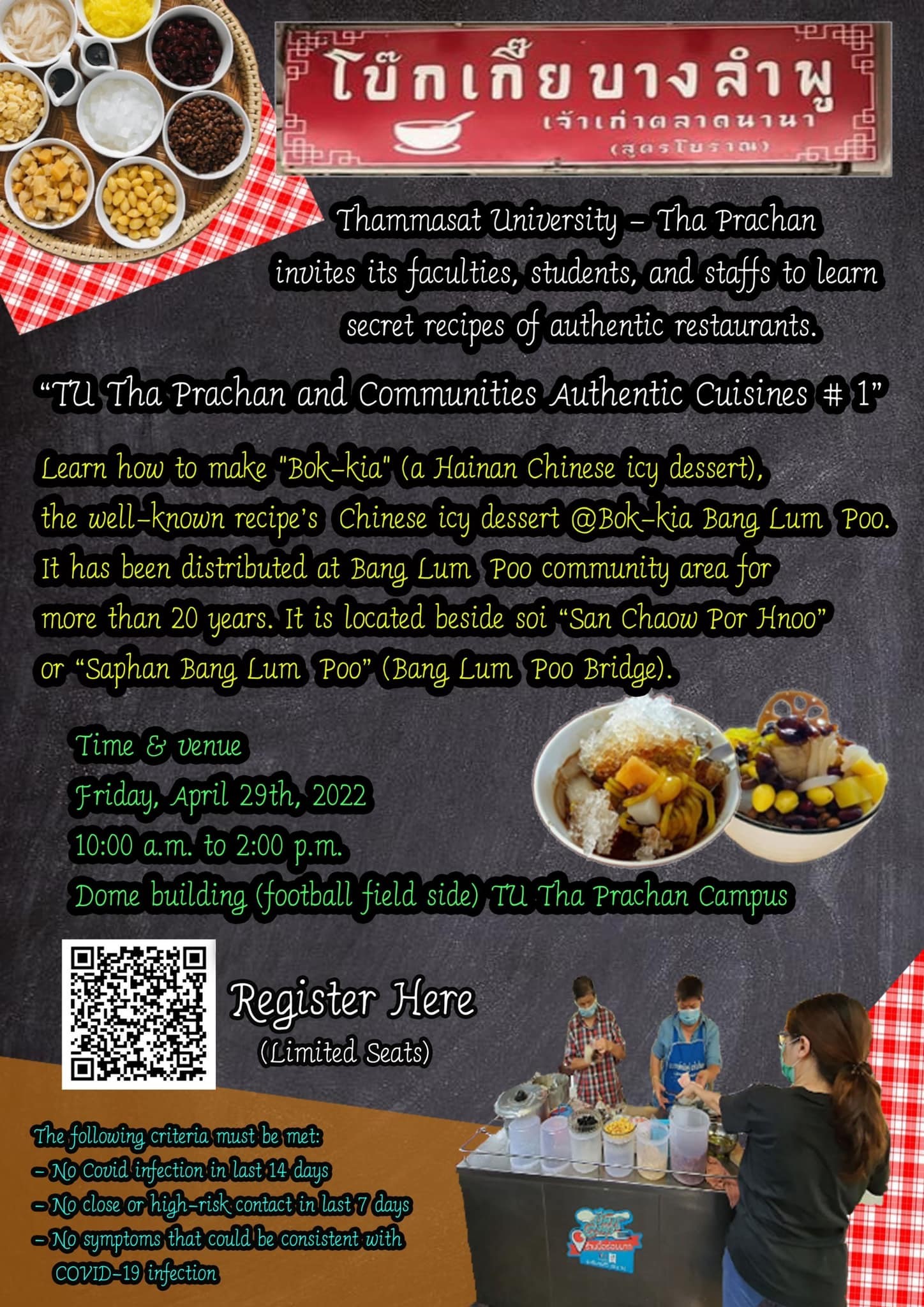
Sustainable commuting on Thammasat campus
To accommodate transportation on campus, Thammasat University signed a contract with Anywheel to provide rental bicycles on campus. In 2021, there were 1000 Anywheel rental bicycles and 73 service stations all over Thammasat University Rangsit Campus. Each service station offers 10-25 public bicycles that can be rented through their mobile application. The target in 2022 is to increase the number of rental bicycles by 50% and to start providing rental electric scooter service to encourage the community to choose modes of transportation that do not create air pollution.
Thammasat University cooperates with Haup Car, an electric car rental company, to provide rental electric car service at Rangsit Campus. There are currently 2 rental stations on campus which also offer charging service for other electric cars to encourage those who travel to Thammasat University to adopt the use of electric cars. In 2021, 3 more rental and charging stations were installed, so currently there are 10 rental electric cars available on campus.
Thammasat University Rangsit Campus has a public van station which is a connecting hub between city centers and Rangsit-Khlong Luang area. It offers van services from 5:30 am to 8 pm daily. The number of public van users is as many as 3,500 people per day.
In Thammasat University Rangsit Campus, free shuttle bus service is offered with 5 different routes covering the whole campus area. There are currently 25 shuttles in service. The 100% electric shuttle fleet ensure that this on-campus transportation option does not cause any air pollution. The information on the shuttle bus routes and the current location of the buses can be tracked and accessed via TU Around App.
Thammasat University promotes the use of electric vehicles for everyone travelling to and from Rangsit Campus by installing 6 electric vehicle charging stations throughout the campus. These stations can serve up to 12 electric vehicles at a time.
Remote working for resilient work condition
Thammasat University is consisted of 4 campuses. Each campus is far from one another, so transportations between the campuses can be required for both the students and staff. In this era of information technology, Thammasat University incorporates new innovations into the working and learning environments to reduce greenhouse gas emission due to transportation and University’s space utilization.
Thammasat University often holds inter-campus meetings and conferences. Currently, inter-campus online meetings can be arranged on Microsoft Team which reduces the need of long-distance transportation.
Cooperation between departments uses written documents as the method of communication, so the resources that are consumed a lot during the processes are paper and energy used for document delivery. A system for e-document delivery within the University has been developed and incorporated to decrease the use of paper as well as greenhouse gas emission from the document delivery process.
Thammasat University has prepared our classrooms for hybrid classes with the aim to reduce transportation for both the staff and students, which would be required in the traditional classroom system. Besides helping with greenhouse gas emission, this policy also helps control the spread of COVID-19 during the pandemic.
On-campus housing for Thammasat University’s students and employees
Thammasat University provides on-campus accommodation options for the University’s students and staff. The staff dormitories offer rooms at different price points, based on the provided amenities as well as the employee’s salary. The cheapest room option without furniture comes with private bathroom, water purifier, cable TV, and internet access costs 300 THB monthly, which is approximately 8.10 USD, while similar options in a private dormitory/apartment within 5 kilometers of the University cost a minimum of 1000 THB per month. Room options with furniture in the vicinity of the University starts at 2000 THB per month, while the University offers a similar room starting at 1,200 THB or 32.40 USD monthly. In comparison with accommodations outside the University, Thammasat staff dormitories provide alternatives with up to 70% discount.
Thammasat University provides on-campus housing options for the students at Rangsit and Lampang campuses. Rangsit Campus, which is the largest campus of Thammasat University, offers various types of rooms for the students with a 5-month term which allows the students to avoid paying rents during the summer break. The monthly rent starts from 900 THB or 24.30 USD per person for a 4-person dorm room with shared bathroom, which can compete with a furnished room within 5 km of the campus. In Lampang Campus, the rent of a furnished 4-person dorm room starts from 800 THB or 21.60 USD. There are not a lot of private dormitory options around Lampang Campus. The cheapest option in a 5-kilometer radius from the campus starts from 1900 THB or 51.40 USD for a fan room, which is double of the minimum rent of a dorm room on campus.
Note : The THB-USD conversion is approximated to be 1 USD = 37 THB
Walkway and bike lanes at Thammasat Rangsit
Thammasat University has set the design of covered walkways to promote walking as a part of the development of the walkway and bike lane system within the campuses of Thammasat University, according to Thammasat Centenary master plan, to reduce the use of cars in the campuses. Building the walkway and bike lane system that covers the whole campus can promote the students’ quality of life and reduce pollution resulting from the use of vehicles. The design of covered walkways considers both the functionality and the aesthetic with the following key design concepts:
-
The design uses a column and roof structure to create light and airy feel to blend with the open space or the surrounding buildings.
-
The height of the covered walkways and bike lanes is in the range of 3 – 5 meters, with the width of about 5 meters, 3 meters of which is for pedestrians and the other 2 meters is for bike lanes.
-
The design must connect the walkway system with popular areas on campus, both inside and outside the buildings, for the convenience of pedestrians and cyclists.
- The materials used, such as steel poles, polycarbonate sheets, must be in plain colors that match with the environment to create the feeling of harmony with the surrounding areas.
- The design must include a clear division between the walkways and the bike lanes to accommodate heavy traffic.
Thammasat University and the development of Smart City
Thammasat University cooperated with National Science and Technology Development Agency (NSTDA) and the district of Khlong Luang in the development of “Khlong Luang Smart City” to be an area that integrates technology and innovations to improve the efficiency of area development and management under the concept of Smart City and Sustainable Development Goals (SDGs). The vision of this project is to develop Khlong Luang into “an area of innovations that benefits local communities and the society, sustainably improve the people’s quality of life, and transform the area into a community of equality”. The aims of this development project are as follow:
- To create a town that is welcoming, environmentally friendly, and supportive of the community’s quality of life.
-
To enhance the physical infrastructure system using information technology.
- To create economic activities that provide the community an opportunity to raise their income level.
-
To enable the community to keep up with and be ahead of the changes in this era.
- To create an equal standard of life for all groups in the community.
Besides, Thammasat University also serves in the advisory board in the preparation of “Pathum Thani Smart City” development plan, of which the vision is to create “a city of innovations and health for the education and wellbeing of the people”.
Thammasat sustainable development
Thammasat University has a plan to update the university’s master plan, which will set the design guidelines for all new buildings on campus to be appropriate for the surrounding environment, energy-efficient, and environmentally friendly.
New buildings according to the updated master plan must be designed to reduce the use of energy and exhaustible natural resources. The design and construction of new buildings must consider the environment and sustainability issues. The building plan and the building envelope design must utilize environmentally friendly materials that satisfy national or international green building standards. In addition, the shapes the building must facilitate the use of natural light in the building. The design must also include sunshades to reduce glare with an appropriate window to wall ratio for each direction to avoid overheating, as well as natural light monitoring and artificial light dimming systems to optimize the energy use. The design of the artificial lighting system must complement the natural light to provide luminance that follows the standard of each area with the lighting power in accordance with Energy Conservation Promotion Act (No. 2) B.E. 2550 (2007). The artificial lighting system must contribute to the conservation of energy using various methods, such as using energy-efficient light bulbs, and setting automatic lighting schedules.
All new buildings at Thammasat University have been constructed under this design guideline, and many of them have received environmentally friendly building awards, such as Social Complex Building 3 (SC3), the buildings of Thammasat Secondary School, Puey Ungphakorn Centenary Hall, and the building of Faculty of Learning Sciences and Education.
While keeping a sustainable building design in consideration, Thammasat tries to minimize new construction projects by repurposing existing buildings, for example, converting the unused Interzone Building into the first building of Thammasat Secondary School, converting the former Student Affairs Building into a new lecture building for Puey Ungphakorn School of Development Studies, and converting Khiang Dome Student Dormitory into the current Student Affairs Building.
In case that new construction projects are more suitable, Thammasat attempts to choose developed, underused sites as the sites of construction, such as those of Puey Ungphakorn Centenary Hall and Kittiyakhan Grand Auditorium.
The area of Puey Ungphakorn Centenary Hall and Park used to be the Asian Games Park, which was used for the 13th Asian Games in 1998. After the Games, this area became under used by the students, so it has been developed into this H-shaped building that has been planned to serve as the new center of the campus.
The area of Kittiyakhan Grand Auditorium used to be Gymnasium 2 that was used for karate, judo, and taekwondo matches during the 13th Asian Games in 1998. In 2011, amidst the historic flooding, Kittiyakhan Grand Auditorium, which was then Gymnasium 2, served as a temporary shelter for more than 1,500 flood victims. Gymnasium 2 was heavily affected by the flooding in 2011. The building was developed into Kittiyakhan Grand Ausitorium, named by Princess Bajrakitiyabha Narendira Debyavati Rajasarini Siribajra, to accommodate large-scale activities for the people in the upper-central region, including Pathum Thani, Ayutthaya, Saraburi and many others.