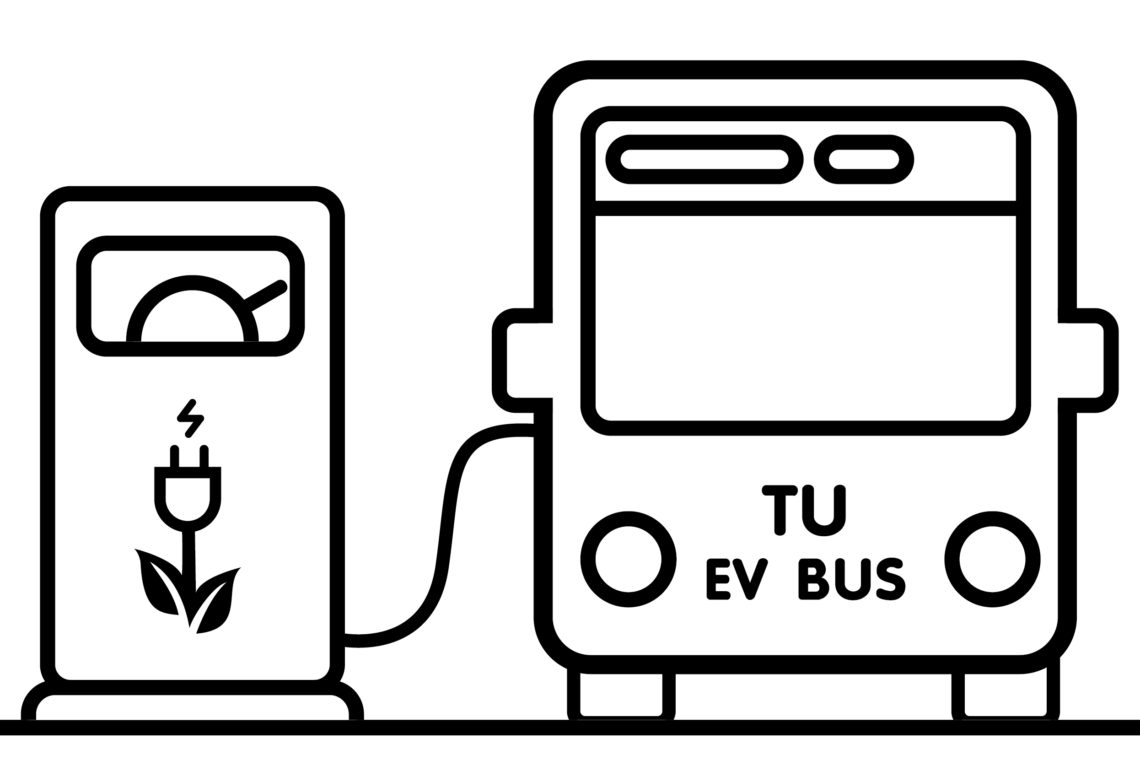
At Rangsit Campus, Thammasat has supported daily free service buses to officers and staffs for more than 20 years, including motorcycle taxi services for more than 15 years. And when Thammasat at Rangsit has stepped on sustainable campus, in 2019, everyone could find electric motorcycle services (both hire and taxi), where electricity for charging comes from solar panel.
This year, 2020, Thammasat has signed contract with private sector to build 10 electric buses for service in 10 routes every working days since mid-year 2021. This year also, it will have another contract with another private sector to build 20 electric shuttle buses for routine service in Rangsit Campus everyday from 0630 am to 2000 pm. This service will operate in mid-year 2021. This both cases, Thammasat will provide charging station, where electricity comes from both solar cell and electricity grid.
Each campus at Thammasat University will conduct routine efficiency check of everyday use equipment, air condition as an example. Thammasat has already signed Memorandum of Understanding with Provincial Electricity Authority (MOU between TU and PEA) for changing air conditions, and chillers, which were used more than 10 years, to the energy saving ones. In addition, Thammasat has also launched the campaign for staffs and students to turn off air condition between 12.00 and 1330 pm to save the electricity cost during lunch time.
Thammasat and Electricity Generating Authority of Thailand have agreeable to set up sandbox to find the most efficient ways to reduce overall energy consumption at Thammasat University Rangsit Campus
Since 2012, Thammasat has launched the programme to reduce the number of cars and motorcycle used in university, and increased the number of sharing bicycles, bicycle routes, and length of bicycle lane.
In 2020, Thammasat has already got the new bicycle batch and also the service station for students and staffs convenience. This also includes the project of changing 20 shuttle buses service in Rangsit Campus from Natural Gas Vehicle (NGV) to be Electric Bus in 2021 and also changing 10 daily diesel buses service in 10 routes to be 10 Electric buses in 2021.
(Thammasat has got eight Energy Saving Building Design awards from Ministry of Energy since 2016. These awards have led some faculties and institutes to improve or refurbish their buildings to be higher energy efficiency.
Since October 2016, Thammasat has launched the solar roof top installation project for reducing the cost of electricity and increasing the ratio of clean energy used in Rangsit Campus. Thammasat has evaluated and found that once this project is complete, Thammasat will have the solar energy used in the Rangsit Campus up to 9.9 MW.
One of the building that got Energy Saving Building Design awards in 2016 named Visit-Auksorn. This building was later built and designed under the concept of Thai Green Building Institute (TGBI). This led this building to have functions that fitting well with 8 categories of the TGBI.
(1) Building Management (BM) got full score of 3.
(2) Side and Landscape (SL) got 9 of 16 scores.
(3) Water Conservation (WC) got 4 of 6 scores.
(4) Energy and Atmosphere (ES) got full score of 20.
(5) Materials and Resources (MR) got 3 of 13 scores.
(6) Indoor Environmental Quality (IE) got 7 of 17 scores.
(7) Environmental Protection (EP) got 3 of 5 scores. And
(8) Green Innovation (GI) got full score of 5. In summary, this building have got 54 scores, which is in the range of “GOLD Class” presented by TGBI.
Since 2003, Thammasat University has launched an admission program form students with disabilities, and two years later, the Disabled Student Services Thammasat University (DSS). Duty of DSS is to support students with disabilities in every way possible. The center is responsible for guidance counseling, student’s preparation, dormitory arrangement, and even implementing universal design in the university.
The guidance counseling session was not only given to TU students but also high school students with disabilities in order to promote the admission program. The center also facilitates high-school students with disability on the day of the examination to ensure that all of them have equal opportunities in the admission process.
Once the students are admitted, the center also hosts a meeting to prepare the newly admitted students with disability for the university education and living. Even during the COVID-19 pandemic, the DSS center provided the preparation session online for the students with disabilities. Moreover, the DSS also provides relevant trainings for the students, for example, a training on Microsoft Office for students with vision impairment.
Regarding accommodation, every students with disabilities who wants to stay in the campus will be arranged into the dormitory without any exception. Buddy or volunteer staff (by request) as well as assistive devices matching with their disabilities will be allocated to them.
Instructional materials for courses they take will be provided in the forms that match with their types of disabilities, e.g. braille instructional materials for students with vision impairment, audiobooks for those with hearing impairment. Regarding examinations, the service center is responsible for making examination materials ready and suitable with the students’ disabilities.
DSS center also push forward the implementation of universal design in buildings in the university to ensure the accessibility of people with disabilities to the university’s building and infrastructure. Starting with the left-over from budget for devices and equipment, the center have implemented over 20 universal design projects.
In addition to the DSS efforts, Faculty of Engineering also innovates “Plug & Go Wheelchair”, an innovation for people with disabilities and senior citizens. This innovation won 2 awards from the competition on innovation for disabled and senior people.
Please see more details of the service and related documents here: