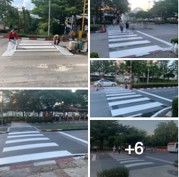
Many fatal accidents involving pedestrians crossing crosswalks have led society to question why we have crosswalks if crossing the crosswalk is not safe. Thailand has issued the “Road Traffic Act, B.E. 2522 (A.D.1979) which specify several regulations and reinforcements on crosswalks and pedestrian’s rights, one of which clearly stated that “Rights must be given to the pedestrians in the crosswalks first”.
The laws governing road safety in Thailand state that a vehicle which fails to stop while a person is crossing at a pedestrian crossing faces a fine not exceeding 1,000 baht.
In addition, if a driver hits a person using a pedestrian crossing, the punishment is up to 3 years in jail.
The laws governing road safety in Thailand state that a vehicle which fails to stop while a person is crossing at a pedestrian crossing faces a fine not exceeding 1,000 baht.
For Thammasat University, pedestrians have priority and access throughout the campus area. Thammasat University, not only strictly reinforces the law but also issue a policy on pedestrian safety as well to promote walking around the campus. Please refer to the policy #9 Policy on Pedestrains Safety on our SDG website https://sdgs.tu.ac.th/policy-operation/ for more information on pedestrian safety.
Aligning with “Thammasat Centenary Master Plan” which aims to reduce the use of personal cars around campus and Thammasat Hospital area, the University built the walkway and bike lane to cover the entire Rangsit Campus area. The “Walkable City” was the project that brought in the needs of the pedestrians, the physical design that will facilitate and encourage walking such as:
- Redesigning the layout of walkways around the campus to better facilitate the pedestrians
- Reconstructing, expanding and/or repairing sidewalks especially the ones with holes and rough pavements
- Repairing or repainting cross walks
- Installing guiding blocks and warning blocks for people with disabilities
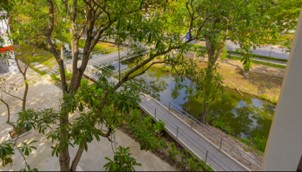
Thammasat University started by installing Braille Blocks at the Rangsit campus to test the Guiding Block system, while the Tha Prachan campus will use the Warning Block system. Tactile paving (also called Tenji blocks, truncated domes, detectable warnings, tactile tiles, tactile ground surface indicators, tactile walking surface indicators, or detectable warning surfaces) is a system of textured ground surface indicators found on footpaths, stairs and railway station platforms, to assist pedestrians who are vision impaired.
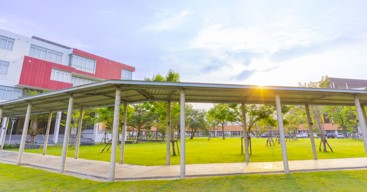
The design of covered walkways considers both the functionality and the aesthetic with the following key design concepts:
1. The design uses a column and roof structure to create light and airy feel to blend with the open space or the surrounding buildings.
2. The height of the covered walkways and bike lanes is in the range of 3 – 5 meters, with the width of about 5 meters, 3 meters of which is for pedestrians and the other 2 meters is for bike lanes.
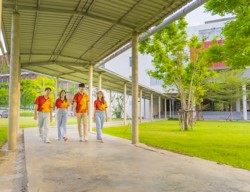
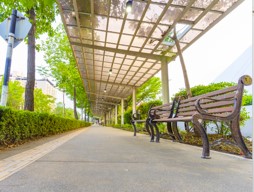
3. The design must connect the walkway system with popular areas on campus, both inside and outside the buildings, for the convenience of pedestrians and cyclists.
4. The materials used, such as steel poles, polycarbonate sheets, must be in plain colors that match with the environment to create the feeling of harmony with the surrounding areas.
5. The design must include a clear division between the walkways and the bike lanes to accommodate heavy traffic.
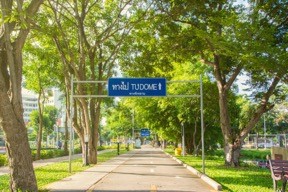
Started in April, 2021, Thammasat University has issued an announcement to prohibit motorcycles running on the bike lane and pedestrians walkways in Rangsit Campus. The Unversity assigned the on-duty security guards to monitor if any motorcycle riders violated the regulation. Alarm system was installed to signal in case there is any violations.
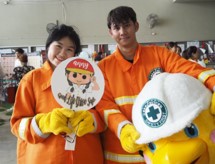
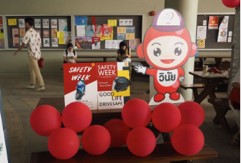
Furthermore, to promote and induce safety awareness for the community within and around Thammasat University, Rangsit Campus, a “Safety Week: Good Life Drive Safe” campaign was launched with series of activities and seminars to educate the public on road safety knowledge and precautions, the causes of motorcycle accidents, and to re-emphasize the important of wearing a helmet.