

Thammasat University evaluates interdisciplinary research success in the science disciplines through a comprehensive framework that prioritizes the health of the research “ecosystem” and the tangible translation of knowledge into societal solutions. This approach moves beyond traditional publication counts, focusing instead on collaborative infrastructure, applied innovation, and societal impact. The university’s strategy is deeply integrated with the United Nations Sustainable Development Goals (SDGs), ensuring that technical expertise is consistently met with social responsibility.
Key Frameworks for Measuring Interdisciplinary Success
1. Collaborative Infrastructure & “Eco-system” Metrics
Thammasat measures success by the strength and productivity of its Centers of Excellence (CoEs), which are specifically designed to bridge science with other fields like medicine, engineering, and computer science.
- Formation of Interdisciplinary CoEs: Success is measured by the number of active, nationally recognized CoEs that successfully integrate multiple science faculties. For instance, the Center of Excellence in Biomedical Engineering is evaluated on how effectively Computer Science experts and Medical practitioners collaborate on joint applications (e.g., 3D-printed prosthetic eyes).
- Grant Utilization for Multi-Disciplinary Teams: The university tracks the allocation of “Matching Funds” and research grants reserved specifically for teams spanning at least two different scientific or technical disciplines.
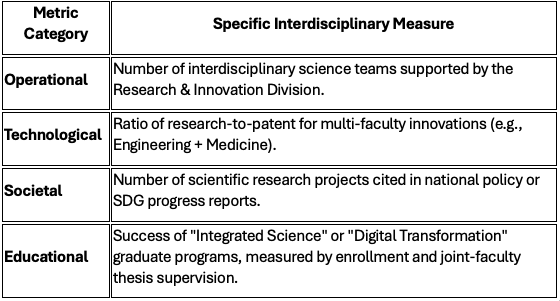
- Joint Academic Supervision: Success is also measured by the frequency of joint faculty supervision for graduate students and the output of multi-disciplinary team projects.
2. Innovation & Applied Intellectual Property (IP)
For the sciences, success is defined by the progression of research from theoretical stages to commercial applications.
- Commercial Scale-Up: A primary metric is the conversion rate of research from “Pilot Scale” prototypes to “Commercial Scale” applications.
- Interdisciplinary Prototype Development: Metrics specifically for science-based innovation (e.g., the “Arm Booster” for stroke patients) include its accessibility and price point for the public, measuring how “science” (Engineering) and “social benefit” (Health Science/Economics) have merged successfully.
- Patent Filings: The number of patents filed and granted for multi-faculty innovations is a critical KPI. For example, the Thammasat Food Science department filed over 20 patents for food innovations in 2025.
- Invention Awards: Participation and success in international platforms, such as the Seoul International Invention Fair (SIIF), serve as external validation of interdisciplinary innovation.
3. Societal Impact & the Science-Policy-Society Interface
The SDG Mission Unit provides a critical layer of evaluation by linking scientific research directly to global sustainability targets.
- Policy Adoption: Researchers are evaluated on how effectively their data—such as PM2.5 measurements or carbon neutrality modeling—is adopted into national guidelines or government environmental policies.
- Tangible Community Outcomes: Success is demonstrated through the implementation of university-developed technologies in local communities, such as 3D-printed prosthetic eyes or water filtration systems in remote regions. The number of communities successfully implementing university-developed technologies (e.g., water filtration systems in ethnic minority villages).
- Global Sustainability Rankings: Impact is reflected in international standings, such as being ranked 64th worldwide in the 2025 THE Impact Rankings.
4. Refined Academic & Peer-Review Quality
Traditional metrics are adapted to emphasize the breadth and internationalization of scientific output.
- Scopus/Interdisciplinary Indexing: Success is noted when science faculty publish in “Interdisciplinary Science” journals rather than just niche-specific ones.
- International Research Collaboration: This measures the success of integrating Thammasat’s scientific output with global research networks, a requirement for its “Global and Frontier Research University” status.
- Strategic Targets: The University’s Strategic Development Plan No. 13 (2022–2027) sets rigorous targets, including aiming for 90% of undergraduate programs to embed SDG-related knowledge by 2027.
Summary Table of Science-Specific KPIs