SDG 8 in Numbers

This stacked area chart illustrates the number of students with work placements for more than a month across seven academic years, from 2017-2018 to 2023-2024. The number of students with placements exceeding one month generally increased, rising from 6,008 in 2017-2018 to its peak in 2022-2023 at 7,852. In the final year, 2023-2024, the trend reversed, showing a reduction. The number dropped to 6,665 students, representing a decline of 1,187 long-term placements compared to the preceding year.

This stacked bar chart tracks the proportion of employees on secure contracts from 2017-2018 through 2023-2024, distinguishing between total employees and those on contracts exceeding 24 months. The trend shows substantial growth across the timeframe. Employees on secure contracts increased significantly, rising from 4,466 in 2017-2018 to 6,882 by 2023-2024. This growth of 2,416 secure contracts demonstrates a clear upward trajectory. Total employees also increased from 6,909 to 9,377 over the same seven-year period.
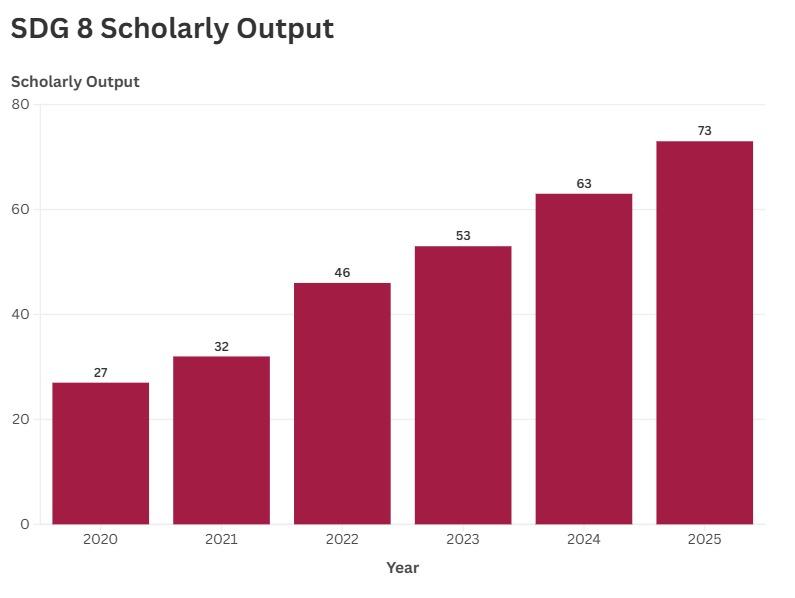
This vertical bar chart illustrates the consistently increasing trend in SDG 8 Scholarly Output across six years, from 2020 to 2025. Output begins at 27 scholarly works in 2020 and rises steadily each year, reaching 73 works by 2025. This represents a significant overall increase of 46 scholarly outputs during this period. The largest single-year jump occurred between 2021 (32 outputs) and 2022 (46 outputs), showing a substantial growth of 14 outputs.
Research in SDG 8
Based on an analysis of 344 publications from 2020 to 2024, Thammasat University has developed a robust and deeply relevant research program focused on SDG 8. The university’s scholarly contributions are organized into four highly interconnected thematic clusters. These clusters collectively address the complex socio-economic challenges and opportunities facing Thailand as a rapidly developing nation navigating globalization, technological disruption, and the urgent need for environmental sustainability:
- The Evolving Labor Market and Green Economy: A primary area of research is The Evolving Labor Market and Human Capital, which critically examines the shifting landscape of work in Thailand. Studies in this cluster delve into contemporary labor dynamics, such as the rise and precarity of the gig economy, persistent wage gaps, and the redefinition of skills required for modern employability. This is intrinsically linked to a strong focus on Environmental Sustainability and the Green Economy. This complementary research cluster investigates pathways for sustainable growth, including climate change mitigation strategies, the implementation of a circular economy, and, crucially, the development of the “green skills” necessary for a workforce to thrive in emerging sectors like renewable energy and sustainable resource management.
- Urbanization, Technology, and Infrastructure: The university also concentrates on Urbanization and Sustainable Development, with a significant body of research on the challenges and opportunities of Thailand’s growing cities. These studies explore the design of smart cities, the development of resilient transportation infrastructure, and the strategic implementation of regional planning initiatives like the Eastern Economic Corridor to ensure growth is both sustainable and equitable. This focus is directly informed and propelled by research into Technology, Innovation, and the Digital Economy. This cluster explores the transformative impact of adopting Industry 4.0, the integration of Artificial Intelligence in key sectors like finance, and the application of digital tools to modernize agriculture, analyzing both the potential for economic acceleration and the associated societal adjustments.
Synthesis and Impact
Across these interconnected themes, the research maintains a strong primary focus on Thailand’s national and sub-national challenges. It effectively addresses a wide and diverse range of stakeholders—from government policymakers shaping national strategy and multinational corporations navigating the local market, to the gig economy workers and vulnerable communities most affected by economic shifts. This vital work is strengthened by an extensive network of domestic and international collaborations, which ensures the research is both locally grounded and globally informed. Collectively, this comprehensive body of work positions Thammasat University as a key knowledge partner, providing the critical evidence and analysis needed to shape policy for sustainable and equitable economic growth in Thailand and the broader region
Outreach and Academic Services in SDG 8
In recent years, with a strong focus on activities in 2024, Thammasat University has demonstrated a profound commitment to SDG 8 through an impressive portfolio of over 230 academic and social service initiatives. These extensive efforts were strategically designed to foster professional development, empower local economies, and shape national economic discourse. The initiatives can be categorized into three primary clusters:
- Professional Development and Corporate Ups-killing (approx. 135 initiatives)
A significant majority of the initiatives were dedicated to enhancing the skills of the national workforce and improving corporate efficiency. Spearheaded by faculties such as the Faculty of Commerce and Accountancy and the Institute for Continuing Education and Human Resources, a wide array of training courses and workshops were offered to the public, private, and state enterprise sectors. These programs covered critical business functions including financial analysis, digital marketing, strategic management, project management, modern HR practices, and effective communication. By equipping professionals and organizations with up-to-date skills, these activities directly contribute to increased productivity and competitiveness in a rapidly evolving economic landscape. - Entrepreneurship and Community-Based Economic Growth (approx. 65 initiatives)
The university played a pivotal role in fostering entrepreneurship and strengthening local economies, particularly through direct support for SMEs and community enterprises. The Faculty of Commerce and Accountancy led numerous projects to develop local businesses, such as cocoa processors, organic farms, sustainable tourism operators, and handicraft producers. The Office of Advanced Science and Technology also provided crucial training for aspiring entrepreneurs on topics like startup mindset, intellectual property valuation, and digital marketing. These programs provided tangible support in product development, market access, and business management, directly contributing to increased local income and sustainable livelihoods. - Labor Rights, Economic Policy, and Inclusive Workforce Development (approx. 30 initiatives)
Addressing the “decent work” and “inclusive growth” aspects of SDG 8, Thammasat also focused on labor rights, equitable employment, and high-level economic policy dialogue. The university hosted seminars on labor law, the role of labor in a sustainable economy, and forums on Thailand’s economic structure led by the Faculty of Economics. A standout component was the extensive vocational training program for inmates, offering practical skills in electronics repair, baking, cosmetology, and other trades. This crucial initiative aims to facilitate their successful reintegration into the workforce, promoting social inclusion and reducing recidivism.
Collectively, these initiatives highlight Thammasat University’s comprehensive and multi-faceted approach to SDG 8. By combining professional upskilling, grassroots economic empowerment, and influential policy discussions, the university not only fosters economic growth but also champions the principles of decent work and social inclusion, reinforcing its role as a key driver of sustainable development in Thailand.
Featured Stories
Pioneering Career Pathways for a Future-Ready Workforce
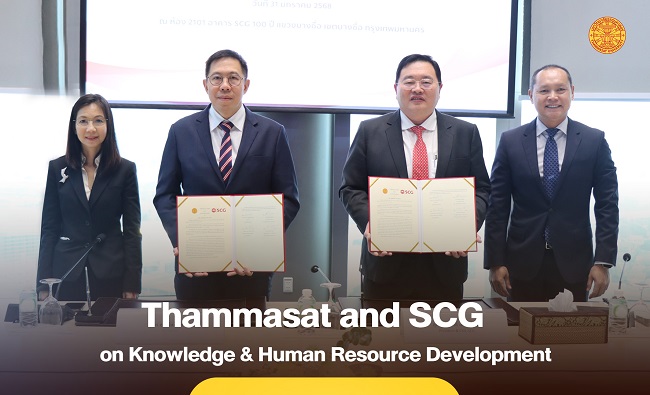
In 2024, Thammasat University significantly enhanced student career development. The University established the Thammasat University Career Enhancement and Employability Centre (TUCEEC) in August as a central platform for career guidance, skills development, and employer engagement. This new centre’s mission is complemented by a major expansion of work-based learning. Throughout the year, the university forged strategic MOUs with key organizations like the Industrial Estate Authority of Thailand (IEAT), Thai Financial Planners Association, and Thai Reinsurance. These partnerships unlock a new scale of internship and co-operative education placements, providing students with invaluable hands-on experience and strengthening their pathways into professional roles.

Empowering Staff Through Fair Governance and Professional Growth
Thammasat University ensures equitable employment practices through its democratically elected University Staff Council. This body facilitates dialogue with leadership, contributes to policy, and ensures fair treatment. (Importantly, international employees receive the same welfare and benefits as Thai staff.) This year, the Council introduced the Professional Network, a new platform specifically designed to promote knowledge exchange, skills development, and career advancement among support staff. This key initiative enhances organizational capacity and supports a culture of continuous improvement.
Commitment to a Living Wage and Fair Remuneration
Thammasat University’s employment framework, effective from 2024, prioritize fair remuneration aligned with the Living Wage principle, ensuring all staff can maintain a dignified standard of living. This policy guarantees that salary structures for all positions, including academic and professional staff, exceed statutory minimum wage levels. Furthermore, remuneration for many key positions, such as academic and professional staff, is set to surpass the estimated urban living wage in Thailand (approx. THB 14,324/month). This commitment to competitive and equitable pay supports staff well-being, strengthens talent retention, and reinforces a fair and inclusive academic community.