
SDG 7 in Numbers
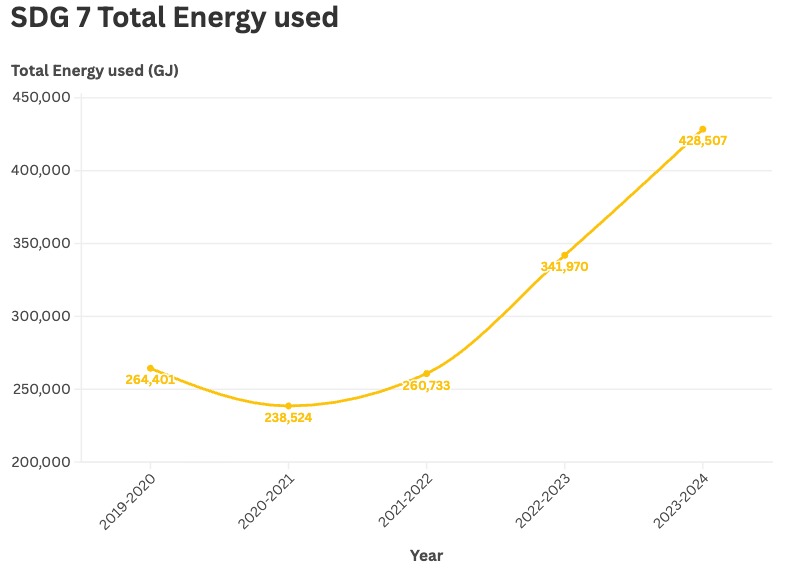
This line graph displays the SDG 7 Total Energy Used (GJ) across five academic years, indicating a notable increase overall. The total energy usage was 264,401 GJ in 2019-2020, dropping slightly the following year. However, usage surged subsequently, reaching 428,507 GJ by 2023-2024. This final figure represents an approximate 61% increase compared to the initial 2019-2020 usage. The significant upward trend shows maximum consumption in the most recent period.
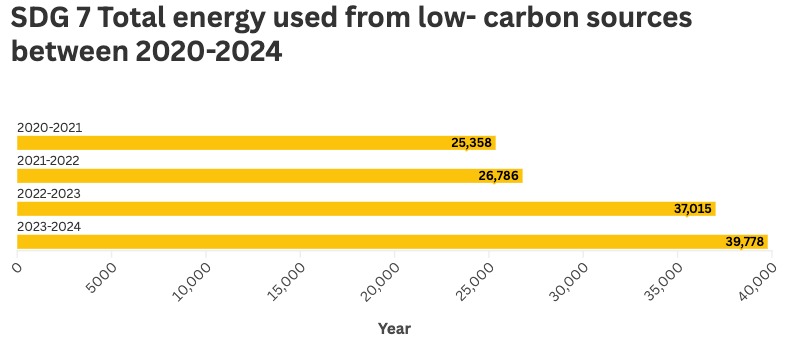
This horizontal bar chart illustrates the SDG 7 Total energy used from low-carbon sources from 2020-2021 to 2023-2024. The data shows a consistent, sustained increase in energy from these sources across the four years. Starting at 25,358 units in 2020-2021, the amount rose to 39,778 units by 2023-2024. This growth signifies an increase of approximately 56.8% from the first year recorded to the last. This continuous upward trend highlights increased adoption of low-carbon resources.
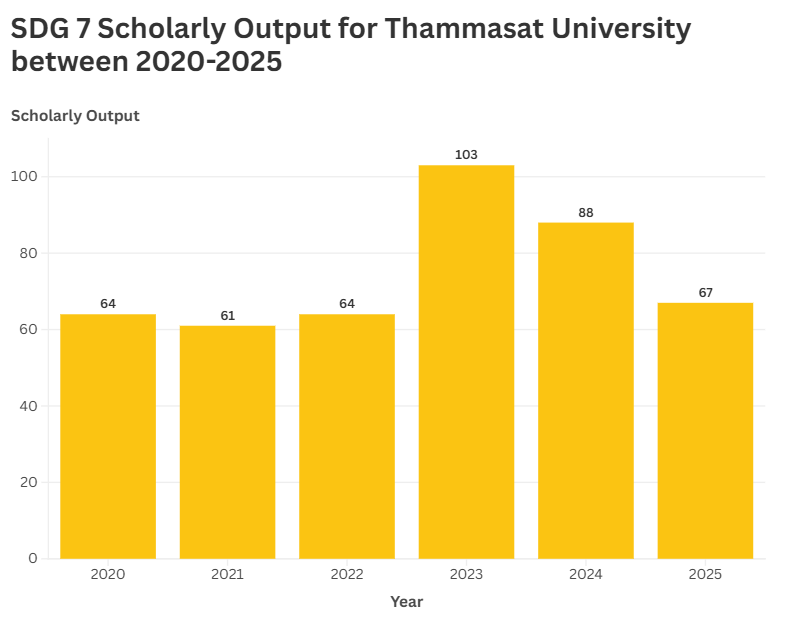
This bar chart presents the SDG 7 Scholarly Output of Thammasat University from 2020 to 2025. The trend is highly varied, with a massive spike in output in 2023. Outputs increased sharply from 64 in 2022 to 103 in 2023, reflecting a jump of about 61%. This peak was followed by a reduction to 88 outputs in 2024 and a further predicted drop to 67 in 2025. Output remains elevated compared to 2021.
Research in SDG 7
Based on a detailed analysis of 615 publications from 2020 to 2024, Thammasat University has established a vast, comprehensive, and strategically vital research program addressing SDG 7. The university’s contributions are remarkably broad, spanning the entire energy ecosystem from foundational materials science that enables new technologies to high-level national climate policy that guides the country’s future. This extensive body of work can be organized into several distinct yet interconnected key research clusters:
- Bioenergy, Materials, and Solar Power: A primary research strength lies in Bioenergy and Waste Valorization, a field of immense importance to Thailand. This work leverages the nation’s abundant agricultural resources to convert diverse forms of biomass and waste—from rice straw to palm oil effluent—into valuable biofuels, bio-oil, and other energy products, directly aligning with and advancing circular economy principles. This applied research is supported by foundational work in Advanced Materials for Energy Storage and Conversion. This cluster focuses on the critical task of developing next-generation materials for high-performance batteries(Lithium-ion, Lithium-Sulfur), super-capacitors, and highly efficient catalysts, which are the essential building blocks for a clean energy transition. Complementing these areas, a significant body of work is dedicated to Solar Energy Systems, which explores innovative photovoltaic technologies like floating solar farms—a key solution for a country with land-use constraints—as well as advanced solar cells (e.g., perovskite) and the practical application of solar thermal technologies for industrial and residential heating.
- Energy Efficiency, Electric Mobility, and Climate Policy: On the demand side, a substantial cluster of research on Energy Efficiency and Management provides actionable strategies for green buildings, crucial industrial process optimization (particularly in Thailand’s vital sugar industry), and the implementation of smart energy systems to reduce overall consumption. A specific and rapidly growing focus is on Electric Mobility, with research covering not only the technical aspects of EV technology but also the critical socio-economic factors of consumer adoption and the policy frameworks required to support Thailand’s ambitious transition away from internal combustion engines. Underpinning all these technological and market-focused areas is a robust cluster on Climate Policy and Economic Analysis. This involves sophisticated modeling of national and regional GHG mitigation pathways, providing the essential data-driven analysis required to inform Thailand’s long-term strategy for achieving its net-zero emissions goals and meeting its international climate commitments.
Synthesis and Impact
Across these diverse themes, the research is consistently characterized by a strong focus on nationally relevant challenges, particularly in the bioenergy sector, and a commitment to providing a critical, evidence-based foundation for Thailand’s energy policy. This impactful work is amplified by extensive national and international collaborations, cementing Thammasat University’s role not just as an academic institution, but as a key leader and knowledge hub driving innovation and providing indispensable guidance for the nation’s sustainable energy future.
Outreach and Academic Services in SDG 7
In 2024, Thammasat University demonstrated its strong and strategic commitment to SDG 7 by spearheading 8 key academic and social service initiatives. These multifaceted efforts spanned high-level public policy discourse, hands-on technological advancement, and crucial energy efficiency programs, showcasing a comprehensive strategy to promote a sustainable and resilient energy future for Thailand. The activities were thoughtfully organized into three distinct clusters:
- Energy Policy and Just Transition Dialogue (approx. 3 initiatives)
A significant portion of the university’s efforts focused on shaping national energy policy and fostering an informed public understanding of the energy transition. The Faculty of Economics hosted a crucial public seminar on Thailand’s Power Development Plan (PDP 2024), creating an essential platform for academics, policymakers, and citizens to debate the country’s future energy mix and its long-term economic and environmental implications. Concurrently, the Faculty of Law organized high-level academic seminars to proactively address the legal and technological frameworks required for new energy sources. These included a forward-looking discussion on Small Modular Reactors (SMRs) and another critical seminar on moving “Beyond Coal,” which emphasized the necessity of a socially just and equitable transition that supports affected communities while advancing national renewable energy goals. - Clean Technology and Skill Development (approx. 2 initiatives)
The university actively promoted the adoption and understanding of clean energy technologies through practical, hands-on training and education. The Sirindhorn International Institute of Technology (SIIT) conducted an engaging workshop on electric vehicle (EV) technology, targeting both students and the public to build technical capacity and accelerate the shift towards sustainable transportation in line with national objectives. Similarly, the Faculty of Science and Technology provided practical training on the application of solar photovoltaic (PV) systems. This initiative empowered local communities and stakeholders with the knowledge to design, install, and maintain decentralized renewable energy solutions, thereby fostering energy independence and resilience at the grassroots level. - Energy Efficiency and Management (approx. 3 initiatives)
Enhancing energy efficiency was a core focus, with impactful initiatives aimed at the industrial and building sectors, which are major energy consumers. The Faculty of Engineering undertook pivotal consultancy projects for the Department of Alternative Energy Development and Efficiency. These included developing robust energy assessment criteria for factories and creating a sophisticated system to monitor energy conservation in buildings based on national.
Featured Stories
Advancing Energy Efficiency in the Built Environment
Thammasat University continues to demonstrate leadership in sustainable building design through the achievement of two major energy-efficiency recognitions:
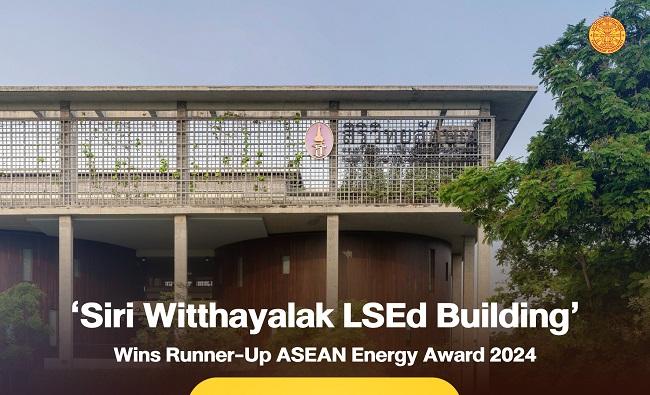
- Siri Witthayalak Building – ASEAN Energy Awards 2024
The Siri Witthayalak Building, home to the Faculty of Learning Sciences and Education, received First Runner-up in the Energy Efficient Building category at the ASEAN Energy Awards 2024 (Tropical Building sub-category). The building’s architectural design incorporates passive cooling strategies, including an open rectangular layout to facilitate natural cross-ventilation and the use of skylights to maximize daylight. These features reduce dependence on mechanical air conditioning and artificial lighting, resulting in significantly lower energy consumption. The recognition highlights the building as a practical model for energy-efficient construction in hot and humid tropical contexts.
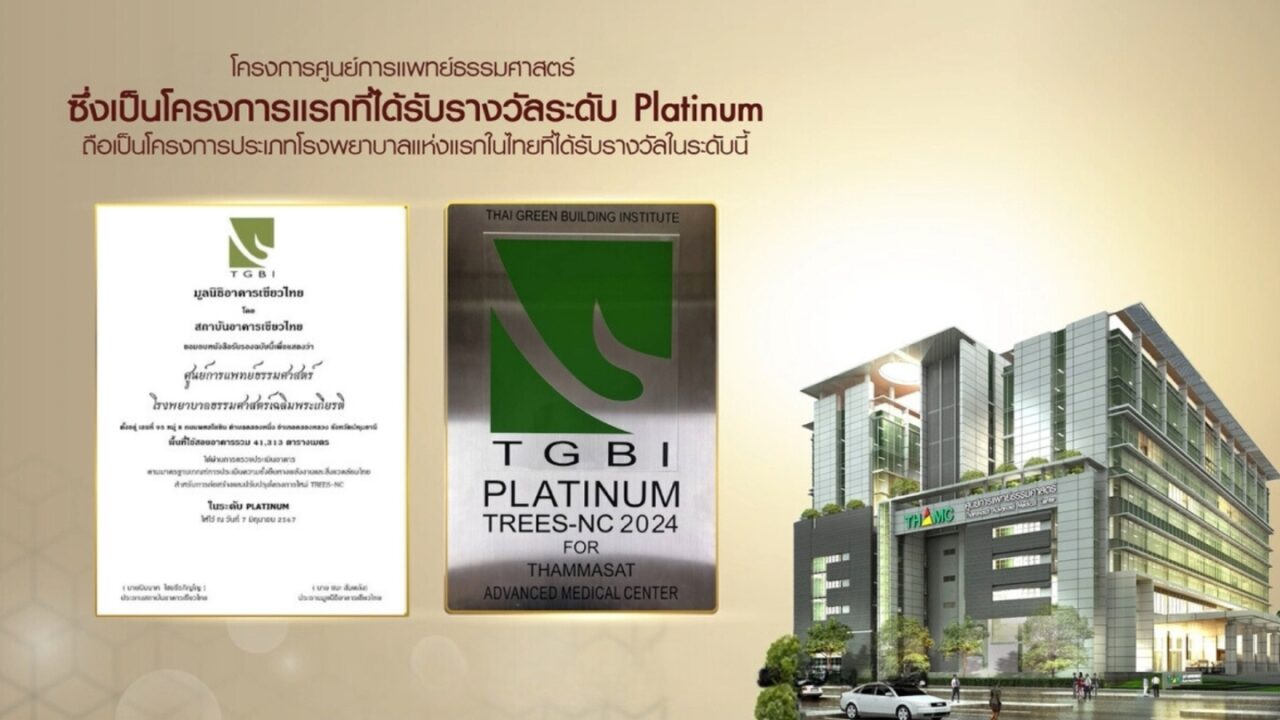
- Thammasat Medical Centre – Platinum Level Green Building (New Construction)
In 2024, the newly constructed Thammasat Medical Centre was awarded Platinum level for energy efficiency in new construction, making it the first hospital in Thailand to achieve the highest standard of green building certification. Designed as an Energy Conservation Building, it achieved a high score in the Energy & Atmosphere category (19 points), reflecting strong performance in resource efficiency, building envelope design, and system optimization. The building reduces overall energy use while supporting high indoor environmental quality for patients and staff, illustrating how healthcare facilities can integrate sustainability with patient-centerd design.
Building Strategic Partnerships for Clean Energy Research and Innovation
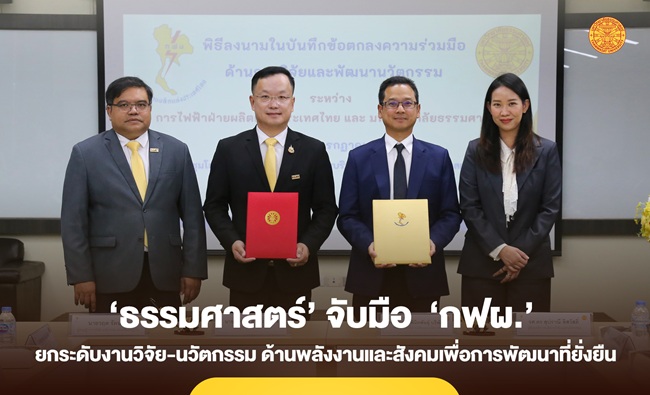
Thammasat University’s School of Science and Technology (SCI-TU) has signed an MoU with the National Science and Technology Development Agency (NSTDA) and PTT Oil and Retail Business (OR) to advance research and innovation in sustainable energy. The collaboration covers biotechnology, energy, materials, and food technology, aiming to develop solutions such as biofuels, circular economy initiatives, and smart energy technologies. This partnership strengthens Thammasat’s role in applied research and industrial engagement, supporting Thailand’s transition to green energy and carbon neutrality.